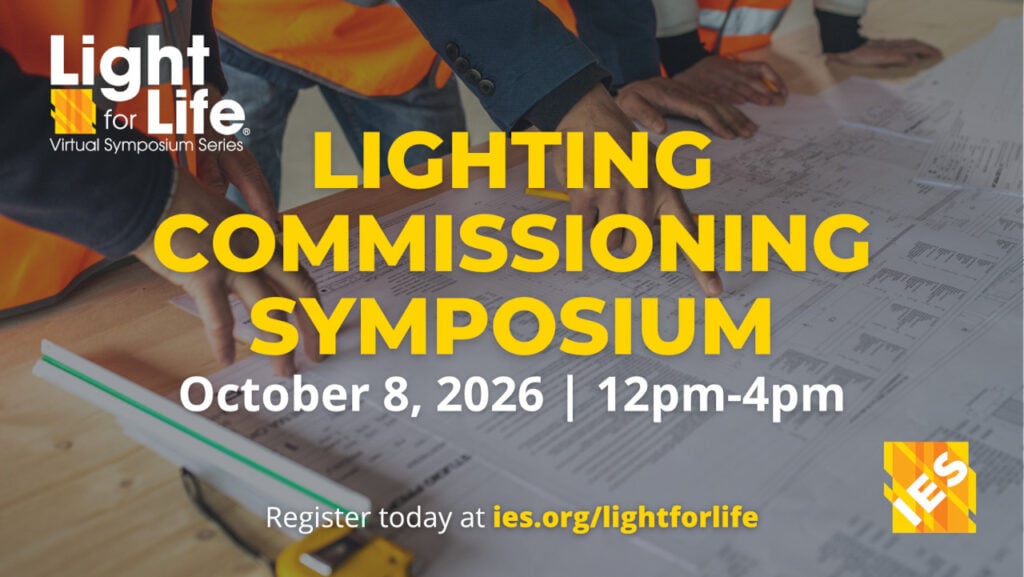
Light for Life® Virtual Symposium: Commissioning
Beyond the Checklist
Overview
Join us on Thursday, October 8, 2026 for Light For Life®: Commissioning, a one-day virtual symposium dedicated to the formal quality process which begins at pre-design and concludes when the warranty process is complete. Participants will receive four (4) IES Continuing Education Credits (CEUs).
Presentations curated to cover:
- Commissioning as a formal process
- Considerations for Owner’s Project Requirements and Sequences of Operation
- Integration with mechanical, electrical and controls
- Perspectives from the National Electrical Contractors Association
- Handling substitutions during submittal reviews
Attendees who join us live will receive a 25% discount on Lighting Control Systems – Properties, Selection, and Specification (ANSI/IES LP-6-25), Documenting Control Intent Narratives and Sequences of Operations (ANSI/IES LP-16-22), and The Commissioning Process Applied to Lighting and Control Systems (BSR/IES LP-8-xx) upon publication. They will also receive complimentary access to the online recording approximately 2 weeks following the live event.
Are you an IES student member? Contact IES today for a code to register at no cost! Contact: Dan Ozminkowski, dozminkowski@ies.org.
Sponsored By

Sponsors TBD
Speakers








Agenda
Introduction
Defining commissioning as a formal practice
Commissioning: More than just startup!
ANSI/ASHRAE Guideline 0 defines commissioning as a quality-focused process that enhances project delivery that verifies the project meets the owner’s objectives and criteria. The commissioning process starts at project inception, through design and construction, and even once the building is in operation. This session will provide an overview of commissioning activities, the commissioning team, commissioning’s benefits, and considerations for scope for both large and small projects. It will also cover commissioning provider certification, and why projects can benefit from having a third party commissioning provider. Links to resources for additional learning and support will also be provided.
Speaker
Trust, But Verify: Commissioning Lighting Controls for Code Compliance and Performance
Good lighting systems promise energy savings, occupant comfort, and operational flexibility, but only when they perform as designed. That’s where commissioning comes in. Explore how today’s energy codes and standards require commissioning and acceptance testing to verify lighting system compliance and performance. Discover how proper commissioning transforms lighting and controls from a code requirement into a valuable tool for building performance and occupant satisfaction.
Speaker
Pre-Design and Design Review
OPR, Systems Integration and Basis of Design
An Owner’s Project Requirements (OPR) is one of the first items created during the pre-design phase. It is a critical requirement for a successful design that is a foundation for the owner needs and wants, including integration, efficiency, and naming standards for lighting data. Once the OPR is created, the design team can create a Basis of Design creates the narrative for the design including all required codes and standards to be applied. LP-8 provides guidance for writing OPRs and BODs. This session will cover these documents from both a design professional and commissioning provider viewpoint.
Speaker
Worth a Comment? Commissioning the Lighting Design
A commissioning design review should do more than generate comments. It should help determine whether the lighting design can perform as intended and support the owner’s operational needs. This session looks at what makes a commissioning review useful, what designers should expect when their work is being reviewed, and how to frame comments that identify meaningful concerns without overstepping the reviewer’s role. And we’ll tackle the harder question: where does commissioning review end and redesign begin?
Speaker
Specifying and Executing Complex Integrations
You cannot have a successful integration without a clear definition of what the integration is, what success looks like, and which systems need to be connected for that success to occur. This session will help designers and system specifiers develop and document a clear path for complex integrations to be successfully implemented. It will help commissioning providers (CxPs) locate the information they need to understand integration requirements, identify the right questions to ask, and critically: How to proceed when they look in the right places and ask the right questions, and the information they need simply does not yet exist. By the end of this session, participants will understand how to communicate with each other regarding these integrations, how to document both the functional and technical needs of these integrations, and how to coordinate to avoid surprises.
Speaker
Break
The Contractor’s perspective
NECA: systems integration best practices
This session presents the commissioning conversation from the electrical contractor’s side of the table: where the National Electrical Contractors Association (NECA) sees commissioning heading, what contractors need from designers and CxPs to deliver the sequence as drawn, and where integrated-systems scope reliably falls through the cracks between Divisions 25, 26 and 27. This session identifies where integrated-systems scope breaks down — and the specification changes that can prevent it.
Speaker
Construction Phase: Boots on the Ground
During construction it is critical that the commissioning provider and the installing contractors, including controls technicians, are following the established procedures and protocols of the design. This includes design and submittal review, validation of substitution requests, the construction plan and schedule, light source criteria, controls integration plan, sustainability, and required installation requirements. Special attention will be paid to early identification and resolution of issues and gaps that present themselves during the early part of construction. At the end of construction there is functional testing, as-built documentation review, building occupancy and operation review, annual maintenance plans, client systems training, and long-term systems maintenance planning. This session will cover what commissioning providers need to know about construction phase lighting and lighting controls commissioning.
Speaker
Lighting & Lighting Control Existing Building Commissioning (EBCx)
Evolving stakeholder needs for existing facilities impact the required lighting and lighting controls in both interior and exterior spaces in ways that may not have been anticipated at the time of design. What turns out of to quickly address the immediate needs in a facility often have costly repercussions in terms of productivity, maintenance, and energy. This session will explore using the commissioning process to improve lighting and lighting control performance in existing buildings and provide some real-world case studies for discussion.
Speaker
Closing
Speaker
End of event
Agenda
Introduction
Defining commissioning as a formal practice
Commissioning: More than just startup!
ANSI/ASHRAE Guideline 0 defines commissioning as a quality-focused process that enhances project delivery that verifies the project meets the owner’s objectives and criteria. The commissioning process starts at project inception, through design and construction, and even once the building is in operation. This session will provide an overview of commissioning activities, the commissioning team, commissioning’s benefits, and considerations for scope for both large and small projects. It will also cover commissioning provider certification, and why projects can benefit from having a third party commissioning provider. Links to resources for additional learning and support will also be provided.
Speaker
Trust, But Verify: Commissioning Lighting Controls for Code Compliance and Performance
Good lighting systems promise energy savings, occupant comfort, and operational flexibility, but only when they perform as designed. That’s where commissioning comes in. Explore how today’s energy codes and standards require commissioning and acceptance testing to verify lighting system compliance and performance. Discover how proper commissioning transforms lighting and controls from a code requirement into a valuable tool for building performance and occupant satisfaction.
Speaker
Pre-Design and Design Review
OPR, Systems Integration and Basis of Design
An Owner’s Project Requirements (OPR) is one of the first items created during the pre-design phase. It is a critical requirement for a successful design that is a foundation for the owner needs and wants, including integration, efficiency, and naming standards for lighting data. Once the OPR is created, the design team can create a Basis of Design creates the narrative for the design including all required codes and standards to be applied. LP-8 provides guidance for writing OPRs and BODs. This session will cover these documents from both a design professional and commissioning provider viewpoint.
Speaker
Worth a Comment? Commissioning the Lighting Design
A commissioning design review should do more than generate comments. It should help determine whether the lighting design can perform as intended and support the owner’s operational needs. This session looks at what makes a commissioning review useful, what designers should expect when their work is being reviewed, and how to frame comments that identify meaningful concerns without overstepping the reviewer’s role. And we’ll tackle the harder question: where does commissioning review end and redesign begin?
Speaker
Specifying and Executing Complex Integrations
You cannot have a successful integration without a clear definition of what the integration is, what success looks like, and which systems need to be connected for that success to occur. This session will help designers and system specifiers develop and document a clear path for complex integrations to be successfully implemented. It will help commissioning providers (CxPs) locate the information they need to understand integration requirements, identify the right questions to ask, and critically: How to proceed when they look in the right places and ask the right questions, and the information they need simply does not yet exist. By the end of this session, participants will understand how to communicate with each other regarding these integrations, how to document both the functional and technical needs of these integrations, and how to coordinate to avoid surprises.
Speaker
Break
The Contractor’s perspective
NECA: systems integration best practices
This session presents the commissioning conversation from the electrical contractor’s side of the table: where the National Electrical Contractors Association (NECA) sees commissioning heading, what contractors need from designers and CxPs to deliver the sequence as drawn, and where integrated-systems scope reliably falls through the cracks between Divisions 25, 26 and 27. This session identifies where integrated-systems scope breaks down — and the specification changes that can prevent it.
Speaker
Construction Phase: Boots on the Ground
During construction it is critical that the commissioning provider and the installing contractors, including controls technicians, are following the established procedures and protocols of the design. This includes design and submittal review, validation of substitution requests, the construction plan and schedule, light source criteria, controls integration plan, sustainability, and required installation requirements. Special attention will be paid to early identification and resolution of issues and gaps that present themselves during the early part of construction. At the end of construction there is functional testing, as-built documentation review, building occupancy and operation review, annual maintenance plans, client systems training, and long-term systems maintenance planning. This session will cover what commissioning providers need to know about construction phase lighting and lighting controls commissioning.
Speaker
Lighting & Lighting Control Existing Building Commissioning (EBCx)
Evolving stakeholder needs for existing facilities impact the required lighting and lighting controls in both interior and exterior spaces in ways that may not have been anticipated at the time of design. What turns out of to quickly address the immediate needs in a facility often have costly repercussions in terms of productivity, maintenance, and energy. This session will explore using the commissioning process to improve lighting and lighting control performance in existing buildings and provide some real-world case studies for discussion.