
[11.5.15]
In roadway lighting:
A categorization of the distribution of light across an imaginary road, with the luminaire mounted at the edge of the road and facing toward the center of the road. An example is shown in Figure 11-2. Distances are measured in terms of multiples of the luminaire mounting height (MH).
Transverse light distributions are divided into two groups based on the location of the luminaire with respect to the area to be lit (i.e., near center of area or near its edge). Each group is subdivided according to how far forward the half-max candela trace reaches within the longitudinal distribution range determined by the point of maximum candlepower (short, medium, or long; see Figure 11-2).
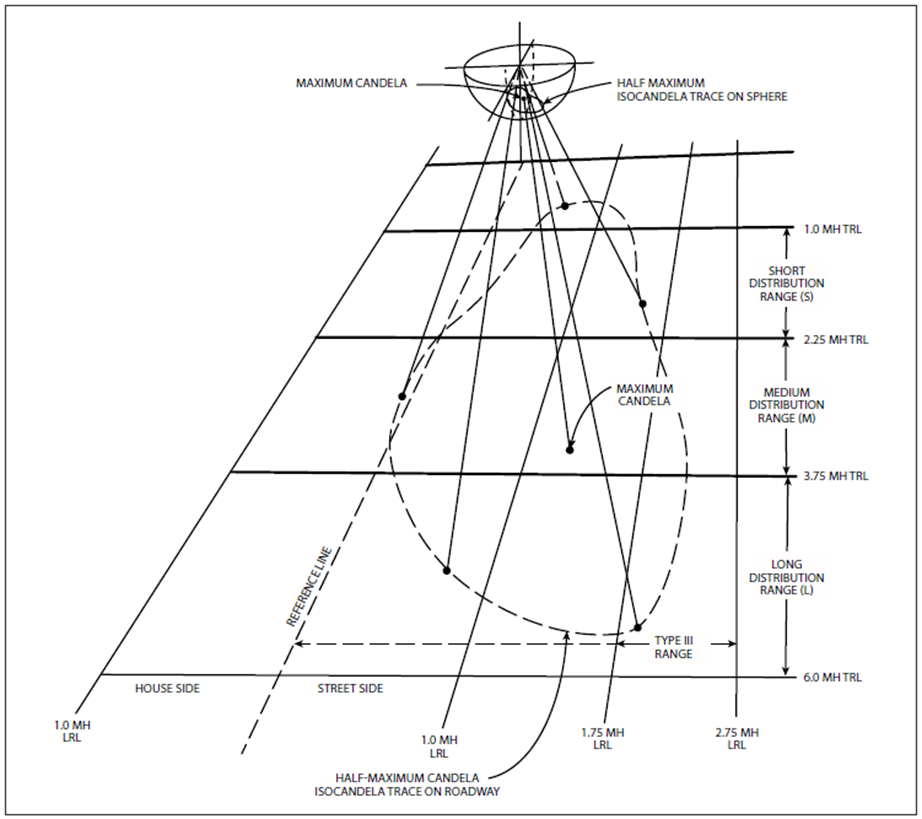
Figure 11-2. Diagram showing the projection of maximum candlepower and half-maximum-candlepower isocandela trace from a luminaire having a Type III distribution on the imaginary sphere and the roadway. Notes: TRL = transverse roadway line; transverse roadway lines run across the road, i.e., from side to side. LRL = longitudinal roadway line; longitudinal roadway lines run along the road. (Note: Identical to Figure 11-1.)
- Luminaires at or near center of area: The group of transverse distribution classifications that apply to luminaires intended to be mounted at or near the center of the area to be lighted. These luminaires have similar light distributions on both the “house side” and the “street side” of the reference line (refer to Figures 11-2 and 11-3).
- Type I: A distribution whose half-maximum candlepower isocandela trace lies within the Type I width range on both sides of the reference line that is bounded by 1.0-MH house-side LRL and 1.0-MH street-side LRL within the longitudinal distribution range (short, medium, or long) where the point of maximum candlepower falls.
- Type I, Four-Way: A distribution that has four beams of the width defined for Type I.
- Type V: A distribution that has a circular symmetry of candlepower distribution that is essentially the same at all lateral angles around the luminaire.
- Type VS: A distribution where the zonal lumens for each of the eight horizontal octants (0-45, 45-90, 90-135, 135-180, 180-225, 225-270, 270-315, and 315-360 degrees) are within ±10 percent of the average zonal lumens of all octants. The distribution is similar to the Type V distribution but has a square shape.
- Luminaires on near side of area: The group of transverse distribution classifications that apply to luminaires intended to be mounted near the side of the area to be lighted. These luminaires vary as to the width of their distribution range on the street side of the reference line (see Figure 11-2). The house-side segment of the half-maximum candlepower isocandela trace within the longitudinal range in which the point of maximum candlepower falls (short, medium, or long) may or may not cross the reference line. Examples of each type are shown in Figure 11-3.
- Type II: A distribution for which the street side segment of the half-maximum candlepower isocandela trace within the longitudinal range in which the point of maximum candlepower falls (short, medium, or long) does not cross the 1.75-MH street side LRL.
- Type II, Four-Way: A distribution that has four beams, each the width on the street side distribution as defined for Type II.
- Type III: A distribution for which the street-side segment of the half-maximum candlepower isocandela trace within the longitudinal range in which the point of maximum candlepower falls (short, medium, or long) lies partly or entirely beyond the 1.75-MH street-side LRL but does not cross the 2.75-MH street-side LRL.
- Type IV: A distribution for which the street-side segment of the half-maximum candlepower isocandela trace within the longitudinal range in which the point of maximum candlepower falls (short, medium, or long) lies partly or entirely beyond the 2.75-MH street-side LRL.
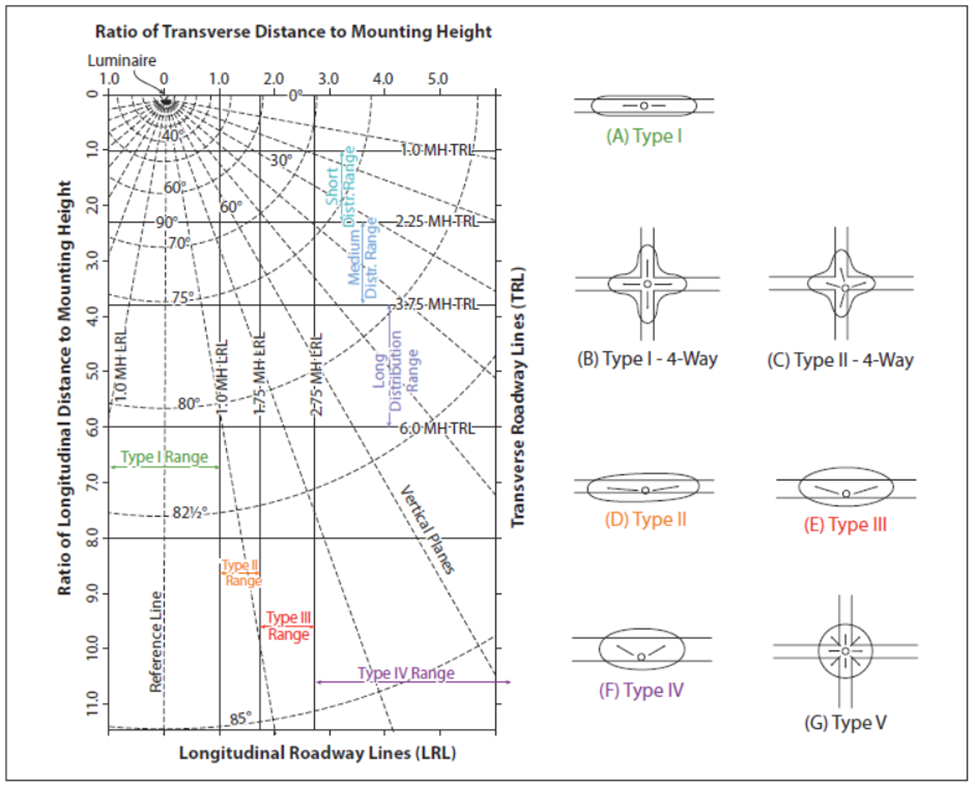
Figure 11-3. Plan view of roadway coverage and approximate shape of the light distribution for different types of exterior luminaires.
See also longitudinal light distribution.
« Back to Definitions Index