[11.5.14]
In roadway lighting:
A categorization of the distribution of light along an imaginary road, with the luminaire mounted at the edge of the road and facing toward the center of the road.
The extent of the longitudinal distribution is determined by the point on the ground intercepted by an extension of a line drawn from the light source at the angle of the maximum candela value. An example is shown in Figure 11-1. Distances are measured in terms of multiples of the luminaire mounting height (MH).
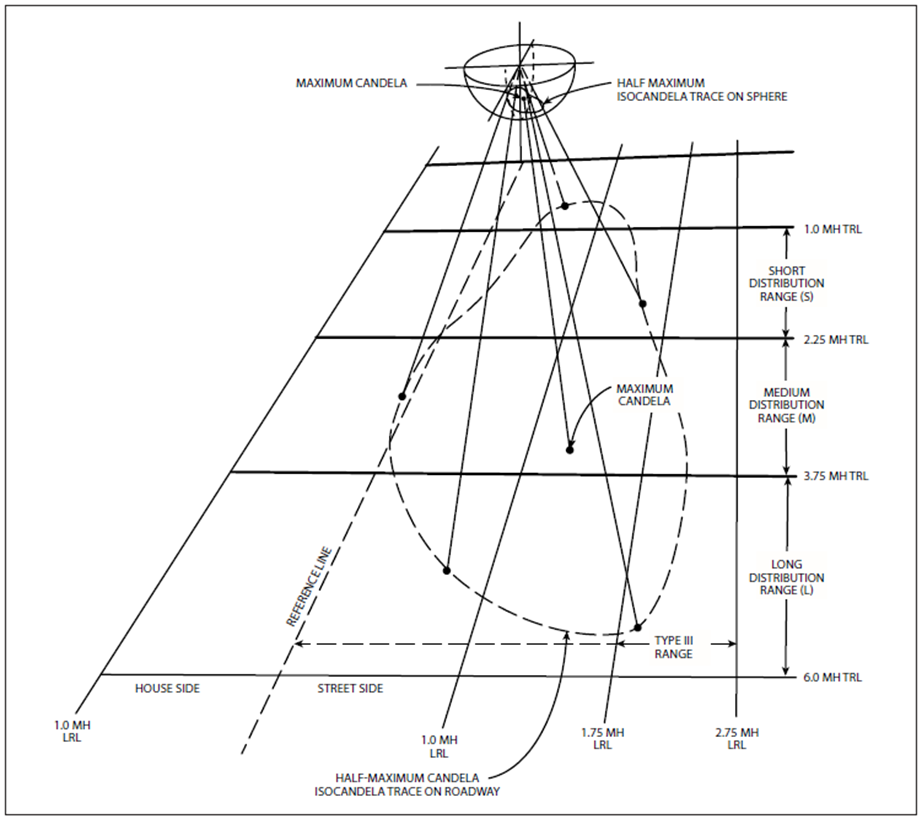
Figure 11-1. Diagram showing projection of maximum candlepower from a luminaire having a “medium” distribution on an imaginary sphere and the roadway. Notes: TRL = transverse roadway line; these lines run across the road, i.e., from side to side. LRL = longitudinal roadway line; these lines run along the road.
Longitudinal (along-road) light distributions are divided into three groups: short (S), medium (M), and long (L).
- Short distribution: A luminaire is classified as having a short light distribution when its maximum candlepower point (the direction of maximum intensity extended to the ground) lies in the “S” zone of the grid, which is from the 1.0-MH TRL to less than the 2.25-MH TRL.
- Medium distribution: A luminaire is classified as having a medium light distribution when its maximum candlepower point lies in the “M” zone of the grid, which is from the 2.25-MH TRL to less than the 3.75-MH TRL.
- Long distribution: A luminaire is classified as having a long light distribution when its maximum candlepower point lies in the “L” zone of the grid, which is from the 3.75-MH TRL to less than the 6.0-MH TRL.
See also transverse light distribution.
« Back to Definitions Index