
[5.9.9.4] A metric for evaluation of temporal light modulation. Given a cyclical waveform (see Figure 5-1): the ratio of time-integrated light output measured above the average value, relative to the total time-integrated light output. Referring to the right-hand side of Figure 5-1), the flicker index is calculated as Area A/(Area A + Area B).
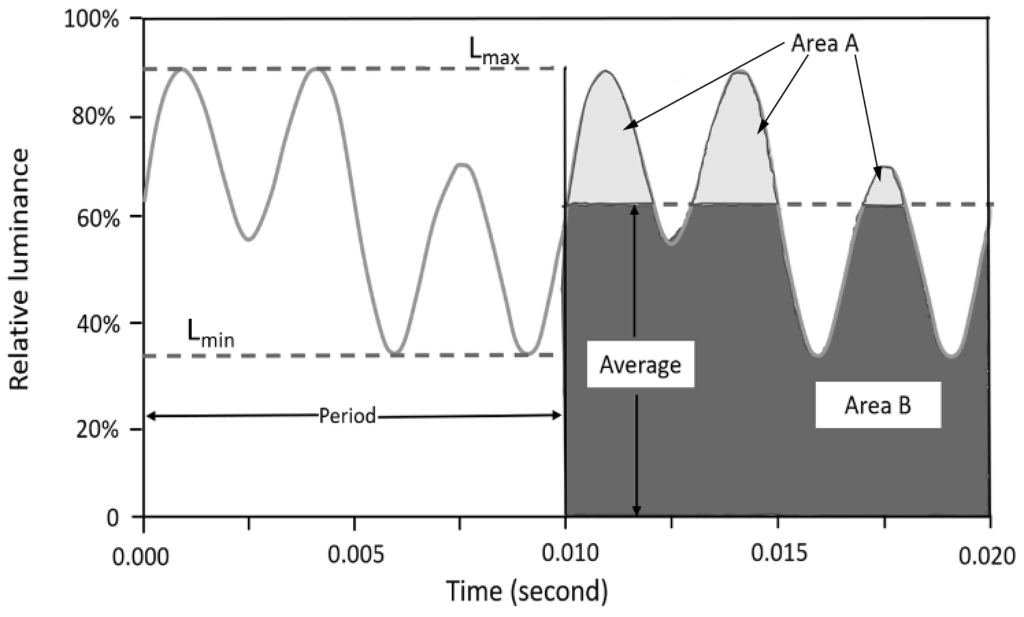
Figure 5-1. A periodic temporal light modulation (TLM) waveform illustrating period, and values critical for calculating percent flicker (left) and flicker index (right). The waveform repeats itself every 0.01 second, thus exhibiting a fundamental frequency of 100 Hz, and it has a sinusoidal modulation 3 times per period, indicating a secondary frequency of 300 Hz. (Graphic courtesy of Pacific Northwest National Laboratory)
Note 1: Flicker index ranges from 0 to 1, with numbers lower than approximately 0.1 generally indicating low probability of visibility at 120 Hz.
Note 2: Flicker index considers duty cycle and wave shape (via utilizing the cycle average), but it does not consider frequency.
« Back to Definitions Index