The Forum for Illumination Research, Engineering, and Science (FIRES) is the IES online space for our lighting community to openly share and discuss the latest research and innovations in illumination engineering and science. As a space for the free dissemination of knowledge and exchange of ideas, FIRES is intended to foster relationships between individuals and larger institutions, and reignite the emphasis on science and engineering in the lighting industry. Through FIRES, we hope to have a significant influence on the development and advancement of lighting.
Now the conversation continues further on IES’s LinkedIn page. Join us in the FIRES Exchange, where you can comment on articles and post your own “Spark”, a brief paragraph or two (links allowed, may be moderated and/or edited).
Share your Ideas!
To post an article in FIRES, go to our Policies and Submissions page.
Questions? research@ies.org
Editorial Disclaimer

GUV Measurements – From the Lab to the Field
By Michael L. Grather, CTO, LightLab International Allentown, LLC We have all seen the wide range of new products claiming to be effective against pathogens of all sorts. Common claims…

luox – A new open-access, open-source platform for spectral computations
By Manuel Spitschan Around 20 years ago, a new type of cell was discovered in the human retina, the fine layer of tissue at the back of our eyes that…

The Test of Time
By Brian Liebel IES Director of Standards and Research This article is an expanded version the article found in the 50th Anniversary issue of LD+A, July 2021, providing additional background,…

Quantifying Light Pollution Sources: The Quintic Root of Hipparchus
By Ian Ashdown, Senior Scientist SunTracker Technologies Ltd. Nighttime light pollution is sadly familiar to all of us. While our grandparents and great-grandparents may talk fondly of seeing the Milky…

Double Dynamic Lighting — Bringing Qualities of Natural Light into the Office
Authors: Ellen Kathrine Hansen, Mihkel Pajuste; Aalborg University, Copenhagen In this new dynamic lighting approach, the sky type and daylight inflow are taken into consideration actively, bringing the dynamic office…

Ultraviolet Radiation Terminology
By Ian Ashdown, P. Eng., FIES Senior Scientist, SunTracker Technologies Ltd. A word of caution: I am going to be annoyingly pedantic here, but with good reason. The lighting industry…
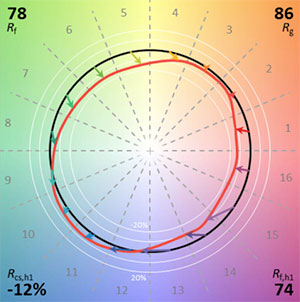
Spectral Similarity as a Measure of Naturalness?
By Jason Livingston (Studio T+L), Michael Royer (PNNL), Lorne Whitehead (University of British Columbia) It seems that every month there is a new metric proposed to quantify the performance of…

Applying circadian-effective lighting — Understanding the 3 Ps
Right after receiving my PhD, I took a position as a research scientist at the National Research Council Canada (NRCC) in Ottawa. It was a very good decision. The NRCC…

Unifying the Art and Function of Light in the Built Environment – The Collaborative Roles of Visual Ergonomists and Lighting Designers
By Jennifer Long, PhD Jennifer Long Visual Ergonomics, Katoomba NSW, Australia In his editorial “Is there a science of lighting design?” Peter Boyce observed, “the lighting designer who can deliver…

Designing a UV-C Germicidal System
By Ian Ashdown, P. Eng., FIES Senior Scientist, SunTracker Technologies Ltd. Germicidal lamps emitting ultraviolet-C (UV-C) radiation have been in use since the 1930s (Wells and Wells 1936). These are…
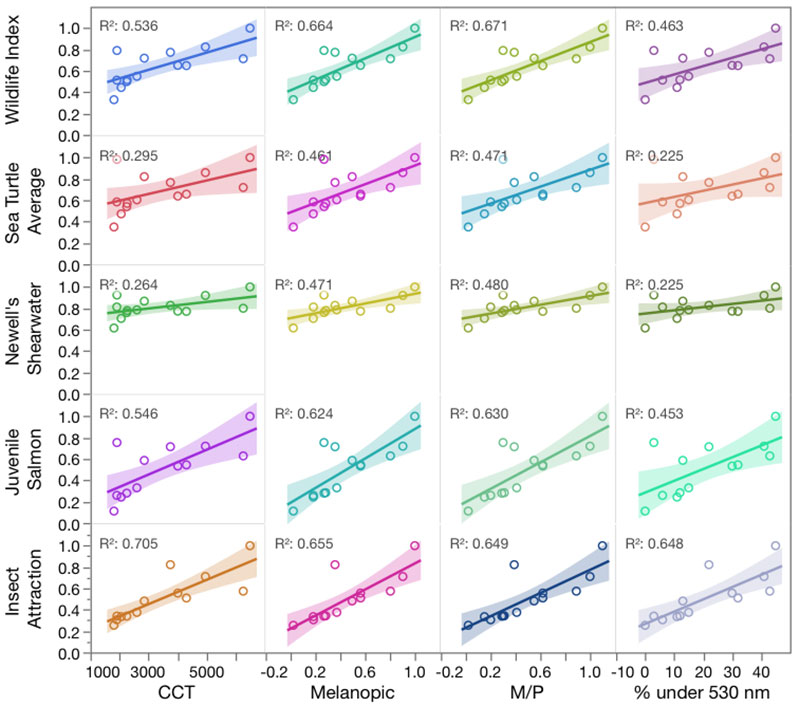
On the Use of Summary Metrics of Light Spectral Characteristics to Assess Effects of Artificial Light at Night on Wildlife
By Travis Longcore From the position of wildlife, the best artificial light at night is no artificial light at night.

The Slope of Circadian Enlightenment
By Colleen Hufford, LC, IES, Kelly Seeger, MSc, LC, IES, LEED AP, Signify Arguably, the biggest challenge we face (as an industry) is how to successfully apply circadian science to…
GUV Measurements – From the Lab to the Field
luox – A new open-access, open-source platform for spectral computations
The Test of Time
Quantifying Light Pollution Sources: The Quintic Root of Hipparchus
Double Dynamic Lighting — Bringing Qualities of Natural Light into the Office
Ultraviolet Radiation Terminology
Spectral Similarity as a Measure of Naturalness?
Applying circadian-effective lighting — Understanding the 3 Ps
Unifying the Art and Function of Light in the Built Environment – The Collaborative Roles of Visual Ergonomists and Lighting Designers
Designing a UV-C Germicidal System
On the Use of Summary Metrics of Light Spectral Characteristics to Assess Effects of Artificial Light at Night on Wildlife