
Light pollution’s impact on fireflies
The rapid evolution of lighting technology over the past century has dramatically altered our nighttime environment, with significant consequences for nocturnal species. Among the most affected are fireflies, whose unique bioluminescent communication system is increasingly disrupted by artificial light at night (ALAN). This disruption poses a serious threat to firefly reproduction and population sustainability.
The impact of light pollution is staggering: 80% of North Americans can no longer see the Milky Way, even under optimal conditions, due to skyglow. For fireflies, the consequences are even more dire. ALAN interferes with their species-specific light signals, crucial for mate selection and reproduction. When artificial light drowns out these natural signals, it effectively blinds fireflies to their potential mates, directly impacting their reproductive success.
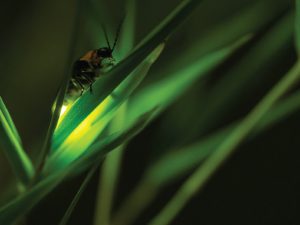
Fireflies play vital roles in their ecosystems as both indicators of environmental health and nature’s pest control. The presence of fireflies often signals a healthy, full-functioning, natural environment, as they require specific conditions to thrive. As predators in their larval stage, fireflies help control populations of snails, slugs, and other small invertebrates, contributing to natural pest management. Additionally, their bioluminescent properties have led to important scientific discoveries, particularly in medical research and biotechnology. Protecting firefly populations not only maintains biodiversity but also preserves vital ecosystem functions and opportunities for scientific discovery.
Technical Considerations for Lighting Professionals
Understanding wavelength impacts is crucial for lighting design in firefly-sensitive areas. Research shows that fireflies communicate in the yellow-green spectrum (475 to 670 nanometers). Standard bright, bluish-white LEDs emit light across the 430- to 700-nanometer range, effectively washing out firefly signals. Recommended lighting specifications include:
- utilizing amber or red LEDs (600- to 700-nanometer range)
- avoiding cool-white or daylight LEDs, CFLs, halogen globes, color-changing LED strips, and blue LEDs with phosphor coatings that might fail
- implementing downwardfacing fixtures with proper shielding
- installing motion sensors and timers for automated control.
The Firefly Habitat Certification program, from Firefly Conservation & Research, offers lighting professionals a structured approach to environmentally conscious design. This certification can be leveraged as a valuable tool for justifying lighting control strategies in sensitive areas, meeting dark sky compliance, enhancing sustainable design credentials, and creating zones of controlled lighting that benefit both human users and local ecosystems.
Since its launch in 2022, the Firefly Habitat Certification program has achieved remarkable success, with 2024 marking its most impactful year to date. The program has certified nearly 500 habitats, including state parks, natural areas, conservation lands, community gardens, and schools. The certification sign has become the primary tool for conservationists initiating new firefly sanctuary designations. Through donor support, the program has distributed 45 signs to resource-limited landowners, preserves, and parks, significantly enhancing public awareness and community engagement in firefly conservation efforts.
Integration Into Lighting Design Practice
Lighting professionals can implement firefly-friendly design through a comprehensive approach to project planning and execution. By conducting thorough site assessments early in the design process, designers can identify critical habitat areas and develop appropriate lighting strategies. These assessments inform the creation of lighting zones that protect dark spaces while ensuring human safety and functionality.
The implementation of adaptive controls allows for dynamic light-level management, particularly during peak firefly activity periods. This can be achieved through sophisticated control systems that adjust illumination based on time of day, season, and usage patterns. Shielded fixtures, carefully selected for their light distribution characteristics, ensure precise light placement while minimizing light trespass into sensitive areas.
Decorative lighting elements in sensitive areas require particular attention. While these features often enhance architectural appeal, their impact on firefly habitats must be carefully evaluated.
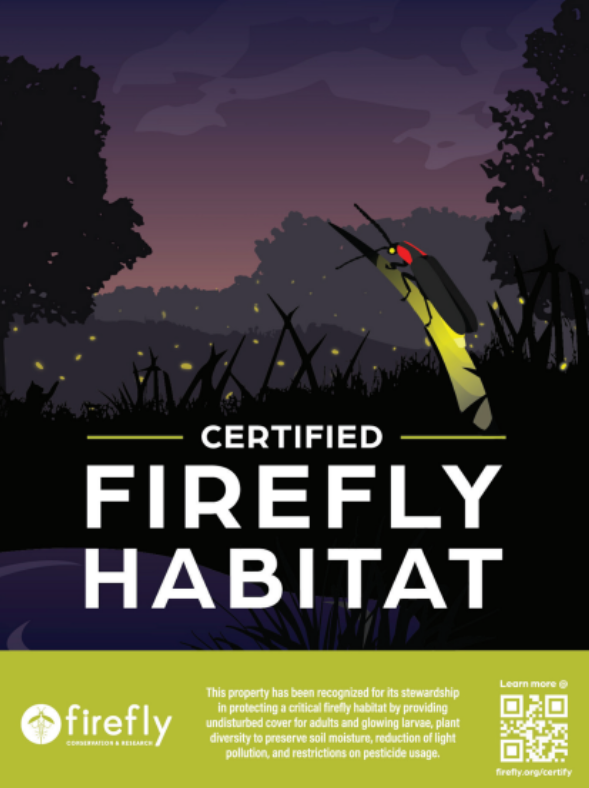
Photo: Firefly Conservation & Research
Best Practices for Implementation
To successfully integrate firefly-friendly lighting, designers should adhere to the following best practices:
Certified Firefly Habitat signs identify areas that provide the essential elements to create and sustain a healthy habitat for adult and larval fireflies.
- Conduct site assessments to identify critical habitat areas and active areas of habitat restoration.
- Develop lighting zones that protect dark spaces.
- Implement adaptive controls to reduce light levels during peak firefly activity, which is 30 minutes before dusk until 12 a.m., to cover all species in their desired peak mating times.
- Design with shielded fixtures that direct light precisely where needed, specifically away from any areas with native vegetation near rivers or streams.
- Remove purely decorative lighting elements in sensitive areas.
Everyone, including lighting professionals, have both the responsibility and opportunity to protect firefly populations through thoughtful design. By incorporating these principles into our lighting designs, we can contribute to the conservation of these remarkable insects while advancing the field of sustainable lighting practice.
Ben Pfeiffer is a recognized firefly scientist, national speaker, and founder of Firefly Conservation & Research, a nonprofit organization established in 2009.