
Retail ecosystems thrive at The Grand Outlet of East Jakarta
Spanning more than 17,000 islands along the equator, Indonesia’s tropical climate features lush rainforests, coral-rich seas, and volcanic mountains. This abundance of natural light, color, and texture is so reflected in Indonesian daily life that when it came time to develop the country’s first outlet mall, The Grand Outlet of East Jakarta, Chief Architectural Executive Kentaro Mabe of Mitsubishi Jisho Design Asia (MJDA) recognized that the design needed to honor that culture. He also understood that lighting would play an important role in this nature-inspired design. PT Lumina Group Associate Aulia M. Ihrom worked with Mabe and local architect PT Airmas Asri to craft a lighting concept that immerses shoppers in this uniquely Indonesian experience.
The Rainforest Canopy
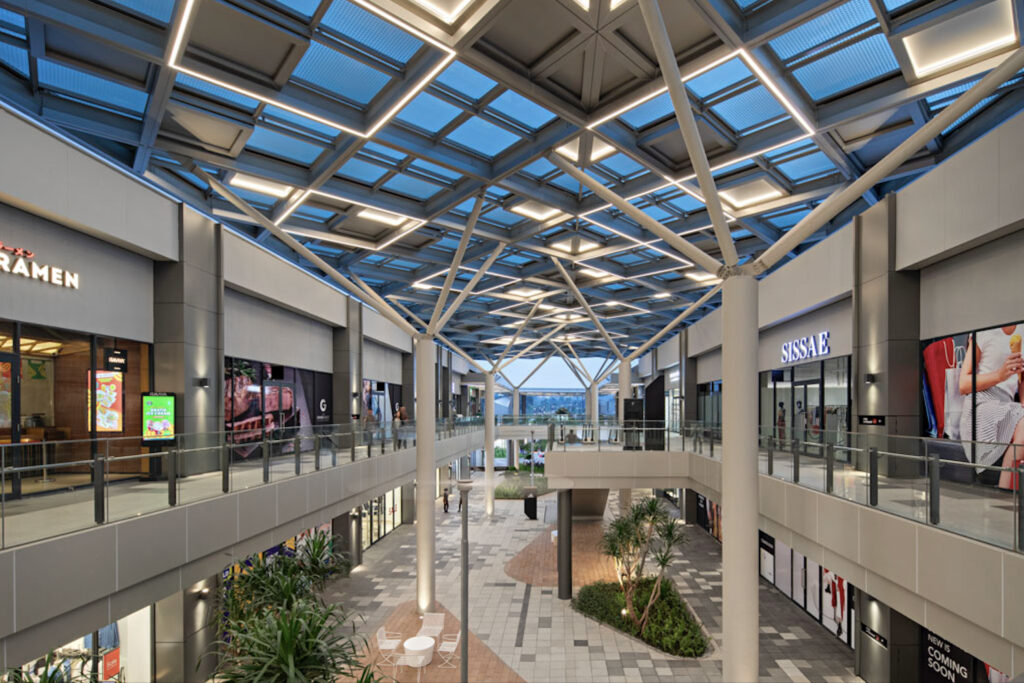
Rising four stories above the main galleria of Forest Square, a vast glass canopy, one of the largest in the country, mirrors the “protective and nurturing quali ties” of a rainforest canopy by providing shelter, regulating climate, and offering cover to the vibrant space below. As Mabe explained, this feature creates “a semi outdoor environment where the boundary between interior and exterior becomes fluid.” Constructed with high-performance glass and separated from the building to allow airflow, the canopy integrates both passive and active environmental control systems to maintain a comfortable micro climate for year-round shopping.
As visitors enter beneath this canopy into Forest Square, the largest of four retail shopping zones, they are enveloped by a play of light and shadow that evokes the feeling of moving through a rainforest. During the day, printed patterns on the glass above cast patterned shadows onto the floor below, while at night, canopy lighting inspired by the Japanese “Komorebi” (which translates to “sunlightleaking through trees”) effect makes visitors feel as if they are walking through nature under a night sky. “Much like the experience of walking in a forest where the sky is visible only above one’s head, luminaires were gathered toward the central axis of the canopy and arranged in a random, organic pattern,” explained Mabe. As day turns to night, these tunable RGB + warm-white LED lighting strips by DURALED shift from warm sunset hues to cooler evening tones, while spotlights simulate sunrays filtering through trees.
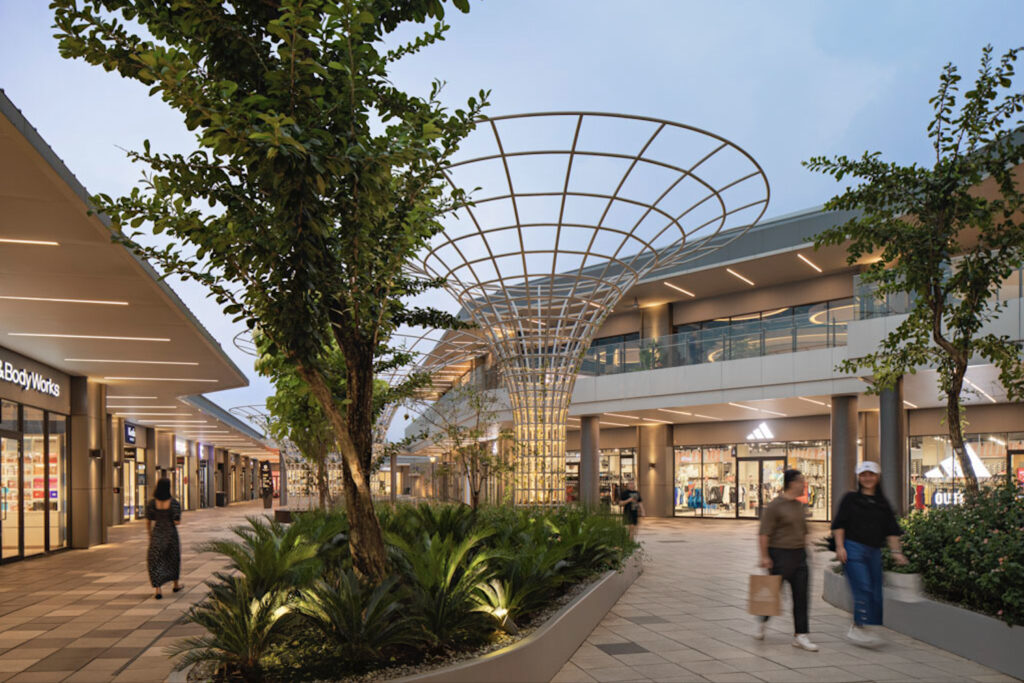
As visitors walk beneath the long canopy, they are guided to an open space called the Greenhub. This central event plaza and “core” of the mall offers a large area designed to “provide a cozy atmosphere for visitors to gather,” complete with flexible seating and sweeping staircases embedded with monochrome white LED strips by UNISTAR. Customizable gobo projectors, from the same manufacturer, use lenses etched with leaf patterns to cast circles of light onto the floor, creating the dappled effect of swaying trees. These projectors are controlled by a simple on/off timer.
Extending from this central hub are three more thematic retail zones, each embodying a distinctive Indonesian ecosystem. Moving along each of these nodes, visitors find themselves crossing through Water Square, Flower Park, and Bamboo Garden.
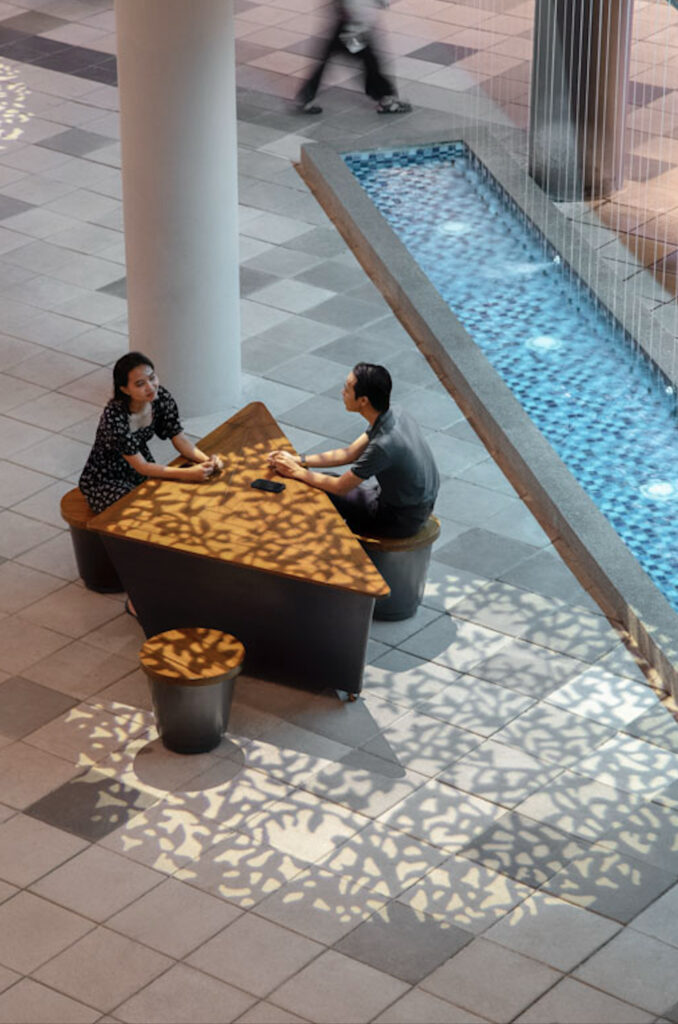
In designing atmospheric lighting for these retail areas, Ihrom said, “The main idea was to recreate as much as we could of the natural lighting that occurs in Indonesia.” The lighting was carefully designed to mimic the natural phenomena in each zone, including rainforest mushrooms that glow a light green and bioluminescent algae that emit soft, blue light along Indonesian shores.
In Flower Park, for example, glowing orbs mixed within flowers accentuate blooms after dark. These fiber-optic lights by UNISTAR change color based on preset dynamic movements and are fitted with circular end caps. “During the daytime,” Ihrom explained, “visitors see the colorful flowers, and then at night they see the glowing color-changing circular shapes in the flower beds, representing the glowing natural features of Indonesia.”
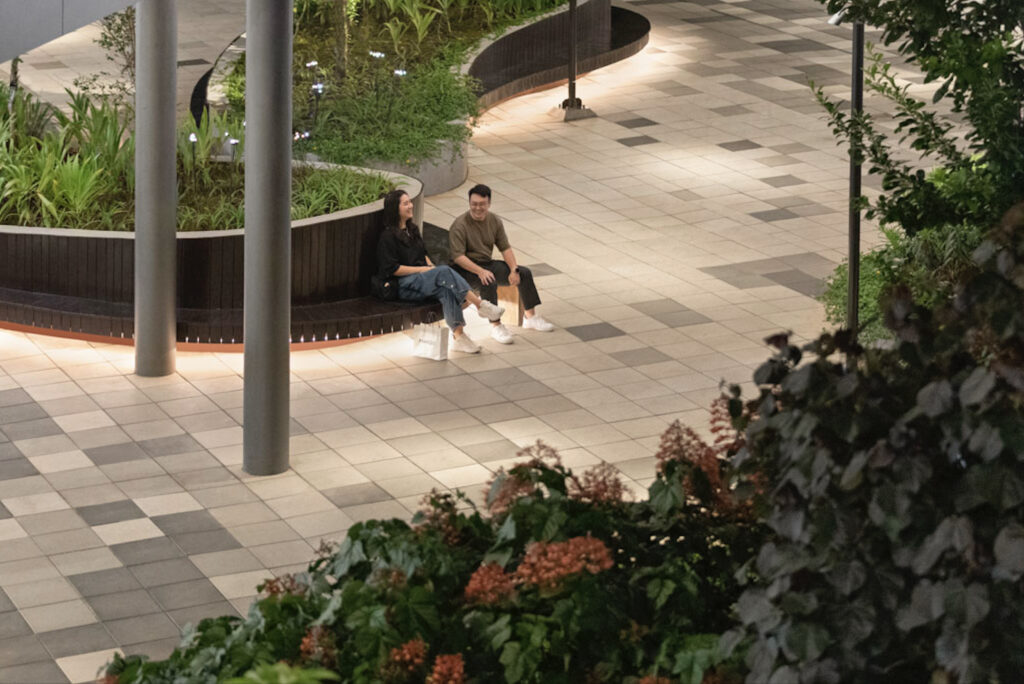
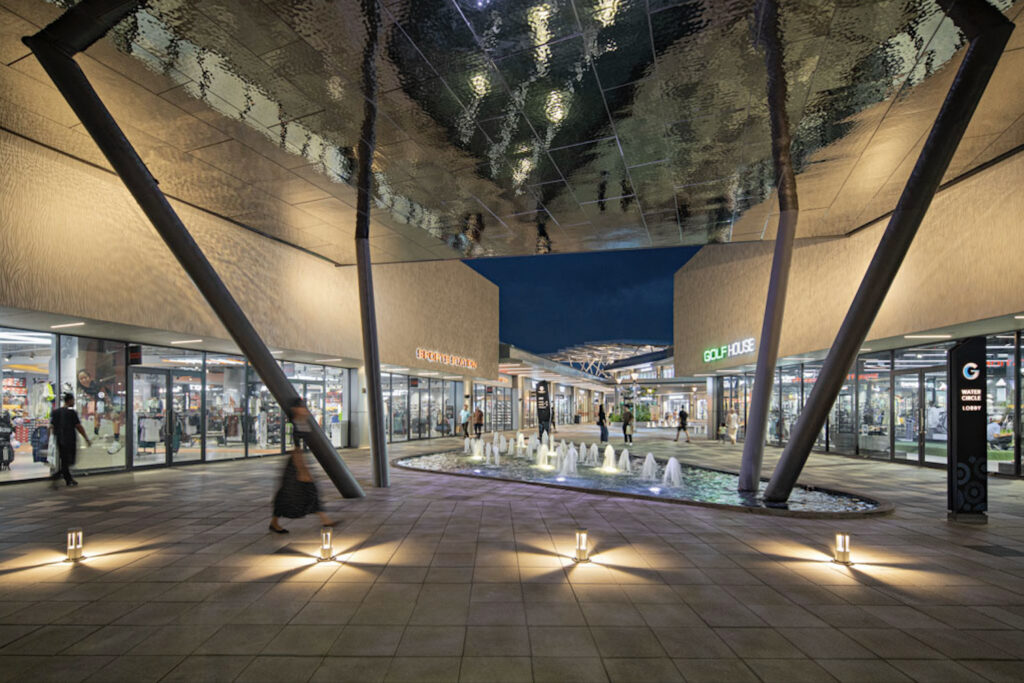
In Bamboo Garden, stalks are illuminated from within to cast a soft light. Water Square, Ihrom added, features “gobo projectors that emit watery effects,” creating the sensation of flowing water that then also shimmers upon the reflective ceiling.
Simplicity and Stability
The project’s main lighting considerations were simplicity and operational stability. The control system was designed with preset lighting scenes, and staff can easily switch color tones or ambience with a remote control. “The lighting fixtures were streamlined to a minimal number of types, utilizing high-efficiency, high-CRI LED sources that achieve both energy efficiency and long lifespan,” said Mabe. “Fixtures were carefully selected for color stability, reliability, and ease of maintenance, ensuring a sustainable lighting environment for long-term use.”
The design team selected these general LED fixtures from Chinese manufacturer SUPLINC, and it optimized energy use in the project’s lighting plan by calculating the power densities to see how the team could make them lower than the standard requirements. The lighting design maintains a power density of 10.6 watts per sq meter, with target illuminance levels of 100 lux at shop fronts and 75 lux in the main circulation areas. All specifications are in full compliance with ASHRAE/IESNA 90.1, reflecting current best practices for energy-efficient lighting.
The glass canopy presented many challenges. Since its design was unprecedented, along with the extensive discussions and iterative studies conducted to create the final lighting configuration, a full-scale visual mock-up was created that allowed the team to “examine fixture visibility, brightness balance, and the overall ambience under real conditions,” added Mabe.
Minimizing visible light sources while also ensuring the desired luminous effect and transitioning from sunlight into nighttime light required careful detail and on site coordination, through which, Mabe noted, “the team succeeded in creating a seamless continuity between the daytime dappled light and the nighttime luminous phenomenon.”
Nature Walk
The project “reimagines the act of shopping as an experience immersed in nature,” said Mabe. The goal, he added, “was not only to harmonize with the surrounding lush landscapes but also to differentiate the facility through architectural expression, establishing a distinct identity and lasting appeal.” The lighting design guides visitors throughout the mall, encouraging visitors to linger. It also creates a multifunctional space in the Greenhub through multi-colored lighting that can be adjusted for events ranging from exercise classes to concerts. Altogether, the mall, which is situated in an industrial area void of public spaces, has become a dynamic hub for the community.
While outlet malls often focus on economy and efficiency, this project treats lighting as an experiential layer. The natural details bring a sensory dimension to the shopping experience, and visitors are drawn to the approximately 150 retail stores as well as the site’s ambiance, evoking a cultural identity that transcends traditional shopping experiences.
Photos: Mario Wibowo Photography.
THE AUTHOR |
Katianne Williams, co-author of the STEM guide Count Girls In, enjoys writing about innovative projects and inspirational people.