
The origins of the EP program and its enduring importance
Everyone starts their career in different ways. Maybe mine began at the age of seven when I found a funny looking light bulb in a kitchen drawer and decided to test it using a battery and two wires. The bulb was a bayonet style with two contacts on the bottom of the lamp and a gnarly looking filament. I took a dry cell battery, taped the bared wires to each pole, touched the lamp—and flash! I was blinded for a moment before panic hit. I promptly did what seven-year-old boys do: I hid the evidence. In time, I would learn that it was a flash bulb from an old camera.
Years later, as a novice in lighting, trial-and-error was still tied to my learning process, but it was due to lack of available educational material, teachers, and mentors that could provide me with answers better than “rules of thumb.” That has changed since 1978 when I started working at a lighting distributor, reading anything I could find on lighting and spending lunch hours with a lamp catalog down in the GE lamp aisle or in a library. However, for many Emerging Professionals (EPs), that story may not be far off—the difference is that now the available information, good or bad, can be sourced on the Internet. But mentors are still few and far between.
In With the Outward
Every now and again, something said at a strategic moment in time will hit you and leave a lasting impact. For me, this happened during the last night of the IES Centennial in New York City in 2006. There were several students that attended via scholarships, including one from my Section in Seattle. A few of us in leadership roles spent time with the students, even taking them to outside events. At the end of the evening, I asked: “Now that you have seen what the IES is about, what do you think?” A response came from a student in Toronto: “Well, you are all a bit inbred, aren’t you?” I looked at him and the only response I had was “You are probably right.” For those of us standing there it became the turning point in finding ways to shift the IES from inward to outward.
After the Centennial, the first step toward change was the creation of the Young Professionals Scholarship Fund directed at lighting students. However, we still lacked a specific event to introduce EPs to the IES. At the 2009 IES Conference in Seattle, Fred Hasler, a professor from Kansas State University, arrived with the student winners of the scholarship. We discussed at length the lack of support for lighting programs in higher education and his efforts locally and regionally to change that, but this was still only a drop into a very large bucket.
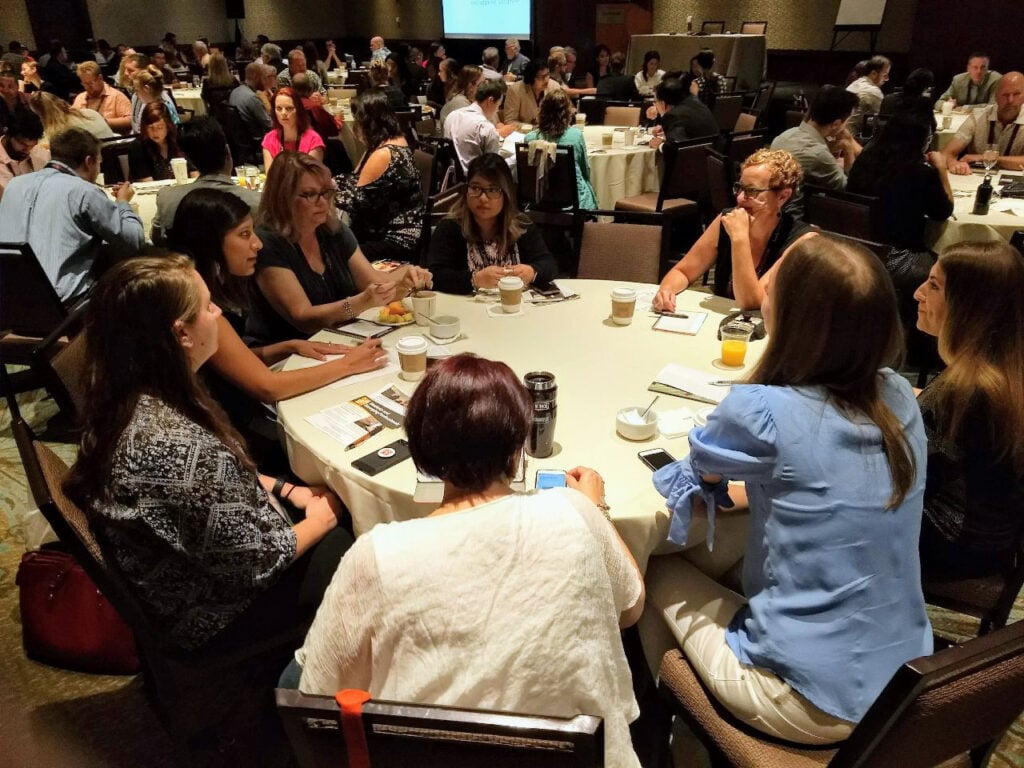
Over the next year, we built a concept for the Student and Emerging Professionals Event, formed a committee along with Kevin Flynn and Lisa Reed, and looked for an opportunity to make it reality. That avenue came from Kim Mercier, who was chairing the 2011 IES Annual Conference in Austin, TX; she invited us to hold the event the day before the conference started. We sent out notices but not too many students signed up; instead, EPs primarily signed up, which signaled that we needed to shift our outlook, both for the event and Society, to cultivate this element of our industry. A pilot test for mentoring was added and helped to show us an important aspect of the primarily Millennial group we were engaging at the time—they desired mentoring from experienced professionals but shied from asking for it.
Our first event was attended by 18 students and EPs, mostly through scholarships from manufacturers, manufacturer reps, and IES Sections. Then, in 2012, the Minneapolis conference saw double the number of attendees and professionals ready to help. At the Illumination Awards Gala that year, I was approached by Kevin Flynn, who said, “Look around the room, our demographic is changing.” It has only continued to shift.
Since the moment in which I understood the importance of looking outward to build the next generation of the workforce, I have spent a lot of time mentoring EPs inside and outside of the lighting industry. I have thought deeply about the concerns expressed and what we, as the more experienced generation, should be doing to assist EPs in their growth. Whether Gen X, Millennial, Gen Z, or Gen Alpha, they all start at the bottom rung of the company ladder, though their approaches may differ. Looking at this from a business-asset basis, the following are some of my personal observations and thoughts.
Liability Versus Asset
We all start our journey as a liability to our employers. Hiring EPs has costs that cannot be recouped in the short term but are investments in the future.
From the employer’s standpoint, a key question is when an EP transitions from being a company liability to becoming a true asset, given the significant investment required to recruit, onboard, train, and integrate new professionals. In design practice, the challenge extends beyond acquiring knowledge to developing a deeper understanding of how projects come together and how decisions affect outcomes.
Employers must also determine when an EP is ready to work with less supervision and greater autonomy. Over the long term, they look for the point at which the quality and value of an EP’s contributions significantly exceed the cost of their compensation. During lean times, firms must balance the experience of seasoned professionals with the fresh perspectives and new ideas that EPs can bring. Employers may also have concerns about reten- tion and loyalty, as younger generations hesitate to commit to companies.
The EP POV
EPs come into a new career with hopes of learning, growing, and feeling like they can be part of something more than just a job title. EPs often face negative attitudes from more seasoned employees, the fear of making mistakes, and/or the feeling that their contributions may not be important.
Other concerns from the EP standpoint often include the realization that, regardless of their level of education or experience, they still have much to learn through hands-on training and professional experience. Additionally, many find that their first years in the industry are spent handling “grunt work” while navigating office politics, building relationships, and trying to gain recognition in the hope of earning more challenging assignments. The longer that process takes, the more discouraged they can become, and their ambitions may shift elsewhere.
Because EPs are often at the bottom of the organizational ladder, they may also worry that their positions are vulnerable. These concerns can be compounded when they work for firms that lack strong leadership or mentoring, leaving them with responsibilities they have little ex- perience or knowledge to manage while supervisors hold their feet to the fire.
When Liability Becomes Asset
The shift from liability to asset takes time, but mentoring, whether internal or external, can accelerate the process. For example, the following is anecdotal but based on a composite of discussions with EPs that have succeeded more rapidly:
My experience at my first job in lighting where a supervisor was also mentoring me was that I would be given tasks with explanation on how they should be completed. There were regular progress checks, as well as discussions of the task and its importance after completion. One day, many projects later, I was waiting for my supervisor to meet and review my recent task, but he stayed at his desk, busy with his own project. It was at that moment I realized I was now responsible for my own work.
The size of the threshold between needing help and achieving self-sufficiency depends on both the willingness of the EP to learn and the mentor’s commitment to providing guidance. Mentoring is critical because it helps EPs build accountability and, ultimately, become company assets through skills development and confidence in their work. Effective mentorship strengthens communication skills by teaching EPs to articulate ideas, needs, and concerns clearly and to ensure their work is well prepared and defensible. It reinforces strong work habits and professional conduct, whether in the office, on a job site, or in front of a client.
Mentors also help EPs develop time-management skills to balance deadlines, schedules, goals, and workloads. Additionally, and just as importantly, mentors create an environment of support where EPs can learn and try new things. Ultimately, mentoring fosters empowerment, enabling EPs to represent both their work and their organization with confidence inside and outside the workplace.
Call for Mentors
Whether it is at the company or industry level, there is a strong need for mentoring. Over the years, the IES, through LightFair and the EP event, has tested mentorship and proved its benefits to the lighting industry. If we are to be bold and create an industry-wide program, we need more seasoned professionals that are willing to dedicate time, knowledge, and listening skills to help build the coming generations of EPs. We have the tools, we have the talent, we have those coming behind us that need the support; let’s take that next step and make it a reality.