

Five young professionals discuss the projects and tools kick-starting their career paths
From having just graduated to working in the field, Emerging Professionals (EPs) serve as the voice of the lighting industry’s next generation. The EPs featured in this roundtable have worked on theater projects, exhibitions, corporate amenities spaces, bridges, ecology centers, and more—and they bring with them fresh perspectives as well as tried-and-true techniques. Each panelist has been generous with their insights on illumination practices, including anecdotes of personal triumphs and challenges. Whether you’re a student exploring the profession, a veteran reflecting on its evolution, or somewhere in between, this conversation offers contemporary perspectives on where lighting is today and where it’s headed next.
Anirudh “Ani” Anand is an architectural and lighting designer at The SEED and strives to develop an interdisciplinary mode of practice that holistically incorporates light with architecture. He enjoys learning from disciplines outside of design, drawing inspiration from the arts, natural forms, history, science fiction, and cuisine. Anand enjoys making with his hands and working with light as a medium.
Daniele Guevara is an emerging architectural lighting professional based in Toronto. She is an award-winning theatrical designer, EP program chair for IES Toronto, bird rescue patroller for FLAP Canada, and dark-sky advocate.

Hadistian Emirul “Emir” Ikhsan was a second-year MFA Lighting Design student at Parsons School of Design at the time of this writing. Originally from Jakarta, Indonesia, he worked as an interior designer for a decade. In addition to his studies, Ikhsan was employed part-time with City Lighting Reps and as a research assistant for the Pioneers of Architectural Lighting Design project. He is now a junior lighting designer at Renfro Design Group.

Rozlyn Mead is an emerging architectural designer and interior designer based in Toronto. She is passionate about sustainable, accessible design and explores how lighting shapes human experience within the built environment.

Yun-Hsuan Tsai is a New York–based lighting designer with HLB Design who has a background in theater and an MFA degree in Lighting Design from Parsons School of Design. Her work spans architectural, theatrical, exhibition, and photography lighting, with a focus on human experience and narrative through light.
What tools are in your EP starter kit?
Ani Anand: My favorite tools that I use daily are sketching, LightStanza, and the Fusion Optix app. These allow me to quickly understand and test ideas and lighting conditions.
Sketching has long been a favorite tool and pastime of mine. Putting pen to paper or making a sketch model allows me to fluidly think through things in real time. Sketching is a perfect way to get the body moving as well as to disengage from the screen and make something real.
I joke that I’m the poster boy for LightStanza, but it has afforded me so much more flexibility in calculations than other tools such as AGI or Dialux. The speed with which one can test multiple options and see the results optimizes productivity.
I love Fusion Optix for its ability to quickly analyze lighting in the moment without the need for complex software; it allows me to look at something beautiful and know instantly what the contrast ratio is, so I can try doing it myself.
Daniele Guevara: Highlighters, 2B pencils, chisel-tip graphic pens, Sharpie markers, and a 30+ year-old electric eraser, are my favorite analog tools for sketches. A light meter, green laser pen, mini laser measuring tool, and notebook are must-haves on-site. I’ve been using Revit, AutoCAD, and AGi32 consistently for layouts and calculations.
Emir Ikhsan: My toolkit is a mix of physical tools, observation, and design values that help me move from concept to experience. I rely on tools like a light meter, spectrometer, sketching, mockups, and material testing to understand how light behaves in space. Beyond that, one of my most important tools is observation—paying close attention to atmosphere, shadow, glare, reflection, and how people emotionally respond to their environment.
Rozlyn Mead: Revit, AutoCAD, and Enscape are my core tools for moving from concept to visualization to documentation. I also rely on Excel for code analysis and project organization. I always keep a sketchbook on-hand; quick sketches are still the fastest way I think through ideas.
Beyond tools, my mindset is key: curiosity, adaptability, and a strong understanding of the Ontario Building Code (OBC).
Yun-Hsuan Tsai: Procreate is one of my go-to tools for conceptual sketching and brainstorming. I also use Photoshop to create inspiration collages and explore the various elements of the spaces I’m designing for. That early phase is the most exciting part of the process for me—it’s when there’s the greatest freedom to explore ideas and imagine possibilities without constraints. As projects move toward resolution, lighting calculation software such as AGi32 or DIALux becomes essential for grounding those ideas in reality. These tools are critical for code compliance verification and preliminary visualization, as well as for understanding the design at multiple scales—from details like optics and aiming to overall lighting effect and layering.
What is a design project you are currently working on and what is your role in the project?
Anand: I am currently working on a range of design projects, mostly as a lighting designer. As part of a small team, I can participate in all aspects of the design process, from concept to construction. One project that stands out is a corporate amenity space, which is the largest project I have ever worked on. I am creating lighting layouts, specifying fixtures, running calculations, and developing details. As this project develops, I hope to stay engaged with the process through construction administration and commissioning.
Guevara: I’m currently working on a high-end residential project in Switzerland with my sister’s interior design studio, Gaile Guevara Studio. I’m creating lighting layouts and details, running lighting calculations, and sourcing luminaires.
Ikhsan: I’m currently working on my thesis project, which investigates how CCT and scent can shape positive customer behavior and influence the perceived quality of fragrance in a home-fragrance retail display. My role in the project is as both the researcher and designer. Alongside developing the research framework, I’m designing a customized shelving display that will support the thesis testing and presentation. The display is being developed not just as a fixture, but as part of the experimental environment, where lighting, materiality, and product presentation all work together to shape the customer experience.
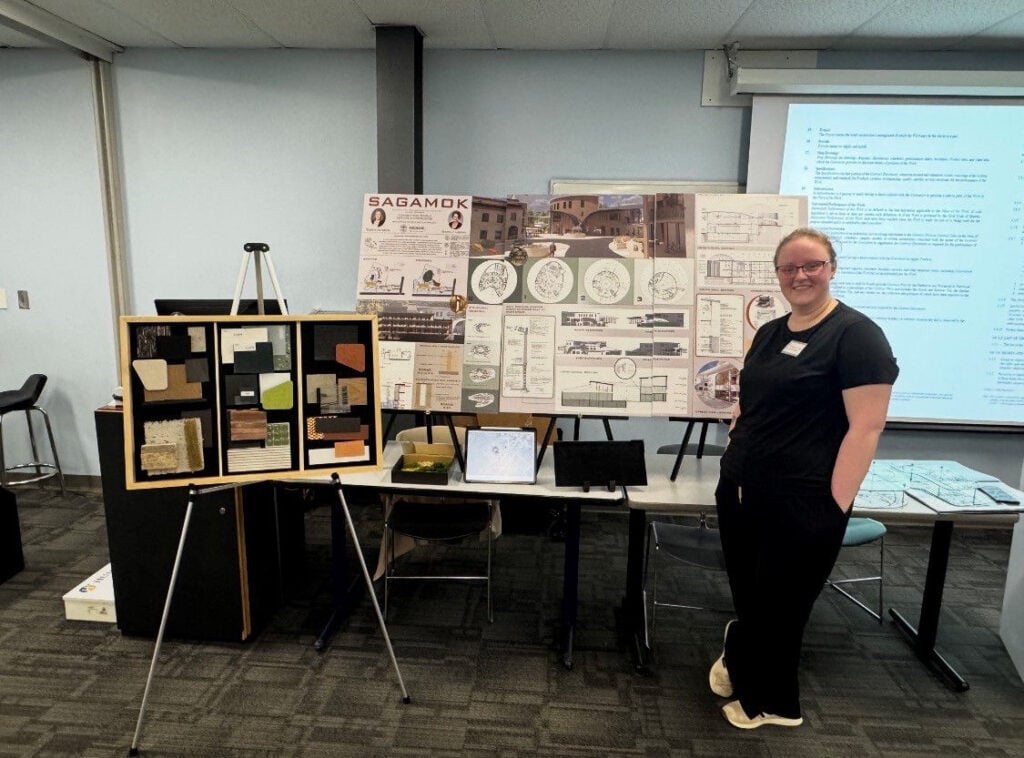
Mead: I’m currently working on my capstone: an adaptive reuse ecology center in Alton, Ontario, Canada. The project combines an existing heritage building, a new addition, and a blacksmith café into a community-focused, sustainable site. I’m leading everything from concept to technical execution—developing the Revit model, producing a full drawing set, resolving OBC requirements, and integrating lighting strategies that support both function and atmosphere.
Tsai: One of the projects I’m currently focused on is a large-scale recreation center that includes both interior spaces and an exterior landscape. This is my first time stepping into the role of BIM [building information modeling] coordinator, which has been an exciting learning experience. In addition to managing model population and coordination, I’m involved in developing the design through presentation materials primarily used during the schematic design phase, as well as supporting calculation studies and fixture specification as the project moves into the design development phase.
What is the most interesting design project with which you’ve been involved?
Anand: The most interesting project I’ve worked on is a digital art museum in a unique space with a 63-ft-tall atrium. Designing lighting for a digital art space carries unexpected challenges relative to a more traditional art museum, for example, there is no need for the usual track art lighting on the walls, and more emphasis on creating memorable experiences in common spaces. As a result, we were able to invest more time developing beautiful lighting details and coordinating complex controls to achieve our vision and maximum flexibility.
Guevara: Just after the pandemic, I worked with the design firm Mulvey & Banani during the commissioning phase of Little Canada, a celebration of Canadian cities, history, and geography; I focused luminaires throughout the exhibits. Working on this attraction was especially interesting because the tiny scale of the displays required an extra level of attention. While utilizing skills I learned through theater work, I loved the new challenge of finding the perfect location for each luminaire to avoid excessive shadowing and glare. The lighting showcased the craftsmanship of the models while helping to establish the character of each distinct setting. Little Canada received a 2023 IES Illumination Award of Merit and continues to be one of Toronto’s top attractions.
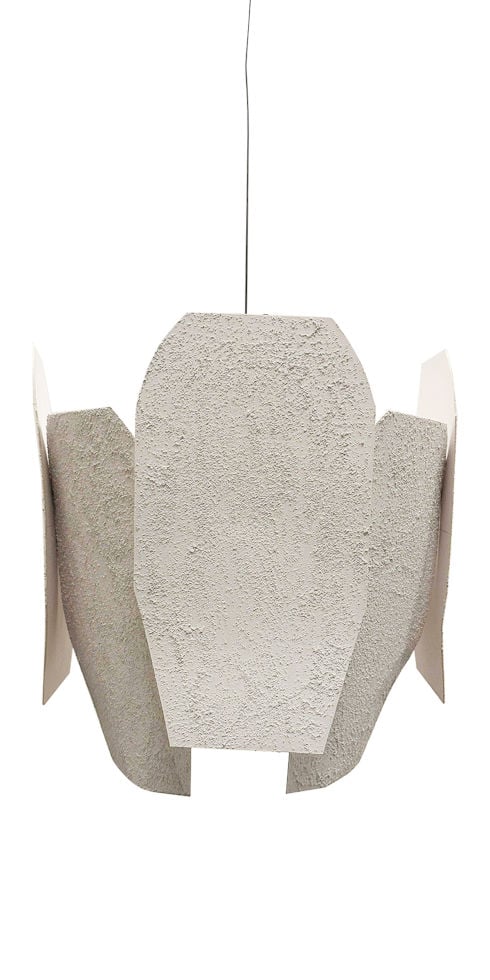
Ikhsan: One of the most interesting projects I’ve worked on was a luminaire project from my first semester where I designed and built a full-scale, 1:1 luminaire for a dining room. It was opportunity to think about a dining light as something more flexible than a fixture made only for one purpose. I deliberately designed it as an adjustable pendant light so that the lighting could respond to different activities that might happen around the dining table, whether that was eating, reading, or playing board games.
I also enjoyed working through the material experimentation. I used paper board finished with sand gel to create a textured surface while still maintaining the paper’s translucent quality; when the luminaire is turned on, the whole surface glows, giving the object a soft and atmospheric presence.
Mead: My capstone project at The Sagamok Ecology Centre has been the most exciting project I’ve worked on. The project blends storytelling, sustainability, and technical problem-solving into one cohesive design. I’ve explored how lighting can guide movement, highlight materials, and reinforce the narrative of the space. It’s the first time I’ve fully integrated architecture, interiors, and lighting—which has been incredibly rewarding.
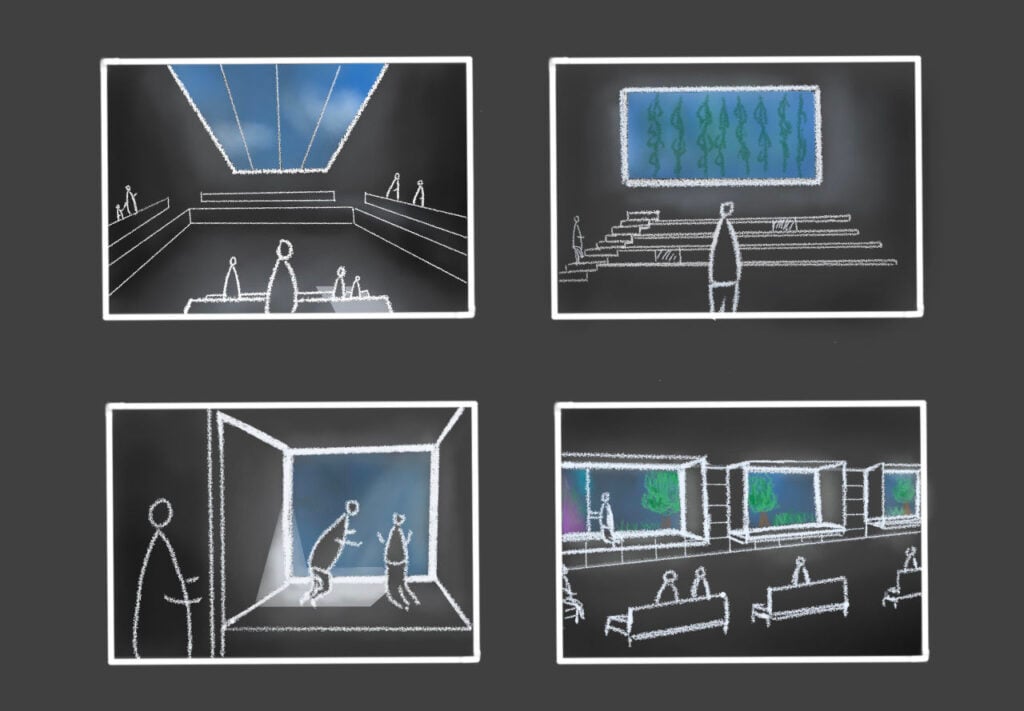
Tsai: Developing lighting scenes through animations and storyboards for a bridge project. It allowed me to fully maximize my creativity and draw from my background in theatrical lighting. The dynamic, narrative side of lighting has always been a passion of mine, because it’s where light becomes a storytelling tool that shapes end-user experience and memories. I especially enjoyed working with the community to understand its needs and aspirations, while translating those ideas into lighting scenes that felt meaningful and responsive to how the space would be experienced.
What has been one of your more-challenging tasks?
Anand: One of the hardest things for me since graduating has been adjusting to the business side of practice—specifically, balancing business considerations with creativity and design vision. In practice, we must be mindful of time management in a different way than when we were students. Not only are we juggling more projects that all deserve attention, but each project is limited by the capacity of its fee. We don’t always have the luxury of spending as much time perfecting every element of the design.
Learning to let go of my perfectionism has been an active process; I have learned that sometimes optimization is necessary to balance one’s own needs, both as an individual and as part of a business.
Guevara: I’ve worked on two challenging hospital projects. It was a jump into the deep end of code compliance and I gained insight into the high level of expertise, dedication, and depth of coordination required to see these projects through all stages. My position allowed me to appreciate these spaces from a new perspective. From maternity wards to ICUs and ERs, hospitals carry the entire gamut of human experience. These projects allowed me to think of lighting not just as satisfying technical requirements, but as a means to help create supportive and caring spaces.
Ikhsan: For me, it was an office for Impact Hub Jakarta, Indonesia. What made it challenging was that this project took place before I formally studied lighting, when I was still working as an interior designer. I needed to develop a customized lighting installation that was both visually integrated with the architecture and appropriate for the needs of a coworking space. Suspended circular ceiling elements and inserted linear fixtures required careful thinking around composition, brightness, glare control, and overall user comfort.
I had to think beyond aesthetics and consider how a custom lighting gesture performs in a real environment. What I took away from that experience is that a project can have a strong concept, but it only succeeds when that concept can translate into a functional and comfortable experience for people.
Mead: Balancing design intent with building code has been my biggest challenge. Working through OBC requirements while maintaining a strong concept pushed me to think more critically about design. It taught me that code isn’t a limitation—it’s a design tool when used early and intentionally.
Tsai: I worked on a transportation renovation where the main challenge was balancing existing conditions with expectations for an upgraded environment within tight budget constraints. Incomplete background drawings required extensive field measurements and the use of 3-D models to understand varying conditions across platforms. Another key challenge was meeting current codes and standards while maintaining visual consistency with adjacent, non-renovated platforms. While demanding, the project was a valuable learning experience—especially through collaboration with more experienced designers—and reinforced how critical real-world context is when making thoughtful design decisions.
What do you envision as having a significant impact on the future of the lighting industry?
Anand: The future of the lighting industry depends on collaboration. Not just between lighting designers, sales reps, distributors, manufacturers, and architects, but among the entire lighting and architecture, engineering, and construction community. As AI and as the urgent need for sustainable models of practice grow, it is imperative that we keep an open mind and forge new connections and opportunities for innovation.
Take the example of sustainable materials—there is tremendous research in biomaterials and sustainable alternatives to the traditional media of our industry (metal and plastic) that is almost never heard of in our circles. We are so used to the performance of aluminum and acrylic extrusions, any alternative that does not perform as well is disregarded. However, if we do not start making strides to incorporate new materials thinking into our industry, we will never discover the new opportunities therein.
While a few manufacturers and designers have started taking this challenge on, what has invariably been produced is a sustainable replication of the same fixtures we have grown accustomed to. However, sustainable materials are not only an opportunity to continue what we’re already doing while being kinder to the planet—they represent a radical new field for design exploration.
Guevara: As cities grow and energy use increases, the future of the lighting industry depends on advocating for well-controlled, intentional design that supports more resilient urban environments. I’m excited by the growing body of research on the benefits of both daylight and darkness, as well as how these can shape better lighting strategies. While manufacturers are improving lighting technology, it’s frustrating to see whole floors of office towers fully lit after hours and newly installed streetlights that produce so much glare. While there is still a pervasive lack of awareness that quality lighting is worth investing in, emerging professionals and the growing community can help bring these issues to the forefront.
Ikhsan: A stronger commitment to human-centered design. What excites me is the growing attention to how lighting affects well-being, emotion, behavior, and sensory experience. I’m also excited by the idea that lighting is becoming more interdisciplinary, with stronger connections to architecture, psychology, health, and even cultural storytelling.
What concerns me is the possibility of lighting becoming too driven by efficiency, standardization, or automation, to the point where we lose the emotional and experiential dimension of design. Good lighting should not only meet technical requirements, but also create a feeling, support people, and give character to a space. To me, the future of the industry depends on maintaining that balance between technical precision and human experience.
Mead: The future of lighting is human-centered and sustainable. Lighting now plays a major role in health, energy performance, and user experience. That shift is exciting. At the same time, the industry needs to balance innovation with simplicity—designing systems that are not just smart, but maintainable, accessible, and long-lasting.
Tsai: One of the most important factors shaping the future of the lighting industry is how emerging technologies, especially AI, are integrated into the design process. As an early-career designer, I’m excited by the ways AI can support our work, from streamlining workflows to helping analyze data and explore ideas more efficiently. At the same time, I’m mindful of the risk of becoming too reliant on these tools. Lighting design is deeply tied to human experience, emotion, and storytelling, and those qualities still rely on the designer’s sensitivity and judgment. Moving forward, I think the challenge and opportunity will be learning how to use technology thoughtfully, in a way that supports creativity and decision-making without replacing the human perspective at the core of design.