
How climate change is redefining outdoor lighting infrastructure
I have spent much of my career working at the intersection of design and environment—first in film production, where every set must feel inhabited and true, then in real estate, where the built environment carries the weight of lives lived within, and now in infrastructure, where the stakes are no longer aesthetic but existential. It is from this vantage point—across all three scales of design—that I want to talk about what climate change is doing to outdoor lighting infrastructure, and why the profession can no longer treat resilience as an optional upgrade.
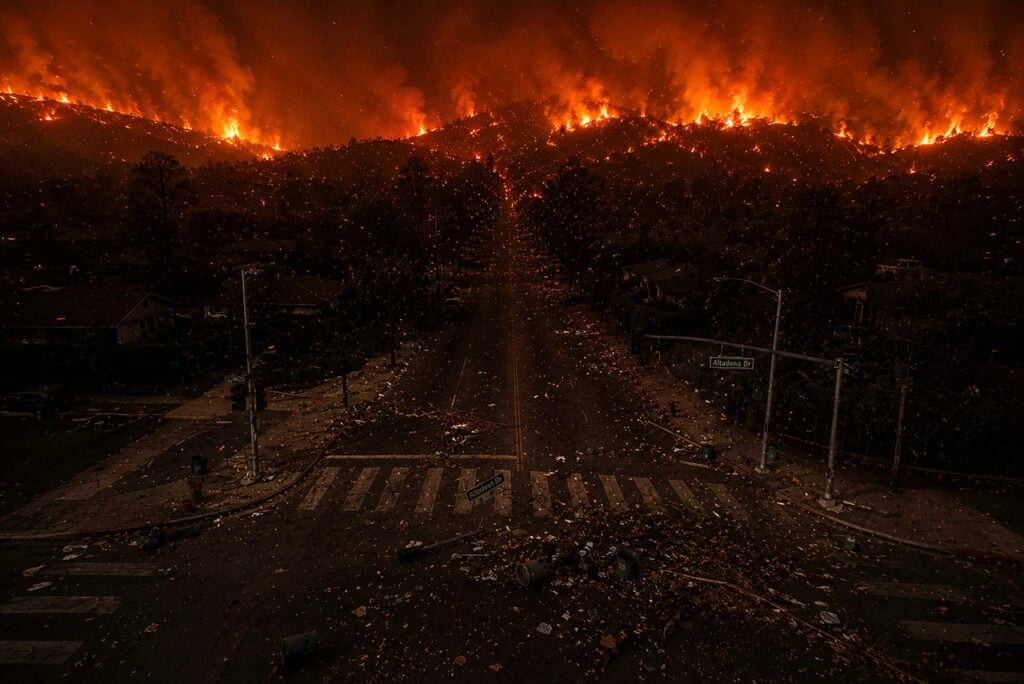
The Woolsey Fire in Los Angeles and Ventura counties, CA, in 2018 changed my understanding of what infrastructure failure looks like from the inside. I was on the Pacific Coast Highway, bumper to bumper, in pitch black—no streetlights, no cell signal, and no information about where the fire was moving. The darkness was not incidental; it was the condition that made every other problem worse. It is the same condition that follows a hurricane making landfall, an arctic blast collapsing the grid, a flood cutting off roads, and a heat wave pushing demand past capacity.
The disaster changes. The failure mode does not: The infrastructure we depend on goes dark precisely when we need it most. That experience set me on a course to rethink the cobra-head streetlight—a design functionally unchanged for over a century—and ask what it needs to do in the climate era. The answer is quite a lot more than illuminate a road.
The Stability Assumption
Conventional outdoor lighting infrastructure was designed around assumptions that no longer hold: a stable grid, moderate ambient temperatures, and a risk environment defined primarily by human error rather than systemic climate volatility. It presumed that failed infrastructure could be repaired within a reasonable timeframe, with crews able to reach damaged sites safely. In the American Southwest, summer temperatures now regularly exceed 115 deg Fahrenheit. In wildfire corridors, grid infrastructure and the road maintenance crews would use are compromised simultaneously. Coastal communities face corrosion rates and storm-surge flooding that exceed the tolerance of standard pole systems. The frequency of weather events that knock out grid power is increasing faster than utilities can harden transmission infrastructure to keep pace.
The result is a growing gap between the performance envelope that outdoor lighting was designed for and the conditions in which it is now being asked to perform. Lighting professionals have an opportunity to name that gap clearly and design toward closing it.
Three Axes of Climate-Driven Design Pressure
In my work, I have found it useful to think about climate-driven design pressure along three distinct axes: energy independence, environmental durability, and ecological sensitivity. Each is reshaping what good outdoor lighting design looks like, and each rewards designers who engage with it seriously.
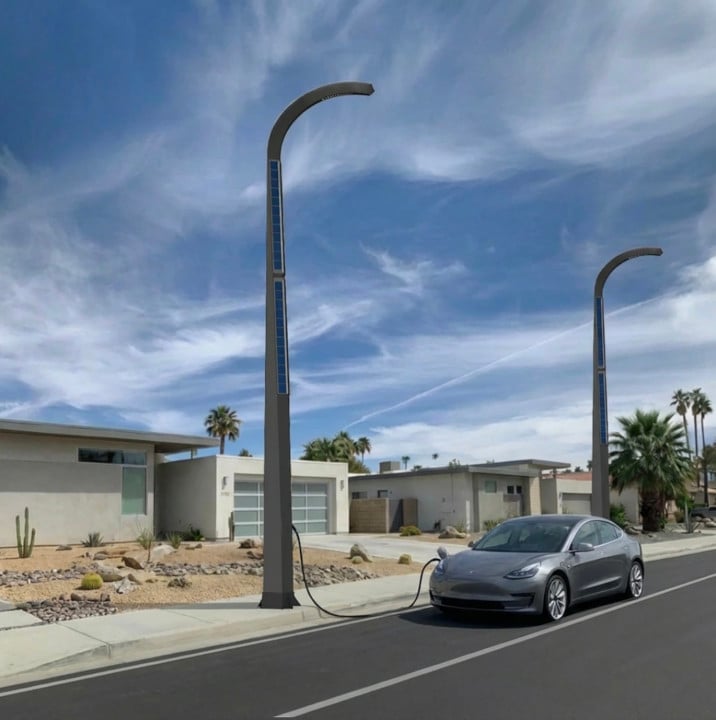
Energy independence is the most immediately visible axis. A streetlight that draws power exclusively from the grid is, by definition, as resilient as the grid—which is to say, in many communities, not resilient enough. The shift toward solar-integrated, battery-backed systems is not primarily about sustainability marketing; it is about maintaining the core function of outdoor lighting when the grid fails. Battery storage technology has matured to the point where a well-designed solar-integrated pole can maintain full lumen output through multi-day grid outages—precisely the scenario that matters most in the immediate aftermath of a wildfire, hurricane, or ice storm.
The second axis, environmental durability, is less discussed but equally consequential. Standard aluminum and steel pole systems corrode and heat degrades optical components and driver electronics faster than specifications written decades ago anticipated. Advanced composite materials offer a strength-to-weight ratio exceeding steel while being non-conductive, non-corrosive, and rated for the temperature cycling now routine in climate-stressed environments. For designers specifying infrastructure in coastal, desert, or wildfire-interface zones, material selection is no longer secondary. It is primary.
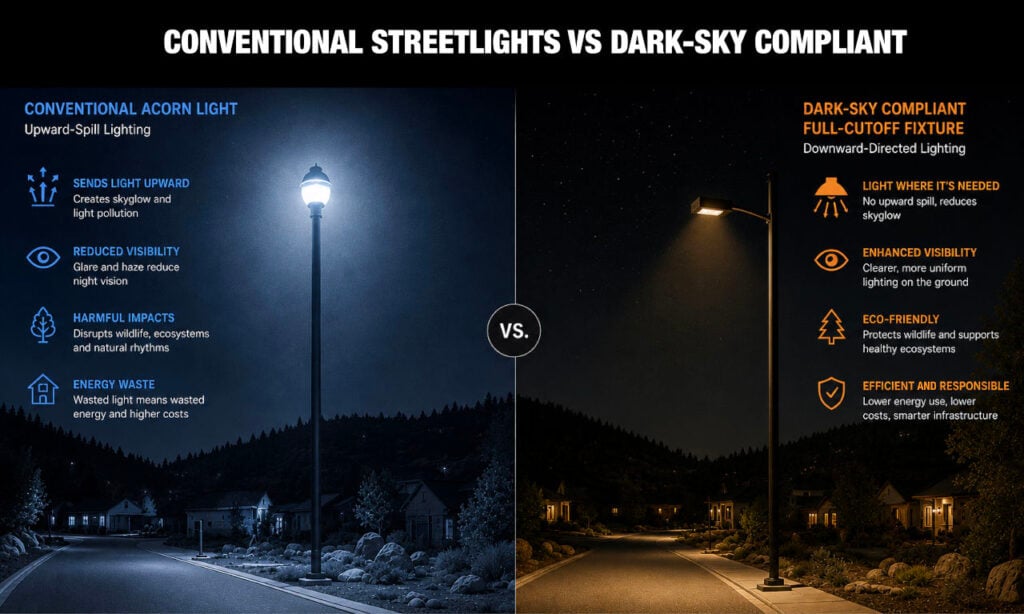
The third axis, ecological sensitivity, is where the profession has perhaps the most work to do. Light pollution is not merely an aesthetic concern; it is a biological one. Artificial light at night disrupts insect navigation, bird migration, and the behavioral patterns of nocturnal species in ways that cascade through ecosystems. DarkSky International’s frameworks for measuring skyglow and directing light downward are increasingly written into municipal code. Dark-sky compliant fixture design—tight beam cutoffs, warm color temperatures, adaptive controls that reduce output in the hours when ecological impact is greatest—should be the baseline for any new outdoor lighting installation, not an optional add-on.
Infrastructure as Community Resilience
The most consequential shift I have observed is a broadening of the question outdoor lighting is being asked to answer. The traditional question has been: Does it illuminate the roadway to the standard required by the applicable specification? The larger emerging question is: Does it contribute to the resilience of the community it serves?
Those two questions have meaningfully different design implications. A streetlight that answers only the first question can be a passive fixture. A streetlight that answers the second question must be an active node in a larger system—one that maintains connectivity, provides Wi-Fi during emergencies, supports electric-vehicle charging that enables electric evacuation vehicles to maintain range, and feeds data back to city management systems that need real-time situational awareness during a crisis. The cobra-head streetlight was designed for a moment when the street was a space for cars and the light was a service to drivers. In the climate era, the street is increasingly an emergency lifeline and the infrastructure along it needs to function accordingly.
The Altadena Lesson
The January 2025 Eaton Fire in Southern California illustrated what infrastructure failure looks like at community scale. Streetlights went dark. Cell towers failed when backup generators ran out of fuel. Evacuation corridors became dangerous. The communities that fared best had some degree of energy independence—neighbors with solar and storage who could charge phones and share information. The rebuilding conversation in Altadena, CA, has since become the most sophisticated infrastructure planning discussion in which I have participated. Residents are not asking for what was there before; they are asking for what should have been there. The outdoor lighting profession has a role to play in delivering it. And, the technology is ready.
Designing for the Conditions That Are Coming
The outdoor lighting profession is now in a familiar infrastructure debate: Standards exist for good reason and should not move hastily, but conditions have already moved and the standards are catching up to reality rather than defining it. My view, shaped by working across design fields where the consequences of getting environments wrong are immediate, is that waiting is not a neutral act. Every light installed today that is not designed for the temperature range, grid independence requirements, ecological sensitivity, and structural load conditions of a climate-stressed environment is an installation that will need to be retrofitted or replaced before its useful life is over. The economics of resilient design become considerably more favorable when the comparison is resilient versus conventional plus the cost of failure.
The Moment Is Now
I came to infrastructure design through film and real estate—fields where environments are felt immediately and judged by people with no tolerance for the gap between what a space promises and what it delivers. Climate change is making that gap in outdoor lighting infrastructure impossible to ignore.
The outdoor lighting profession has an opportunity to lead the conversation about what public infrastructure owes the communities it serves when those communities are under stress, which is precisely the moment when the infrastructure matters most: the light that stays on when the grid goes down, the pole that holds through the wind event that takes out everything else, and the installation that does not add to the ecological disruption that climate change is already accelerating.
It is worth rising toward this design brief. The communities that most need infrastructure equal to it are not waiting for the profession to be ready. They need it now.
The Author
Heidi Adams is the founder and CEO of BASEstud.io, a public benefit corporation designing solar-integrated, battery-backed streetlight infrastructure for a climate-stressed world.