
Designing light for animal pleasure and comfort
My team and I have had the privilege of working with some of the leaders in animal habitat design over the last 40 years on such renowned projects as the Monterey Bay Aquarium, New Doha Zoo, National Aquarium of Taiwan, Long Beach Aquarium of the Pacific, and many others. The lighting design process typically follows American Institute of Architects’ or Royal Institute of British Architects’ stages of development, dependent on what area of the world the project is located. The lighting designer is often brought in under contract through the architectural and engineering consultant or the specialty exhibit designer, depending on the extent of the lighting designer’s scope of work. While the designer is often brought in at the concept/schematic phase(s), there may be a significant gap of time moving forward with subsequent phases if the project is dependent on using the concept/schematic documents to procure additional funding. This may be the norm versus the exception for publicly funded projects.
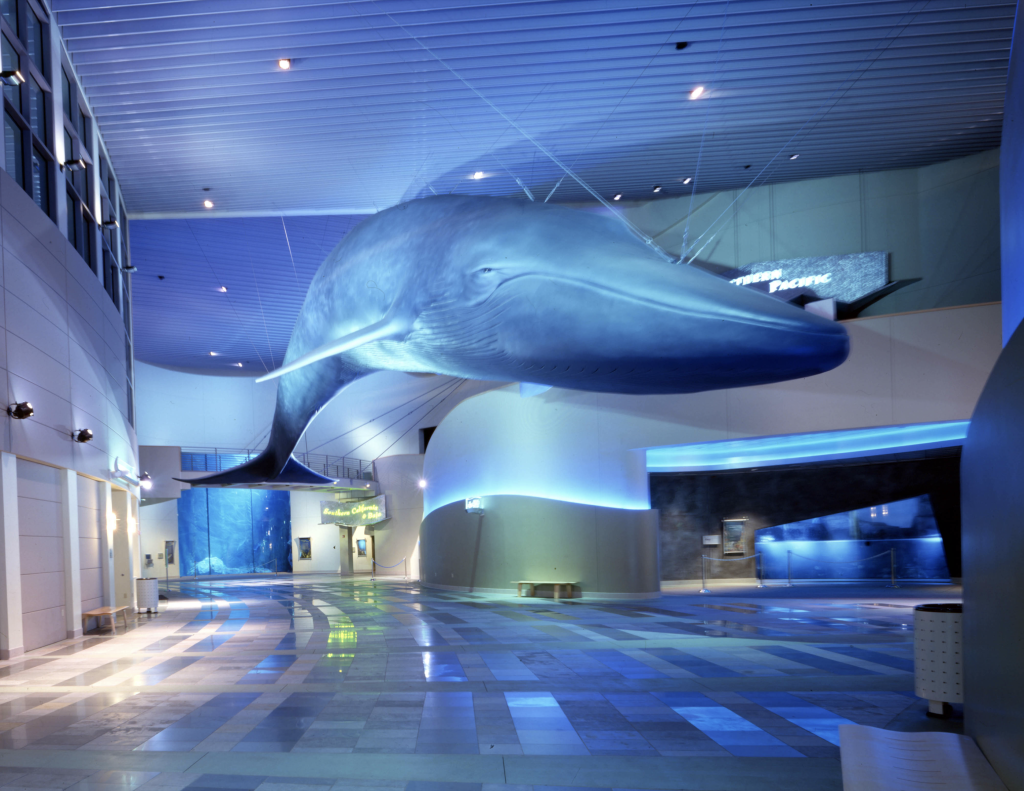
The lighting design approach has two primary objectives: illumination for the visitor experience as well as for animal curatorial needs. While animal habitat owners do an amazing amount of work (mostly unseen by the public) relative to overall animal husbandry and animal needs, it is key that the presentation to the public off ers a visually appealing environment that must work in conjunction with the animals’ needs. The lighting must work with the other dimensional objects—buildings, landscape, habitats, and the animals themselves—to create a memorable, magical, and fun experience using all the tools in the lighting designer’s palette. Most of the lighting for the “dry” side of an animal-featured environment follows lighting design best practices, from the often-iconic lighting of the building exterior (many projects are also major civic or regional features), lobby spaces, and other guest services spaces, but with the signifi cant interface with animal environments.
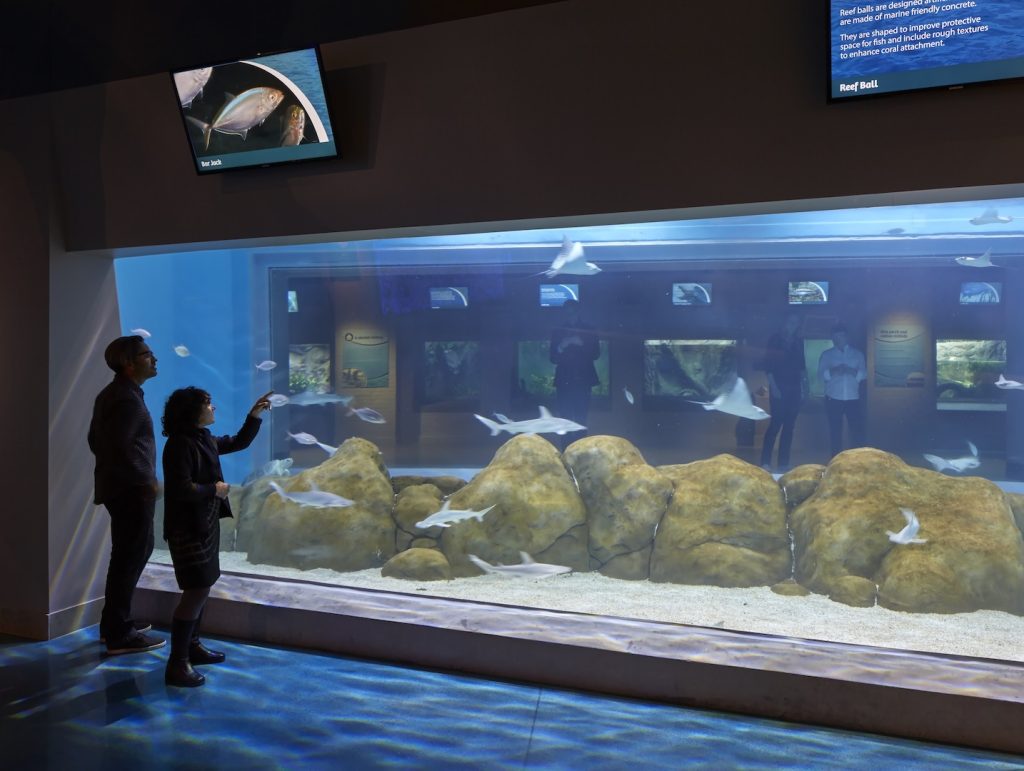
As an example, many animal environments require a physical separator between the guest and animal habitat, usually constructed of acrylic. An upside to acrylic is that it has similar optical properties as water, allowing it to virtually disappear so that the guest is unaware that it could be up to 12 in. (30 centimeters) thick in deep aquarium tanks. The downside to acrylic (as with any reflective surface) is that the lighting levels in the animal space need to be balanced with the lighting levels in the guest space to avoid any reflectance issues that compromise viewing into the animal habitat. This requires close collaboration with both the architectural designer and the dry-exhibit designer to avoid reflectance issues from both architectural elements (including illuminated exit and other signage) and from exhibits in the dry spaces with their own potentially distracting lighting. Modern programmable lighting control systems are also excellent to help create balanced solutions to this challenge.
One example, the Long Beach Aquarium of the Pacific, included an expansive lobby space and featured large windows that viewed outward to the Long Beach harbor, but it had multiple large, featured tanks. The tanks were situated in such a way that the reflective view opposite the primary viewing of each tank was of a neutral or non-competing environment, avoiding competition with the Sun during daylight hours and allowing the internal tank lighting to create iconic features.
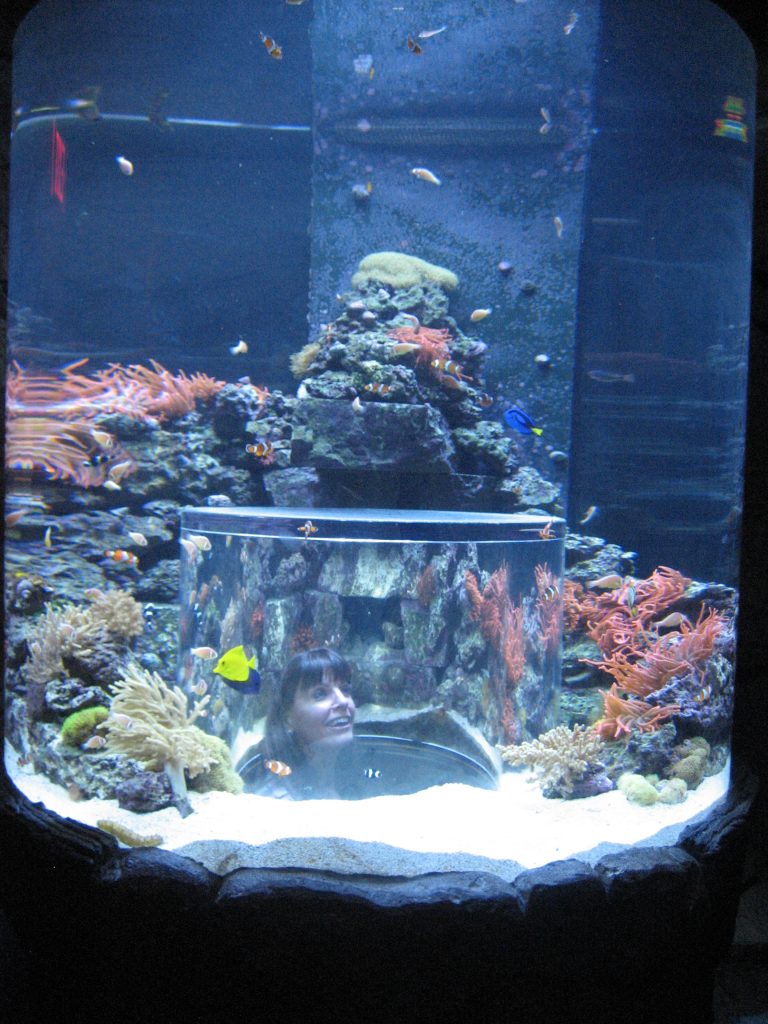
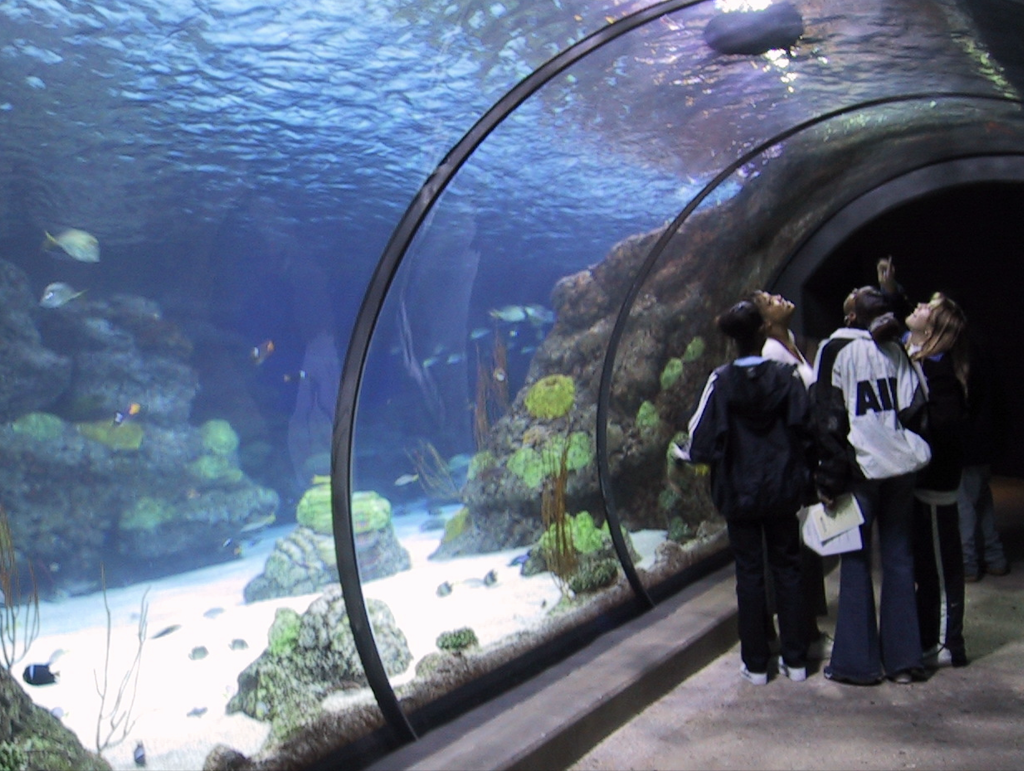
The use of light in and through water requires one special note: while viewing upward into a tank, there is not usually an issue with unsightly guest views of the mechanical area above tanks, although this should be verified with each tank. However, when the view of the tank takes the guest into the tank itself, notably with pop-up domes at the floor of the tank, walk-in vestibules, or (worst case) walkthrough acrylic tunnels, the designer needs to take special care to avoid revealing back-of-house spaces that contain lighting and mechanical equipment. It is necessary to work with the architects and engineers to minimize the clutter and paint everything deep blue or black. In these scenarios, designers should additionally place the lighting so that it has glare shields aimed in a direction that minimizes direct light into the guest viewing areas; designers can also use the bending properties of water to assist with these issues.
Lighting for the Animal Experience
Since experiencing animals is the reason for these projects’ existence, designers have to get this right. Besides the normal project design relationships with architects, engineers, and designers, critical team members with whom designers will need to collaborate include specialty exhibit designers and fabricators, specialty engineers (structural and life support), the lead animal curator, and that curator’s husbandry staff and consultants. Literally every animal has an expert who knows everything about that species.
Most animals have very particular lighting requirements, such as illumination levels (day and night), both visible and nonvisible lighting spectrum needs, circadian rhythm considerations, and other lighting needs specific to individual species. On a project of any size, there will be one or more experts wellversed in those needs. In very general terms, the higher the animal is on the developmental scale, the more critical are the lighting needs, with birds and mammals at the top of the “need” chain. Some of these needs may include the specific requirements of certain wavelengths of light to maximize animal health. A recent example is the penguin habitat of the recently opened SeaWorld facility in Abu Dhabi, UAE. The project team developed new LED light sources to provide both tunable visible lighting as well as UV lighting. The husbandry experts report that the penguins are much healthier, look better, and are breeding more effectively.
Another project, this one at the Desert Biome at California Science Center’s Ecosystems exhibit, involved bats. Bats, being nocturnal mammals who spend daylight hours in dark spaces and hunt/feed using echolocation, are extremely sensitive to visible light. Since a black exhibit is rather boring, the bats were displayed in a very dark cave environment with minimal pathway lighting. The display lighting for the bats themselves was extremely low-level lighting with light filtered to the deep blue portion of the visible spectrum.
Addressing Animal Environments
Artificial lighting for animal environments is, historically, relatively new, corresponding with the development of the electric light source. Prior to that, lighting was either sunlight or rudimentary at best. Let’s take a look at some options.
- Incandescent: While opening opportunities to develop exhibitry presentations, the limitation of incandescent to the warm parts of the lighting spectrum also brought limitations to the animal markets, particularly water environments. Water absorbs the warm spectrum of light first, which can cause a muddy appearance in water environments of any depth.
- Fluorescent: This source adds the ability to reproduce the colder spectrums of light but at the expense of directional lighting for large environments, in particular.
- HID: These provide increased control of lighting at multiple spectrum offerings but at the reduced control of lighting and require large fixtures that are often at odds with space limitations and/or visibility issues.
- LEDs: While LEDs have been around for some time, they have only been commercially viable for about the last decade. The versatility that LEDs bring to the table is exciting, offering a large range of commercially available lighting spectrums (or the ability to custom order for the needs of a project) and the ability to use the project’s control system to program and tune the lighting for particular exhibitry needs or for dramatic or theatrical effects.
- Controls: Different sources, changing timelines, and a variety of animal requirements necessitate a controls system that can handle all these variables. In the past, I have worked with ETC and its Paradigm system to juggle the different parameters—including multiple timelines, astronomical calendaring, plus different power and dimming demands.
Lighting Outdoors at Night
In general, the historical approach to lighting animal environments—in particular, in zoo environments with many large, open enclosures with birds and mammals—the lighting approach is very short: don’t light. At night, most animals are either sleeping or are awake for foraging and hunting. As a result, lighting has historically stayed away from lighting animal environments at night due to concerns about animal needs. But the high degree of guest and visitor interest in viewing animals in their natural state has resulted in a re-evaluation of the possibilities for guest nighttime experiences. This has been made possible (or at least easier and more cost effective) with the parallel development of the tunable LED light source and flexible and programmable project-wide control systems. Among the most effective innovators and users of animal habitat nighttime lighting at a large scale are the Singapore Zoo, Disney’s Animal Kingdom Safari at Walt Disney World, and the proposed New Doha Zoo in Qatar. The last project, one designed by our team, has an extensive drivethrough nighttime safari experience that involves custom low-level pathway illuminance for vehicle guidance (creating interesting questions to ask lighting manufacturers, like “Will your fixture be okay if a rhino steps on it?”) as well as broad washes and focal spot lighting for the free-roaming animals. This involves close collaboration with the exhibit designers and curators regarding the selected animals’ lighting needs.
In summary, lighting for animal environments can be quite a satisfying experience for all concerned if the design team understands that the “all concerned” includes not only your typical guest/visitor to the space but also the special lighting needs of the critters. Modern developments in light sources and control have finally given lighting designers the ability to work with the design and curatorial teams to create environments that are not just pleasant to view but also support the comfort and essential needs of the animals presented.
THE AUTHOR |
Patrick Gallegos is a principal designer at GXU Lighting Design. He has been designing lighting for immersive environments in the themed entertainment, aquarium and zoo, science center, retail, restaurant, hospitality, and commercial architecture markets for more than 40 years.