

Recasting the National World War I Memorial
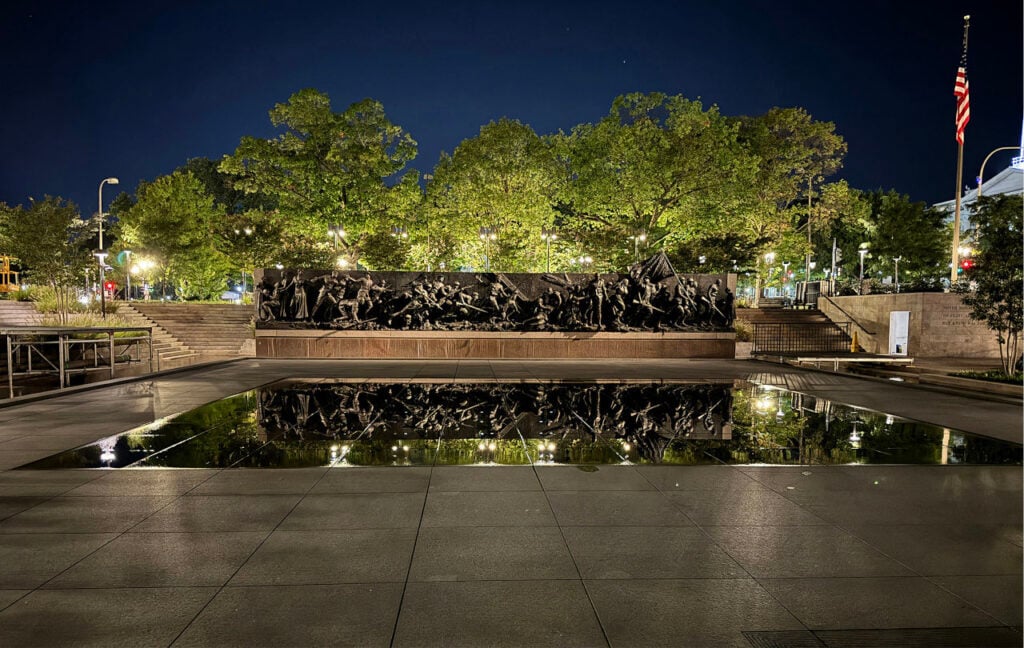
The National World War I (WWI) Memorial in Washington, D.C., is a choreographed experience of light, landscape, and sculpture. The lighting design operates as both guide and storyteller for A Soldier’s Journey, the sculpture at the heart of the memorial. What begins at the bright edges of Pennsylvania Avenue resolves into a quiet, immersive field of low, carefully modeled luminance that evokes reflection, memory, and repose.
The memorial occupies the reimagined Pershing Park, a 2‑acre urban space encircled by the hard brightness of Pennsylvania Avenue and the larger civic expanse of the National Mall. The new WWI Memorial was completed in September 2024, while the original park was dedicated on Armistice/Veterans Day in 1926. The project’s lighting design by Fisher Marantz Stone uses berms, layered light levels, and shielded optics to construct a visual buffer from the city’s glare and create a contemplative interior landscape.
According to Amy Leder, senior associate at Fisher Marantz Stone, “The overall conceptual goal of the memorial is to connect two works of art: the existing Pershing Memorial, which honors U.S. Army General John J. Pershing, and the 58.5‑ft‑long bronze sculptural wall by artist Sabin Howard located at the terminus of a reimagined reflection pool. Titled A Soldier’s Journey, the entire site forms a processional experience with the sculpture wall as the centerpiece.”
Four concentric “rings” of light facilitate the transition from bright city to quiet central memorial. At the perimeter, existing pole fixtures, restored and modernized with LED sources, retain the historic urban character while establishing the brightest zone of the site. As visitors move inward, light levels decrease across planted berms, circulation paths, and the reflecting pool platform, where vertical illumination concentrates on the sculptural wall and Pershing elements, rather than on the ground plane.
The result is a subdued brightness that makes the central memorial feel visually recessed, a sacred cup within the site. Visitors’ eyes are gently pulled away from traffic, signage, and skyline toward the bronze narrative and water’s surface, which together become the focus of the nighttime composition.
Light, Art, and Landscape
A Soldier’s Journey functions as both artwork and luminous anchor for the entire park. The lighting strategy treats the sculpture not as an object to be flooded, but as a cinematic frieze to be read in sequence, using contrast and thoughtful vertical light to express its seven thematic chapters.
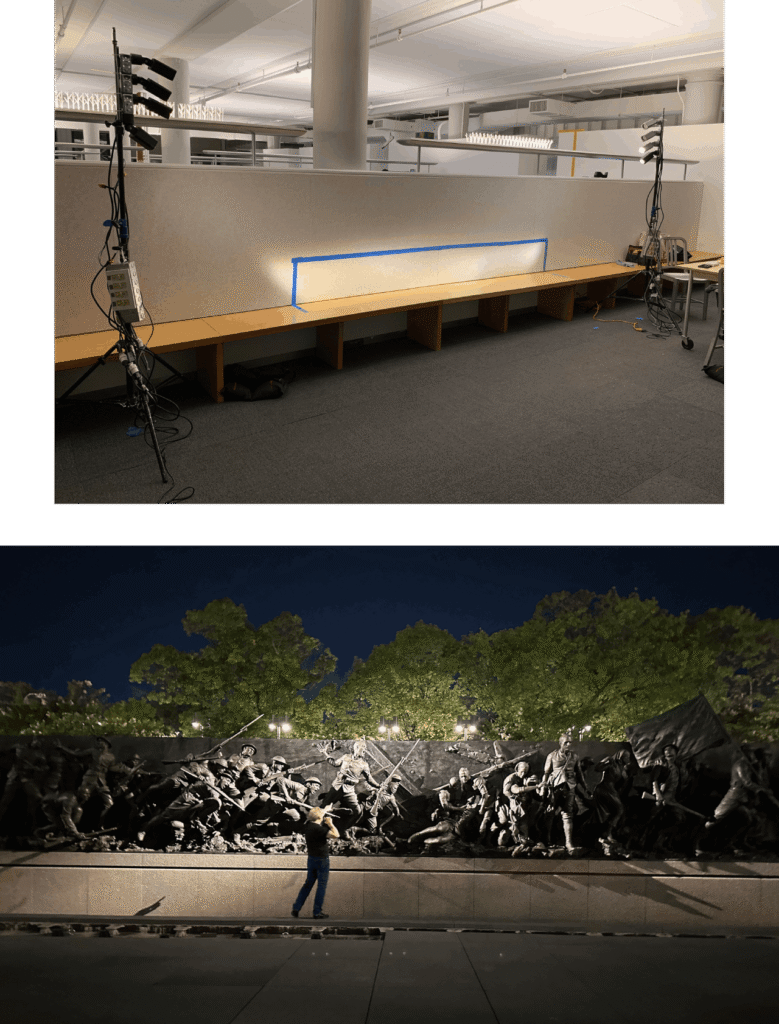
“Ecosense Rise spotlights used at the sculpture and statue were single‑ and multi‑cell floods with varying beam angles for a mix of highlight and washing,” explained Leder. “The narrow‑beam accent fixtures [5 and 10 deg] were used to create contrast and focus on key aspects of the sculptural story, creating dynamic shadows and depth. While the medium [15‑deg] and flood [40‑deg] beams provide soft and balanced lighting across the base and ground. Additional optical accessories were applied while aiming for in‑field adjustability and field control.” Pole lights include Ecosense Rise luminaires on Technilum poles, Systemalux slot round luminaires, and refurbished DDOT standard pole lights.
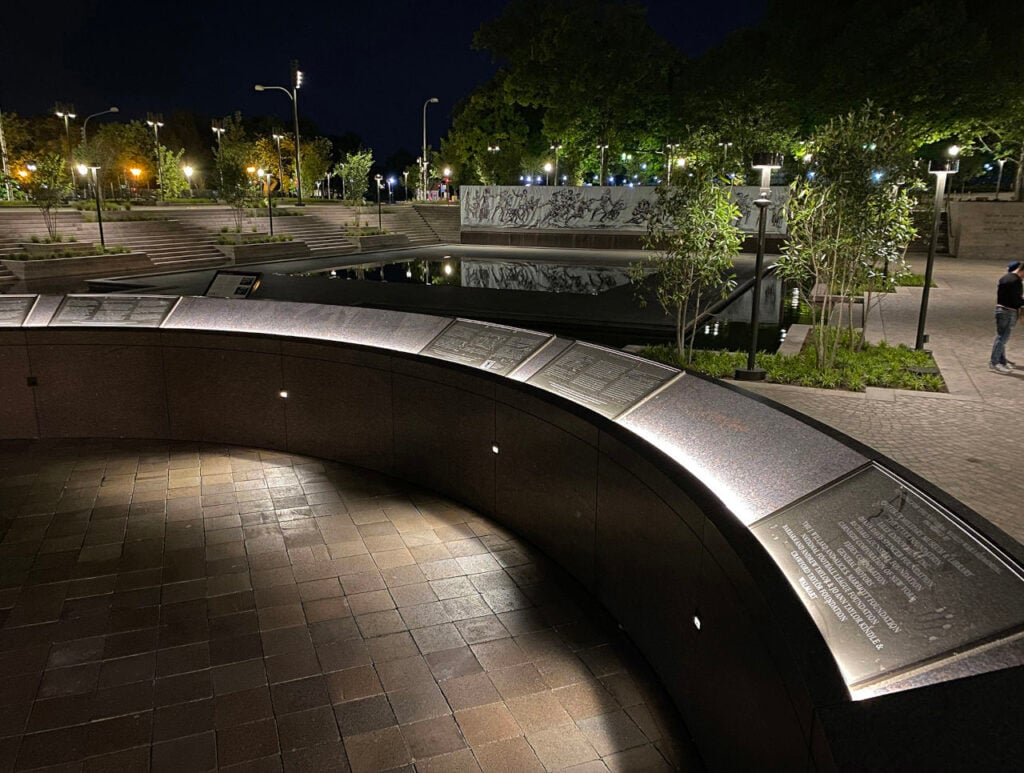
Furthermore, BK Lighting’s Delta Star luminaires uplight the trees, while Vice’s Lightway in‑ground linear grazers wash vertical surfaces. Nearby handrails and benches are edged with low‑brightness concealed lighting (using Luminii’s Kendo bench lights and Kurba Vertical flexible linear striplights) turning them into intuitive wayfinding beacons; their luminous lines register as calm, horizontal cues rather than competing with the sculpture or reflecting pool.
“Throughout the site, lighting for foliage was provided utilizing fully shielded fixtures to keep the visitor focused on key areas, such as information panels and the central fountain,” Leder shared. “Discrete landscape lighting keeps the sources unobtrusive.”
The reflecting pool and the Peace Fountain operate as secondary lenses of light. The pool captures and softens the highlights of the bronze and the sky, transforming the sculptural wall into a doubled, almost dreamlike image, while the fountain’s calibrated luminance reads as a vertical accent in dialogue with the relief and General Pershing’s statue. Hydrel’s 4800 LED SWM were selected for use as submerged fountain uplights. In combination, these elements repurpose the site, which was originally engineered as an ice rink, as a memorial “interior”—a luminous, layered room open to the sky but shielded from the visual noise of the city.
With the memorial visually and symbolically adjacent to the White House, National Mall, and neighboring hotels, the lighting had to negotiate a balance of safety, security, and reverence. Vertical illumination levels along paths and gathering areas are sufficient for comfort and surveillance, yet always subordinate to the sculptural focal points, preventing the site from reading as a simple plaza or event space.
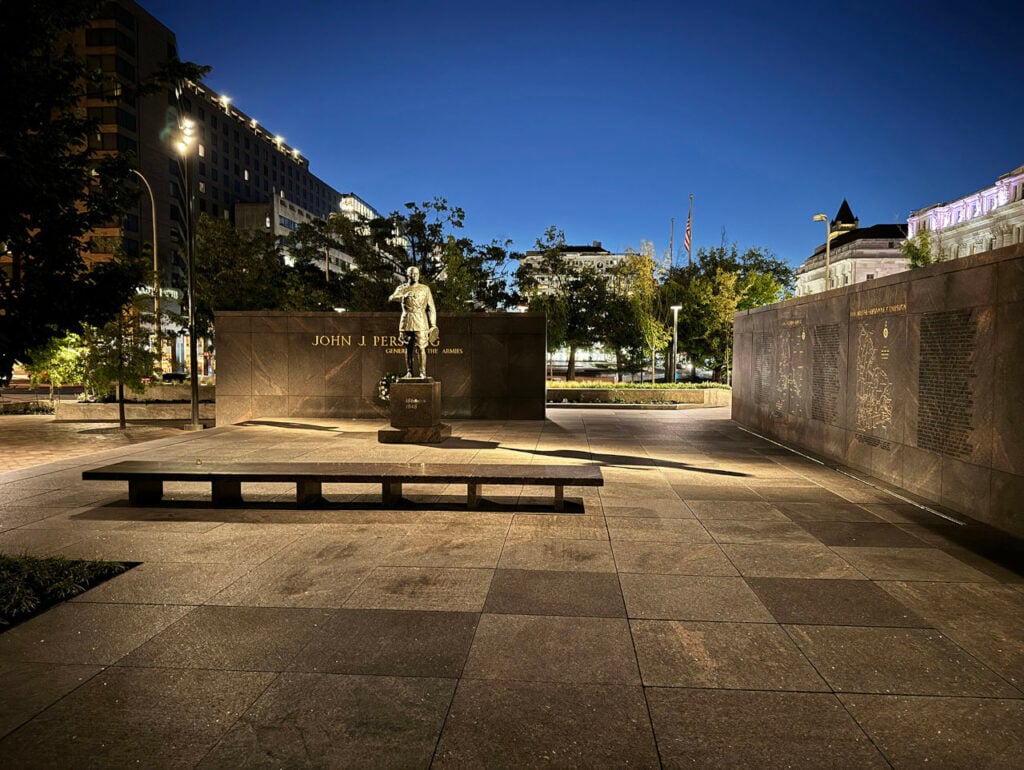
Pole lighting is handled with a preservation‑minded palette. Existing city‑standard luminaires along Pennsylvania Avenue remain as part of the civic streetscape, while selected pedestrian‑scale poles from the earlier park era were refurbished and retrofitted with LED sources. This strategy preserves historic silhouettes and familiar nighttime cues for the avenue, even as the optical systems and distributions are updated for tighter cut‑offs, improved color, and reduced energy use. The memorial utilizes 1.96 watts per sq ft and complies with ASHRAE/IES 90.1‑2013.
By minimizing pole count, consolidating functions into multi‑tasking luminaires, and integrating equipment into walls, railings, and planting edges, the design avoids clutter and the visual “noise” of hardware. The park reads as a continuous, coherent field of space in which light appears as an inherent property of surfaces, water, and bronze.
Sewed Into an Urban Fabric
Translating the conceptual lighting narrative required careful re‑mapping of infrastructure. Pole locations demanded detailed surveying to avoid conflicts with existing subsurface structures and to satisfy structural requirements in a heavily layered urban ground plane. Every light pole placement became a negotiation among sight lines, sculpture viewing angles, tree canopies, and the technical reach of conduit and drainage.
The long, linear sculptural wall amplified alignment sensitivities: small shifts in luminaire position or beam angle could dramatically affect grazing, create hot spots, or introduce unwanted reflections on the water surface. On‑site aiming sessions, paired with the use of adjustable accessories, were essential to refine gradients of light and shadow and to ensure that the narrative reads coherently from multiple vantage points—from the primary viewing platform, the processional paths, and even the higher hotel windows looking down into the park.
Small Family, Big Results
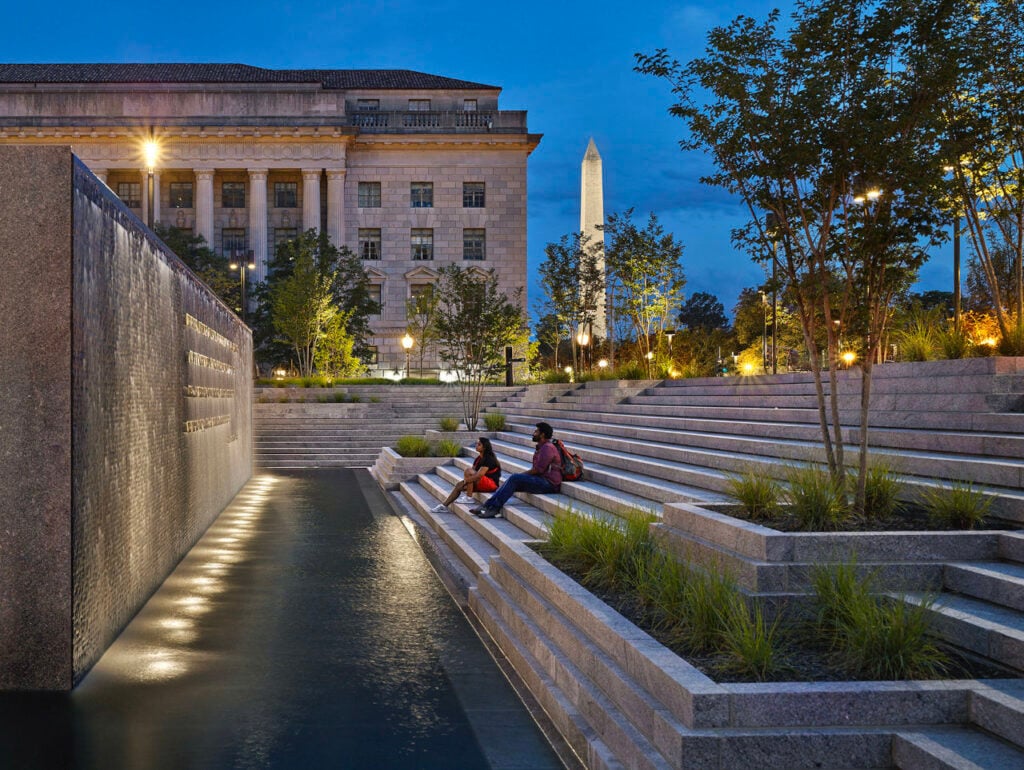
The memorial’s lighting techniques are deliberately focused rather than encyclopedic, leveraging a small family of highly tunable luminaires and accessories to achieve a wide range of effects. Lucifer’s Stealth step lights provide small, low‑brightness wayfinding, integrated into the Belvedere’s curved viewing platform wall, featuring panels that honor the 4.7 million Americans who served in WWI. Optical accessories—louvering, snoots, and field‑adjustment tools—are integral to the design and allow in‑field tuning of beam edges, spill control, and precise cutoffs to prevent glare in the park, the adjacent hotel windows, and the broader city surrounds. Multiple control zones mapped to the seven thematic segments of the relief enable curators to subtly rebalance emphasis over time, adapting the narrative presentation for ceremonies, commemorations, or evolving interpretive needs.
Across the site, all fixtures are low wattage and fully shielded wherever possible, chosen not only for optical precision but also for environmental performance—limiting skyglow, reducing energy use, and respecting nocturnal ecosystems in and around the urban tree canopy. Additionally, Lutron’s Quantum systems control the overall lighting design for the Memorial. The cumulative effect is a site that feels visually rich and complex yet operates with a light, efficient footprint.
At nightfall, the memorial draws visitors away from the city and into a quieter frame of mind. Light gives ground to shadow, reflection to stillness, as A Soldier’s Journey emerges from darkness rather than spectacle. Set against the glow of the nation’s capital, the memorial reveals itself slowly—less an object to behold than a place to pause, remember, and reflect.
The Designers
- Amy E. Leder, Member IES, is senior associate at Fisher Marantz Stone
- Charles Stone, Member IES, is founder of Fisher Marantz Stone.
- Zack Zanolli, Member IES, is associate principal at Fisher Marantz Stone.
The Author
David Shiller is a business development and marketing consultant to the lighting industry, as well as the publisher of LightNOW, an online lighting industry trade publication. He is a 25‑year veteran of the lighting industry and co‑chair of the American Lighting Association Engineering Committee.