





Authors
- Renske Lok PhD, Stanford University, USA
- Manuel Spitschan PhD, Technical University of Munich & Max Planck Institute for Biological Cybernetics, Germany
- Laura Kervezee PhD, Leiden University Medical Center, The Netherlands
- Elise McGlashan PhD, The University of Melbourne, Australia
- Raymond P. Najjar PhD, National University of Singapore, Singapore
Key take-aways and practice points
- Light exposure influences humans physiology and behaviour, including (but not limited to) circadian rhythms, hormone production and sleep.
- Laboratory studies enable characterizing which aspects of light (intensity, spectral composition, spatial patterns, …) drive these ‘non-visual’ responses.
- Thus far, there have been no agreed-upon standards for reporting light parameters in studies or clinical trials using ocular light interventions.
- The ENLIGHT Checklist, with its Explanation & Elaboration (E&E) document, provides a simple method for documenting and reporting light parameters in laboratory studies, thereby future-proofing the scientific literature and facilitating evidence syntheses.
The impact of light on human health and well-being
Over the last few decades, research on the non-visual effects of light on human physiology and behaviour has gained significant traction. Through a pathway connecting the eye to the hypothalamus in the brain, originating in the melanopsin-containing intrinsically photosensitive retinal ganglion cells (ipRGCs), light suppresses the production of melatonin, shifts the circadian clock, and modulates our alertness. Of course, light exposure can be parametrized in many ways, including the intensity, spectrum, wavelength, timing and spatial configuration. These parameters can be modulated in laboratory studies with human participants to not only identify the effectiveness of specific manipulations of light, but also uncover mechanisms.
The need for standardized reporting
With a growing number of studies performed and the growing demand to synthesize evidence for developing guidelines and practical recommendations, there is a need to provide common ways of characterizing, measuring and reporting light interventions. Until now, there has been no consensus in reporting light characteristics across studies, which can hamper reproducibility and complicates direct comparisons between findings, limiting the ability to conduct meta-analyses. Since laboratory studies are resource-intensive endeavors often spanning months to years, improved reporting represents a key step forward, streamlining methodologies, supporting reproducibility, and advancing the field. One way to enhance reporting in biomedical research is by creating reporting checklists via consensus processes that engage extensive groups of experts. The ENLIGHT (Expert Network on LIGHT Interventions) Checklist, published in eBioMedicine (PDF), delivers exactly this.
The ENLIGHT Checklist
The ENLIGHT Checklist was developed through a four-step Delphi process and subsequent validation, producing a fillable PDF and accompanying Explanation and Elaboration (E&E) document). The Delphi process consisted of three online questionnaire-based feedback rounds, one face-to-face group discussion, and a pilot-testing phase to determine which items should be included in the survey, to specify their preferred reporting format, and to reach consensus on which items are deemed essential to report. In the face-to-face sessions, participants were able to discuss or raise any unresolved questions, and we explored the dissemination and impact of the checklist and E&E document. Subsequent independent pilot testing and validation demonstrated the checklist’s usability and clarity and resulted in minor adjustments.
A preliminary list of items (61 items) was reduced through the rounds resulting in a final checklist comprising 25 items, achieved through consensus among experts (final n=60). Nine items were identified as essential for reporting, irrespective of the research question or context. The E&E document provides detailed descriptions for each item.
In brief, the ENLIGHT Checklist is organized by the following subheadings: Protocol-level characteristics, measurement-level characteristics, participant-level characteristics, light sources, light level characteristics, colour characteristics, and temporal and spatial characteristics. The following table (from Spitschan et al., 2023, Table 2) lists all included items. The ENLIGHT Checklist, with its Explanation & Elaboration (E&E) document, is provided as fillable PDF files.
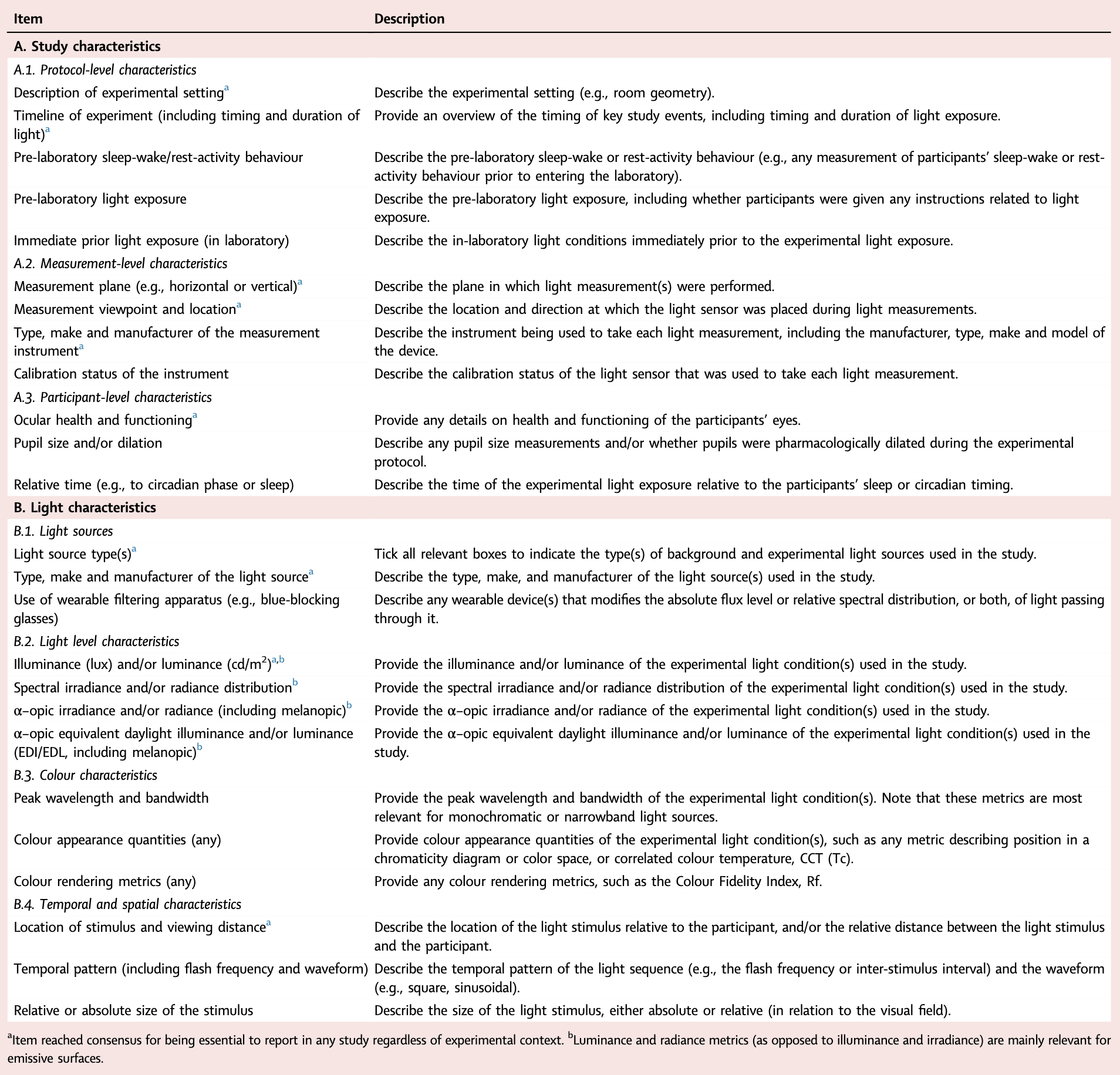
The ENLIGHT Checklist is the first consensus-driven tool for documenting and reporting light-based interventions in biomedical studies in the laboratory (with extensions for field studies currently being planned). Developed with experts and prospective users, it provides an accessible resource. Even minimal light exposure can have significant effects, and variations in delivery, intensity, or spectral composition can lead to differing responses, highlighting the need for standardized reporting. This checklist aims to enhance reproducibility, enable direct study comparisons, and support meta-analyses and evidence synthesis.
Endorsement from scientific associations and funders
Since the publication of the ENLIGHT Checklist, it has been independently endorsed by numerous scientific societies and organizations, including the Society for Research on Biological Rhythms, the Sleep Research Society, the Society for Light Treatment and Biological Rhythms, the Australasian Chronobiology Society, the Center for Environmental Therapeutics, and the Circadian Mental Health Network. It has also been endorsed by the VELUX Stiftung, a major funder of research on light interventions, who have included the ENLIGHT Checklist as a requirement of the submission process for relevant proposals.
We are confident that the ENLIGHT checklist can facilitate the development of a robust and reproducible evidence base on the non-visual effects of light, grounded in systematic reporting.
References
Spitschan, M., Kervezee, L., Lok, R., McGlashan, E., Najjar, R. P., & Consortium, E. (2023). ENLIGHT: A consensus checklist for reporting laboratory-based studies on the non-visual effects of light in humans. EBioMedicine, 98, 104889. https://doi.org/10.1016/j.ebiom.2023.104889
ENLIGHT Checklist website: https://enlight-statement.org/