
Circadian lighting in offices is increasingly defined by vertical melanopic targets such as 250 melanopic equivalent daylight illuminance (m-EDI), yet consistent implementation remains constrained by competing visual, spatial, and energy requirements.
This article presents a simplified analytical framework linking horizontal illuminance (Eh), spatial distribution expressed as the ratio of vertical illuminance at the eye to horizontal illuminance (Ev/Eh), and spectral effectiveness (m-DER) to evaluate feasibility under typical office conditions. When considered alongside IES RP-1 illuminance guidance and common energy performance thresholds, these variables define a limited design space in which circadian, visual, and efficiency requirements must be satisfied simultaneously.
The analysis shows that limits on Ev/Eh and Eh increase reliance on spectral performance. However, improving melanopic effectiveness introduces trade-offs with luminous efficacy, further restricting viable solutions.
Rather than maximizing any single parameter, feasible circadian lighting solutions emerge from balancing spectral, spatial, and energy considerations. This framework provides lighting professionals with a practical basis for interpreting design trade-offs and identifying solutions that remain viable within real-world constraints.
Why circadian lighting remains challenging to implement
Interest in circadian lighting has grown across office and educational projects, yet consistent implementation remains limited.
In offices, daytime circadian lighting is increasingly guided by vertical melanopic targets such as 250 melanopic equivalent daylight illuminance (m-EDI) at the eye, as referenced in WELL Building Standard L03. At the same time, conventional lighting practice follows IES RP-1, which recommends horizontal illuminance (Eh) in the range of 300–500 lux. Energy performance is further shaped by programs such as DLC Technical Requirements V6.0, which establish minimum luminaire efficacy thresholds.
“Circadian lighting is not limited by a lack of interest—it is constrained by the need to satisfy multiple competing requirements simultaneously.”
Individually, these targets are achievable. Together, they often are not.
Designers encounter trade-offs: increasing vertical illuminance often requires wider light distributions that can introduce glare. Raising horizontal illuminance is constrained by RP-1 limits, while improving melanopic effectiveness through spectral adjustment can reduce luminous efficacy.
This article presents a simplified way to understand how these constraints interact—and what that means for design.
A simple framework: three variables that must align
At a practical level, melanopic stimulus at the eye depends on three variables:
- Horizontal illuminance (Eh)
- Spatial distribution (Ev/Eh)
- Spectral effectiveness (m-DER)
These three variables form a coupled system: if one is limited, the others must compensate. This relationship can be expressed as:
\Large m\text{-}EDI = Eh \times (Ev/Eh) \times m\text{-}DERThis defines the relationship between three quantities that are each constrained in practice: horizontal illuminance (Eh), spatial distribution (Ev/Eh), and spectral effectiveness (m-DER).
To evaluate feasibility, it is useful to define a demand ratio, k, representing the ratio of melanopic to horizontal illuminance:
\Large k = \dfrac{m\text{-}EDI}{E_h}For a target of 250 m-EDI:
- At 500 lux, k=0.5
- At 300 lux, k=0.83
These values define the minimum combined requirement that must be met through spatial distribution (Ev/Eh) and spectral effectiveness (m-DER). Higher values of k indicate greater reliance on Ev/Eh and m-DER.
Feasibility boundaries for achieving 250 m-EDI
Figure 1 combines the relationships between horizontal illuminance (Eh), spatial distribution (Ev/Eh), and spectral effectiveness (m-DER) into a single map of feasibility.
- The lower curve (500 lx) defines the minimum combination required at the upper RP-1
limit - The upper curve (300 lx) defines the requirement at the lower RP-1 limit
- The horizontal line (Ev/Eh ≈ 0.6) represents a practical upper limit associated with glare,
comfort, and optical efficiency
Together, these boundaries define a limited region where circadian, visual, and energy requirements can be satisfied. This feasible region is highlighted in pink in Figure 1.
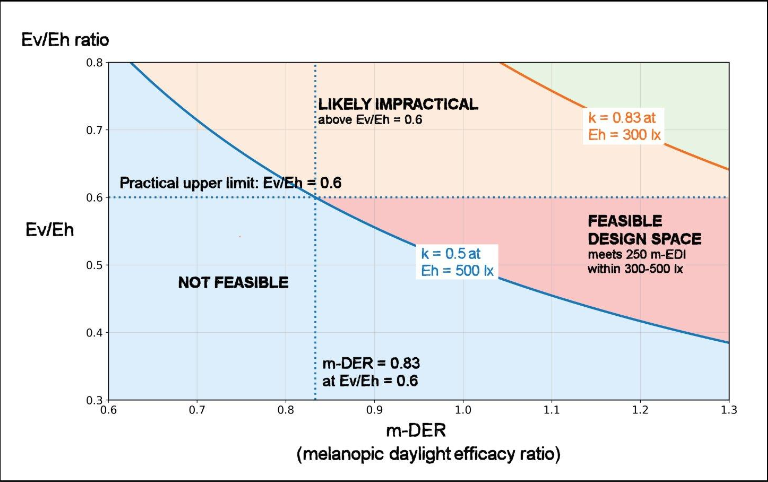
levels (300–500 lx). The curves define the minimum combinations of Ev/Eh and m-DER at 300 lx
and 500 lx, while the horizontal line indicates a practical upper limit for Ev/Eh. The feasible
region lies between these boundaries.
The spatial constraint: Ev/Eh is limited in practice
A common strategy to improve circadian stimulus is to increase vertical illuminance at the eye by widening light distribution, effectively increasing Ev/Eh.
However, Ev/Eh is constrained in practice by:
- glare and visual comfort
- luminaire optics and shielding
- ceiling-based lighting geometry
- optical efficiency losses
While IES RP-1 does not define vertical-to-horizontal ratios, practical office lighting designed for visual comfort inherently limits how far Ev/Eh can be increased. The practical upper limit of Ev/Eh ≈ 0.6 reflects constraints related to glare, visual comfort, and optical efficiency. Higher values tend to increase high-angle luminance and associated glare risk, as discussed in prior studies (Clear, 2013) [1].
Guidance from The Lighting Handbook [2] characterizes visual modelling using the cylindrical-to-horizontal illuminance ratio (Ez/Eh), with values of approximately 0.3–0.6 associated with acceptable facial modelling and visual balance. Although Ez is not identical to Ev, this range provides a practical reference for typical interior environments.
This value is also consistent with circadian lighting guidance [3], which similarly employs an Ev/Eh ratio of approximately 0.6 as a practical reference condition.
The spectral constraint: m-DER becomes critical
Once spatial distribution is bounded, spectral effectiveness becomes the primary adjustable variable.
Figure 1 shows that when Ev/Eh is limited to ~0.6, achieving 250 m-EDI at 500 lx (k = 0.5) requires:
\Large m\text{-}DER = \dfrac{0.5}{0.6} \approx 0.83This threshold exceeds what many conventional LED spectra provide. As a result, typical ~450 nm blue-pump designs often struggle to meet circadian targets within standard office constraints—even when distribution is optimized.
It also highlights a limitation of common design proxies:
- CCT and CRI describe visual appearance
- m-DER directly reflects melanopic effectiveness
The energy constraint: efficacy still governs feasibility
Circadian performance must also meet energy requirements. Increasing circadian-effective light—through higher illuminance, broader distribution, or spectral adjustment—tends to increase energy demand, bringing designs into conflict with efficiency constraints.
Energy codes limit lighting power density (LPD, e.g., ASHRAE 90.1), while DLC sets minimum luminaire efficacy. A design may comply with LPD yet still fail if efficacy is insufficient to deliver the required illuminance within the available power budget.
Projects are typically expected to meet energy code limits—such as those defined by ASHRAE 90.1 (typically ~0.6–0.8 W/ft² for office environments)—while delivering both visual and circadian performance.
Under DLC Technical Requirements V6.0, typical troffer luminaires must achieve at least 120 lm/W at the luminaire level. Accounting for typical optical losses (≈20–30%, which can increase with wider distributions) and driver losses (≈8–12%), this corresponds to an approximate LED package efficacy threshold of ~170 lm/W associated with typical energy constraints.
This introduces a second constraint: improving melanopic effectiveness can reduce luminous efficacy. Viable designs must therefore satisfy both melanopic and energy requirements.
What typical LED approaches reveal
With spatial distribution (Ev/Eh) and horizontal illuminance constrained by typical office conditions, spectral design becomes the primary remaining lever for achieving circadian targets. However, increasing melanopic effectiveness through spectral adjustment introduces an inherent trade-off with luminous efficacy.
Across typical office lighting ranges (≈4000–6500 K), melanopic effectiveness depends on both spectrum and CCT. While higher CCTs can increase melanopic effectiveness, they are less commonly used in offices due to visual preference and comfort.
Within this range, 5000 K serves as a practical reference for comparing spectral effects.
At a consistent 5000 K CCT, different blue-pump strategies produce distinct outcomes—differences that determine whether a design falls inside or outside the feasible region (highlighted in pink in Figure 1).
- ~450 nm blue-pump LEDs
Typical implementations provide m-DER ≈ 0.7–0.75, often insufficient to meet melanopic targets within typical office constraints. For example, at Ev/Eh ≈ 0.6 and m-DER ≈ 0.75, achieving 250 m-EDI would require horizontal illuminance of approximately 566 lx—exceeding the upper limit of RP-1. - ~480 nm blue-pump LEDs
Shifting the blue-pump peak toward ≈480 nm can increase melanopic effectiveness, with m-DER approaching or exceeding 1.0. However, this shift typically reduces luminous efficacy. In practice, even high-performance implementations at around 5000 K often achieve ~160 lm/W under representative conditions, which may fall below the ~170 lm/W threshold associated with typical energy constraints. - ~465 nm intermediate designs
An experimentally characterized ~465 nm blue-pump LED demonstrates m-DER ≈ 0.9 while maintaining package efficacy on the order of ~180 lm/W under representative conditions. This combination can enable designs to remain within typical energy constraints while achieving the melanopic performance required for feasible solutions.
While not yet widely available in commercial luminaires, this spectral class demonstrates that the required combination of m-DER and efficacy is technically achievable within current LED technology.
These representative examples illustrate the trade-offs between melanopic effectiveness and luminous efficacy associated with different spectral strategies. Table 1 summarizes these trends.
Table 1. Representative trends associated with different blue-pump spectral approaches at approximately 5000 K.
| Blue-pump | Approx. m-DER trend | Typical efficacy trend | Practical implication |
|---|---|---|---|
| ~450 nm | Lower | Higher | May struggle to satisfy melanopic targets |
| ~465 nm | Intermediate | Intermediate | Potential balance between melanopic performance and energy requirements |
| ~480 nm | Higher | Lower | May encounter efficacy limitations |
What this means for lighting designers
This framework leads to several practical takeaways:
- Increasing illuminance is not a complete solution
Raising Eh alone may exceed RP-1 recommendations without meeting circadian targets. - Higher Ev/Eh comes with trade-offs
Improved vertical illumination often introduces glare and reduces efficiency. - Spectrum should be evaluated using m-DER
m-DER provides a clearer measure than CCT or CRI. - Energy constraints must be considered early
Designs that meet melanopic targets but fail efficacy thresholds are not viable. - Expect interdependence
Spectrum, distribution, and efficiency are strongly interdependent.
A bounded design space
Figure 1 illustrates that feasible circadian lighting solutions occupy a limited region defined by:
- WELL L03 (melanopic target)
- IES RP-1 (300–500 lux range)
- DLC V6.0 (energy performance)
Outside this region, designs are either unable to meet the melanopic target or require conditions unlikely to be acceptable in typical office environments.
Circadian lighting is not about maximizing a single parameter—it is about balancing multiple constraints.
Conclusion
Circadian lighting in offices is defined by the interaction of spectral effectiveness, spatial
distribution, and energy performance. Practical limits on Ev/Eh and horizontal illuminance constrain design freedom, increasing reliance on spectral performance—yet spectral optimization introduces energy trade-offs.
Feasible circadian lighting is not achieved by maximizing any single parameter—it emerges only within a narrow region where spectral, spatial, and energy constraints are simultaneously satisfied under typical office conditions.
References
- Clear R.D. (2013). Discomfort glare: What do we actually know?. Lighting Research and Technology. 45. 141-158. 10.1177/1477153512444527.
- Zumtobel Group. The Lighting Handbook. 6th ed., Dornbirn, Austria, 2018.
- Light and Health Research Center. Lighting for Health and Energy Savings in K-12 Classrooms – Guidance Document.
- Illuminating Engineering Society (IES). ANSI/IES RP-1-20: Lighting for Offices. New York, NY, 2020.
- International WELL Building Institute. WELL Building Standard v2 – Feature L03: Circadian Lighting Design.
- DesignLights Consortium (DLC). Technical Requirements V6.0.
- ASHRAE. ANSI/ASHRAE/IES Standard 90.1: Energy Standard for Buildings Except Low-Rise Residential Buildings.