Light for Life® Virtual Symposium: Controls
Crafting adaptive, energy-efficient and visually engaging spaces
Overview
Join us on May 21st for Light For Life®: Security, a one-day virtual symposium focused on the latest research and trends in lighting for security and reassurance, hosted by the IES. Presentations curated to cover:
- Nuances in vocabulary for light at night: safety, security, and reassurance
- Lighting for visibility: designing for contrast and mitigating glare
- Considerations for public safety, property, and liability
- Improved methods for exterior illuminance measurements
Attendees who join us live will receive a copy of IES G-1-22 Guide for Security Lighting for People, Property, and Critical Infrastructure included in registration. They will also receive complimentary access to the online recording approximately 2 weeks following the live event.
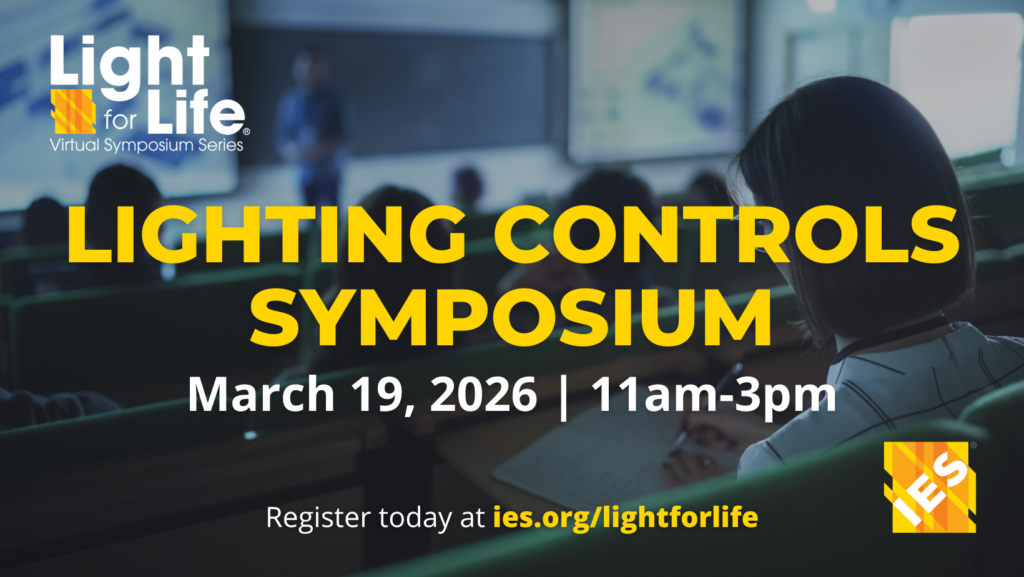
Join us on Thursday, March 19, 2026 for Light For Life®: Controls, a one-day virtual symposium exploring how lighting control strategies shape spaces that are adaptive, energy-efficient, and visually engaging. Participants will receive four (4) IES continuing education credits (CEUs).
Presentations curated to cover:
1. Smarter controls, connected systems, and data‑driven automation
2. AI in next-generation lighting controls
3. Advancing sequences of operations and design intent narratives
4. Incorporating wireless controls
5. Integration across devices and protocols
Registration Fees
Live Event
$99
$199
Are you an IES student member? Contact IES today for a code to register at no cost! Contact: Dan Ozminkowski, dozminkowski@ies.org
Sponsored By

Sponsors TBD
Speakers







Sponsors
Supporters
Agenda
Introduction and Welcome
Lighting Controls: Crystal Balls, Emerging Opportunities, Practical Actions
Pontificating future trends, embracing new functionality, and supporting practical use, we’ll rapid fire on lighting controls faster than a dimmer at a disco. In this quick download and dive, the IES Lighting Control Systems Committee peers into the “crystal ball” – where smarter controls, connected systems, and data‑driven automation are shifting how we design and operate spaces with lighting controls. We’ll make the future of lighting controls feel less mysterious and map out the path to applicable practicality amidst an evolving lighting and controls landscape.
Speaker
Lighting Controls in 2026
As LED lighting maximizes efficacy, lighting controls have been a primary focus for increased energy savings. Occupancy sensing in interior applications and for outdoor street and area lighting promise significant savings, if installed. Adoption of lighting controls however has been slower than projected.
Artificial Intelligence can simplify adaptation to user patterns and adapt to human preferences and health benefits. AI also can minimize the time designers spend on individually controlling, addressing, scheduling, and specifying each luminaire. It can control charge times for renewables adjusting to demand response rates. How quickly we learn to successfully integrate AI into our projects is largely dependent on lighting control and software manufacturers. What can we look forward to, and when will lighting controls achieve their potential? Attend this session to learn more about the future of lighting controls.
Wireless Lighting Controls: From Design to Implementation
Wireless technologies are reshaping the lighting industry at a critical moment. By streamlining installation, reducing first costs, improving energy performance, and simplifying maintenance through integrated sensors and minimized electrical and data infrastructure, wireless controls are rapidly becoming the norm. As adoption grows, a new design challenge emerges: clearly and effectively documenting these systems within construction documents. Drawing on seven years of hands-on experience across libraries, office buildings, and large healthcare facilities nationwide, this presentation shares practical lessons learned—while looking ahead to how wireless lighting forms the foundation for broader smart building technology integration, including RTLS, voice-enabled platforms like Alexa, patient user interfaces, and other connected systems that enable truly intelligent environments.
Questioning Claims of Simplicity in Lighting Controls
The lighting controls industry is experiencing a clear shift: owners, designers, contractors, and operators are demanding simpler networked lighting control systems. But “simple” means different things to different stakeholders, with a risk that oversimplification can be provided with unforeseen limitations and lifecycle costs. This session explores what simplicity actually means in modern network lighting controls. We’ll examine simplicity across different lighting control systems and distinguish between ones that are merely easy to implement versus those that are easy to use. Attendees will gain a practical framework for evaluating simplicity and where it is most important.
Break
Navigating the Time–Complexity Dilemma in Lighting Controls
As lighting controls become more advanced, energy codes and new capabilities are driving increased complexity—making it harder for project teams to design, specify, and verify systems that perform as intended. This session explores the “complexity dilemma” and the “time dilemma” facing designers and specifiers, and highlights best practices that improve outcomes, including the Control Intent Narrative (CIN) and Sequence of Operations (SOO) as defined in IES LP-16. The presentation introduces Design Express, a free set of Microsoft Excel–based CIN/SOO templates organized by building type and pre-populated to align with 2024 International Energy Conservation Code (IECC) lighting control requirements. Attendees will learn how these templates streamline documentation, improve coordination, generate more complete specifications, and support consistent implementation across common space types.
Are Smart Homes Dumb?
Homeowners have more options than ever for lighting control, but the common light switch is still the gold standard for ease of operation. At the high end of the market, whole-home automation and lighting control delivers beautiful aesthetics but too often leaves the homeowners dissatisfied with the experience. At the low end, a lack of ease and interoperability relegates intelligent lighting to the tech savvy. Are we going in the right direction? How might the lighting industry be perfectly positioned to fix the headaches and capitalize on the opportunity?
Speaker
Closing Remarks
End of Day
Agenda
Introduction and Welcome
Lighting Controls: Crystal Balls, Emerging Opportunities, Practical Actions
Pontificating future trends, embracing new functionality, and supporting practical use, we’ll rapid fire on lighting controls faster than a dimmer at a disco. In this quick download and dive, the IES Lighting Control Systems Committee peers into the “crystal ball” – where smarter controls, connected systems, and data‑driven automation are shifting how we design and operate spaces with lighting controls. We’ll make the future of lighting controls feel less mysterious and map out the path to applicable practicality amidst an evolving lighting and controls landscape.
Speaker
Lighting Controls in 2026
As LED lighting maximizes efficacy, lighting controls have been a primary focus for increased energy savings. Occupancy sensing in interior applications and for outdoor street and area lighting promise significant savings, if installed. Adoption of lighting controls however has been slower than projected.
Artificial Intelligence can simplify adaptation to user patterns and adapt to human preferences and health benefits. AI also can minimize the time designers spend on individually controlling, addressing, scheduling, and specifying each luminaire. It can control charge times for renewables adjusting to demand response rates. How quickly we learn to successfully integrate AI into our projects is largely dependent on lighting control and software manufacturers. What can we look forward to, and when will lighting controls achieve their potential? Attend this session to learn more about the future of lighting controls.
Wireless Lighting Controls: From Design to Implementation
Wireless technologies are reshaping the lighting industry at a critical moment. By streamlining installation, reducing first costs, improving energy performance, and simplifying maintenance through integrated sensors and minimized electrical and data infrastructure, wireless controls are rapidly becoming the norm. As adoption grows, a new design challenge emerges: clearly and effectively documenting these systems within construction documents. Drawing on seven years of hands-on experience across libraries, office buildings, and large healthcare facilities nationwide, this presentation shares practical lessons learned—while looking ahead to how wireless lighting forms the foundation for broader smart building technology integration, including RTLS, voice-enabled platforms like Alexa, patient user interfaces, and other connected systems that enable truly intelligent environments.
Questioning Claims of Simplicity in Lighting Controls
The lighting controls industry is experiencing a clear shift: owners, designers, contractors, and operators are demanding simpler networked lighting control systems. But “simple” means different things to different stakeholders, with a risk that oversimplification can be provided with unforeseen limitations and lifecycle costs. This session explores what simplicity actually means in modern network lighting controls. We’ll examine simplicity across different lighting control systems and distinguish between ones that are merely easy to implement versus those that are easy to use. Attendees will gain a practical framework for evaluating simplicity and where it is most important.
Break
Navigating the Time–Complexity Dilemma in Lighting Controls
As lighting controls become more advanced, energy codes and new capabilities are driving increased complexity—making it harder for project teams to design, specify, and verify systems that perform as intended. This session explores the “complexity dilemma” and the “time dilemma” facing designers and specifiers, and highlights best practices that improve outcomes, including the Control Intent Narrative (CIN) and Sequence of Operations (SOO) as defined in IES LP-16. The presentation introduces Design Express, a free set of Microsoft Excel–based CIN/SOO templates organized by building type and pre-populated to align with 2024 International Energy Conservation Code (IECC) lighting control requirements. Attendees will learn how these templates streamline documentation, improve coordination, generate more complete specifications, and support consistent implementation across common space types.
Are Smart Homes Dumb?
Homeowners have more options than ever for lighting control, but the common light switch is still the gold standard for ease of operation. At the high end of the market, whole-home automation and lighting control delivers beautiful aesthetics but too often leaves the homeowners dissatisfied with the experience. At the low end, a lack of ease and interoperability relegates intelligent lighting to the tech savvy. Are we going in the right direction? How might the lighting industry be perfectly positioned to fix the headaches and capitalize on the opportunity?