

Light justice explores how lighting has a profound social impact, particularly for the people who are most vulnerable and have little or no agency over their environments or how those environments are designed. Light Justice Symposiums bring together thought leaders in academia, design, research, practice, and lived experience to examine how lighting affects health, dignity, safety, and equity in both the public realm and interior environments.
Our exploration of lighting for incarcerated people reflects an ethos that good design should serve everyone, not only those with the means or agency to demand it. Incarcerated people have little or no control over their environments, which are shaped primarily by the requirements of custody, security, and separation. Exploring more humane lighting for these spaces challenges us to consider how light and beneficial darkness can support dignity, health, and recovery even under significant constraints. What we learn can extend beyond incarceration, helping us design more just environments for anyone whose circumstances limit their agency over the spaces they inhabit.
Coinciding with the final review of BSR/IES RP-49: Lighting Jails and Lockups, Light Justice held a symposium on November 4, 2026 that focused on spaces of incarceration—including prisons, jails, detention facilities, inpatient mental-health facilities, and other institutional environments where security is often the dominant design priority. (A complete recording of the symposium is available at www.ies.org.) Here, lighting is frequently reduced to two basic requirements: sufficient visibility for surveillance, and durable, tamper-resistant fixtures that cannot be accessed, damaged, or used for self-harm. These requirements matter for safety, but they do not constitute good lighting design.
These conditions are not accidents of oversight; they are inherited from a design philosophy that uses light deliberately as a form of punishment. In the U.S., that philosophy was born in Philadelphia with the 1829 opening of Eastern State Penitentiary, pioneering the Pennsylvania System of solitary confinement intended to produce reflection through isolation. Instead of windows, each cell had a single skylight, historically called the “Eye of God”: light engineered not to connect the resident with the outside world but to remind them they were always being surveilled.
This legacy did not stay in the past. Constant illumination remains standard practice in solitary confinement units nationwide and has been the subject of ongoing legal battles under the Eighth Amendment’s prohibition of cruel and unusual punishment. The only legal requirement is 20 footcandles, with no specification of day and night conditions or separation between sleeping areas and dayrooms. Two centuries after the Eye of God, light in American prisons is still used as a means of control. A core part of this symposium is to shift that use of light from supervision to rehabilitation, especially through beneficial darkness.
From Surveillance to Rehabilitation
When lighting is designed primarily around security and durability, the visual, biological, and psychological needs of people living and working there are overlooked. Constant illumination, glare, limited daylight, and the absence of meaningful darkness or individual control can disrupt circadian rhythms, increase stress, and contribute to sensory dysregulation—particularly for incarcerated populations, who carry disproportionately high rates of prior trauma, and for correctional staff working in these same spaces.
Carceral design has barely evolved from punishment toward rehabilitation, reflecting a broader view that these spaces exist to remove people from society and strip their autonomy—leaving them spaces of erasure. Researchers call this “affirmative design”: architecture that quietly reinforces existing norms because that is what a building is already expected to look like. This symposium’s conversations across disciplines explored the biases behind incarceration and asked how these spaces can be designed to be more humane.
Trauma-informed design, as architecture rather than clinical practice, is far more recent than the buildings it seeks to correct. Trauma-informed care existed for years as a staff training framework before architecture entered the picture. That shift began in 2017, when UK prison reform efforts first extended trauma-informed principles into the built environment, starting with women’s facilities, whose populations carry disproportionately high rates of prior trauma. Plans for a new Scottish women’s prison called for curved corridors, windows without bars, and resident control over lighting and heating, though it was never built. Norway offered an earlier example: Halden Prison, opened in 2010, built natural daylight and unbarred windows into its design as features of rehabilitation. We are still in the early years of bringing this thinking to American facilities, but the direction is set.
Designing for Dignity and Agency
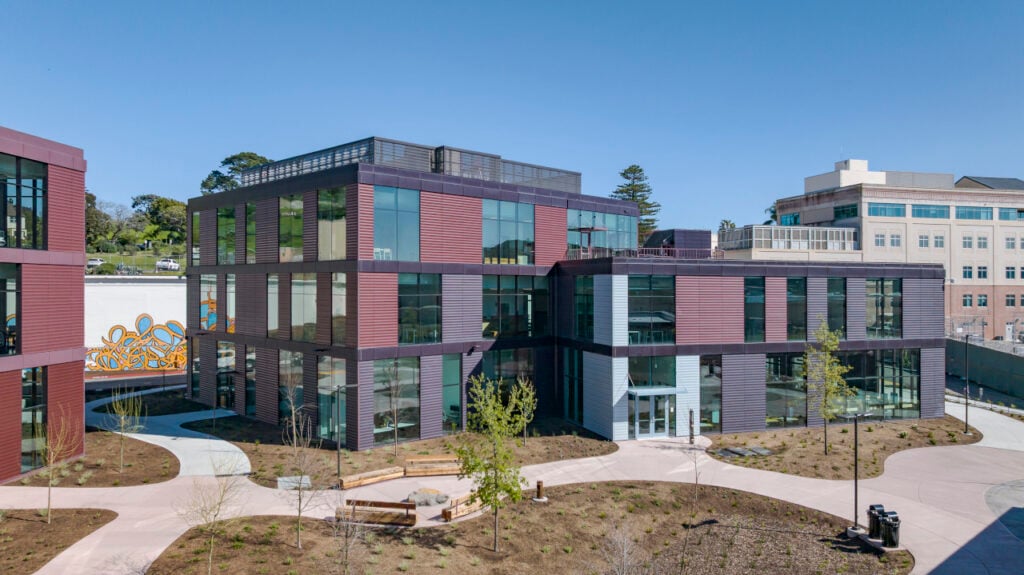
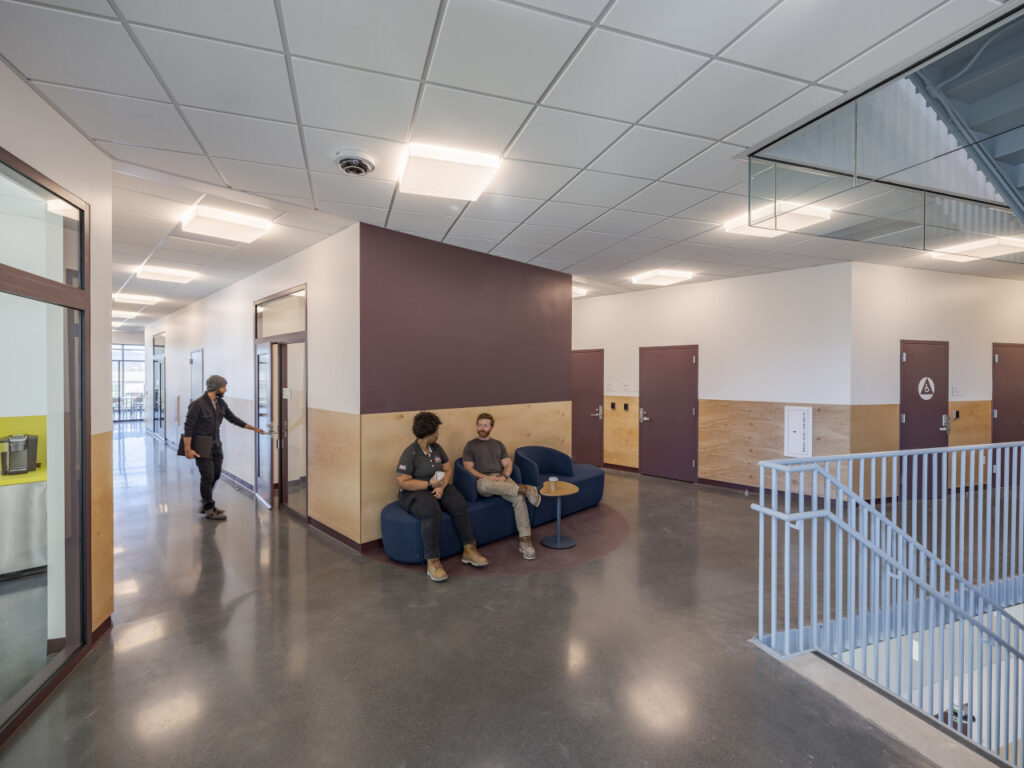
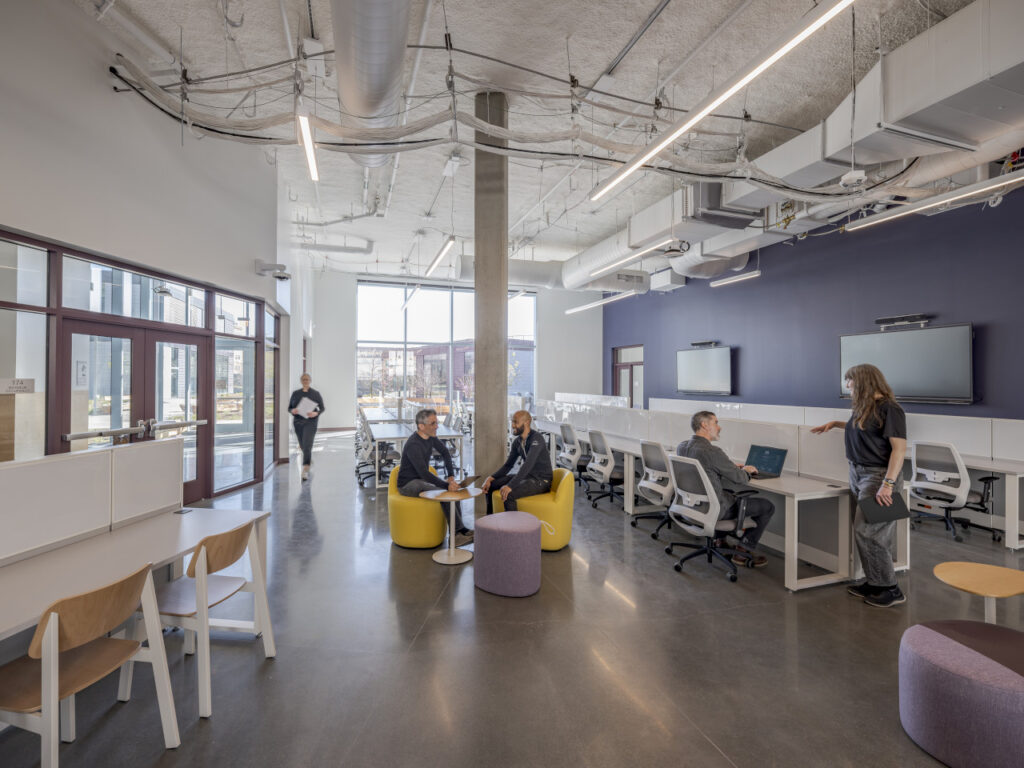
New models are emerging across the country, introducing designs previously seen only in Europe. One example is the San Quentin Learning Center, the first implementation of a systemwide shift toward a normative model of custody grounded in trauma-informed design. The project was delivered by a progressive design-build team consisting of DLR Group, architect of record; Schmidt Hammer Lassen, lead designer; and McCarthy Building Companies. It expands rehabilitation services, education, and job training within a design that connects residents to nature through native plantings and reclaimed-wood seating areas—proof that trauma-informed design is a buildable reality, even in an adult men’s facility. What separates Eastern State Penitentiary from the San Quentin Learning Center is not centuries of technological advancement, but a choice about how these spaces are used.
Beyond new design methods, designers can shape the language and standards that guide these environments. Until recently, there was no dedicated guidance for lighting spaces of incarceration—only a small, unreviewed section of the 10th Edition IES Handbook that most designers never knew existed. As a Member of the IES Security Committee, Richard Muthama helped close that gap by developing the first Recommended Practice specifically addressing spaces of incarceration, advocating for more humane lighting solutions in jails, prisons, and similar facilities. A Recommended Practice, however, is guidance rather than requirement—it carries no enforcement power on its own. One goal worth pursuing is partnering with the American Correctional Association to explore folding these recommendations into the ACA Guidelines used to accredit prisons, which would give them real teeth.
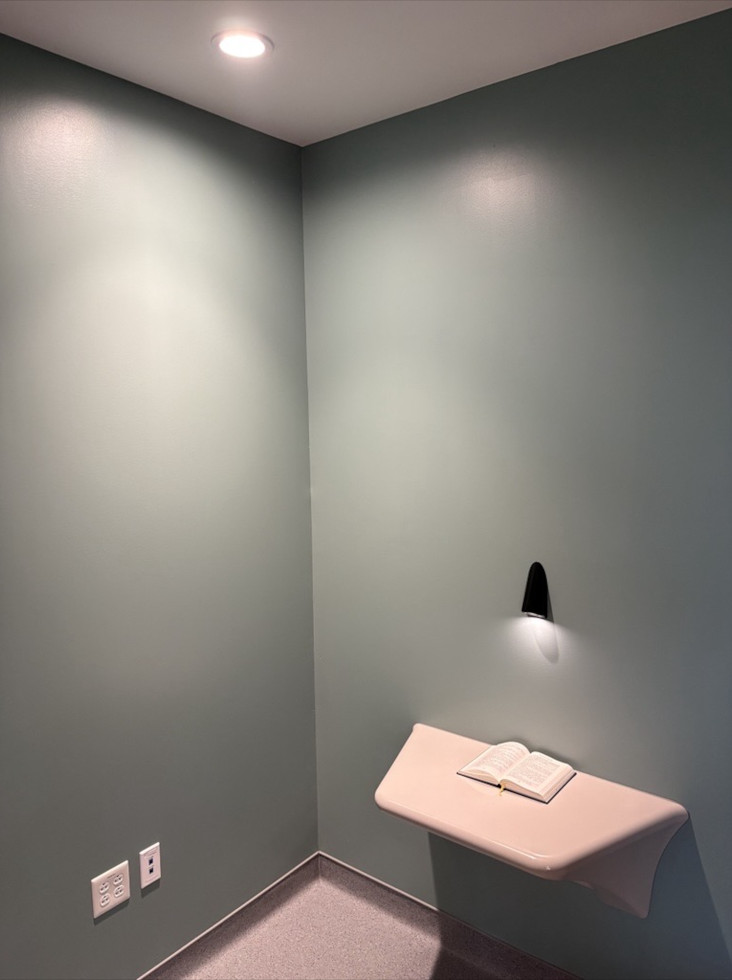
Manufacturers sit at the center of this shift, since durability requirements have long shaped what “institutional” is allowed to look like. Correctional luminaires must meet demanding standards—sealed construction, impact and vibration resistance, ligature resistance—and that durability has traditionally meant fixtures are large, bulky, and unmistakably institutional. Pa-Co Lighting, a Canadian manufacturer, is closing that gap, moving toward warmer color temperatures, dim-to-warm technology, and a reduction in visual scale with compact downlights, slim linear fixtures, and task lights closer to residential than institutional design.
Visa Lighting has approached the same challenge from the angle of control, developing tamper-resistant push-button switch plates that give residents a direct hand in adjusting their own lighting rather than leaving every setting fixed by staff or timer. It is a small piece of hardware carrying real weight: autonomy over one’s own light was precisely what HMP Inverclyde’s unbuilt design called for, and exactly what this symposium’s language of choice and individual control asks facilities to restore. A switch plate will not undo the loss of agency built into custody, but it is a concrete example of returning a measure of it to the person living in the room.
Through a Light Justice and trauma-informed design framework, this symposium asked a different question: How can lighting meet legitimate requirements for safety and supervision while also supporting health, dignity, recovery, and rehabilitation? Bringing together facility staff, formerly incarcerated people, researchers, and experts in humane carceral design, daylighting, and electric lighting, the symposium explored how choice, predictability, sensory regulation, and beneficial darkness can transform lighting from an instrument of surveillance and control into a resource that supports restorative, humane environments of care and custody.
THE AUTHORS
Richard Muthama is a lighting designer with a background spanning architectural and specification lighting design as well as an IES Security Committee Member.
Edward Bartholomew, Member IES, IALD, LEED AP, is co-founder and executive director of Light Justice and an award-winning lighting designer with 35 years of experience as principal of Bartholomew Lighting.