
When lighting practitioners think of lighting controls, they often think of commercial building energy codes and the mandatory minimum requirements. As these requirements have evolved over the years, so has lighting control system design, shifting the bar for what lighting controls can and should do at a minimum.
For example, where bi-level switching might have been sufficient in the past to provide a cost-effective minimum level of flexibility for users, now continuous dimming is increasingly required with the advent of LED dimming drivers offered at no premium. While open-office lighting once relied on a simple time-sweep with manual override, many of today’s energy codes require granular control, zoning, and sophisticated operating sequences. Control is moving from the room to the luminaire, creating an intelligent, networked platform for advanced programming, optimization, and enterprise-level data insights.
Such advances have redefined what a minimally satisfactory lighting control system should accomplish and, in doing so, have fostered industry familiarity with lighting control systems once considered sophisticated. What might have been considered highly complex and mysterious a decade ago simply isn’t anymore. It’s from this base of familiarity that lighting practitioners can explore ways to go beyond code to deliver added value and become more competitive, while also thinking beyond energy to deliver new capabilities and benefits to building operators and occupants.
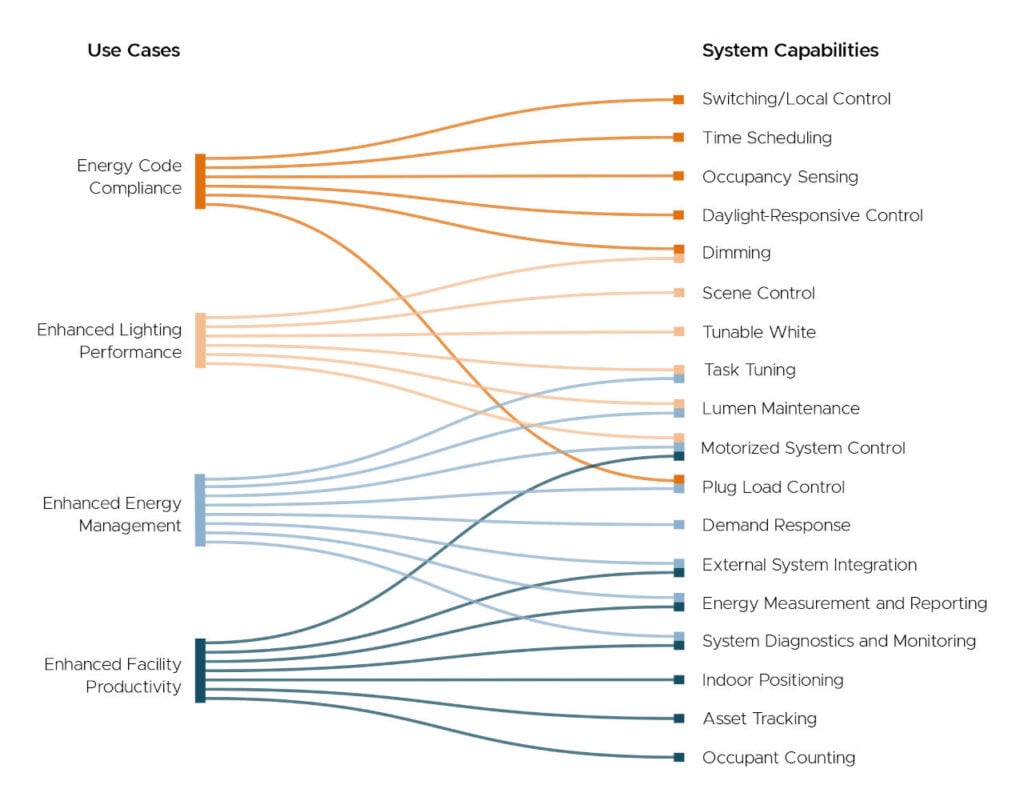
A practical first step is to begin with the three primary benefits lighting controls deliver: visual needs, energy management, and facilities management. Then ask: How can we put “enhanced” in front of each of these benefits?
1. Visual needs: It’s well known that lighting controls can adjust both lighting intensity (dimming) and the color or shade of white light (color tuning) to support vision, comfort, space appearance, mood, and energy savings.
- Control empowerment: Giving users control over their own lighting—whether through personal or group task tuning—can increase workplace satisfaction, a fundamental element of comfort, productivity, and worker retention. People are not one-size-fits-all, so why should they have one-size-fits-all lighting? Control empowers them to select the light levels most appropriate for them while also mitigating glare in the space, which can be enhanced even further with integrated automatic window shading.
- High-end trim: This concept of tailoring applies at the institutional level, establishing a maximum light output for each space based on its actual IES-recommended task light levels. This can save significant energy while individualizing light levels. High-end trim can be equally effective in mitigating glare and skyglow in outdoor lighting systems.
- White-light tuning: LED technology offers dynamic adjustment of the light source color or the shade of white light. This extraordinary tool enables lighting practitioners to use color to visually transform spaces for different functions, enhance occupant comfort, and implement circadian-friendly lighting strategies. In schools, for example, tunable-white lighting can be used to signal activity transitions and promote desired behaviors such as calming, focus, or attention.
2. Energy management: Commercial building energy codes cover this facet of lighting control well. At the forward edge, the latest codes and standards cover automatic receptacle control, a natural extension of lighting control systems, and are starting to address demand response in more detail.
In 2025, commercial building electricity costs increased by an average of 6%, and wholesale electricity prices are projected to increase by an even higher percentage in 2026. As costs escalate largely due to the proliferation of new data centers and cryptocurrency expansion, building owners can turn to advanced networked lighting controls to reduce energy costs and risk. This includes luminaire-level lighting control, task tuning, lumen maintenance dimming, energy data measurement and reporting, as well as integration with HVAC systems. These contributions can add up to significant energy savings that are likely to continue growing in value.
3. Facilities management: Now we come to what might be the biggest opportunity to think beyond energy codes—the ability of centralized networked lighting control systems to generate occupancy and other data for analytics. AI may be giving this value proposition a new life.
By centralizing the lighting control system, all sensor and energy data is fed to a server or the Cloud for analysis. Measuring and monitoring enable highly detailed information on energy and space use, automated system responses, and automated maintenance alerts. Occupancy data can be used to optimize space utilization. By adding Bluetooth nodes to luminaires, we also gain the potential for indoor positioning services such as asset tracking.
This was the promise of the IoT, a potential trend in which lighting hardware and networked lighting control were positioned at its forefront. The trend never materialized to mass adoption, however—not because the concept or technology didn’t work, but because it produced data without decisions. Many owners weren’t sure how to turn all that dashboard data into productive outcomes. Others, fearing the lighting systems they were installing might miss the boat and become obsolete, installed luminaires that were “IoT-ready” but ultimately unused for an IoT purpose at any real scale.
The emergence of large-scale AI fundamentally changes that equation. The value proposition is no longer sensors to data to human analysis to decision and action. With AI, sensors can produce data that an algorithm analyzes in context, then AI either makes a decision or takes action directly. For example, instead of reporting raw occupancy data producing a graphic, the system says: “Conference Room 2 is unused 60% of the time.” Or: “The accounting team now arrives 45 minutes later than six months ago; HVAC schedules should be adjusted.” This shift may appear simple, but it’s profound.
Now take the situation further: the AI is part of the lighting controller’s intelligence and is able to adjust light levels or send alarms for reactive or predictive maintenance; another step further, and the AI acts as an autonomous or semi-autonomous system, utilizing an agent instead of a dashboard. A facility manager can ask “Why was my energy bill 15% higher this month?” or “What would be the impact on conference room utilization if we converted the small conference room on the third floor into a private office?” and will get a detailed answer with actionable suggestions that go beyond charts.
What’s The Worth?
In 2023, the Design Lights Consortium (DLC) produced a report by Skumatz Economic Research Associates, Inc. that identified non-energy benefits of networked lighting controls and developed a methodology for quantifying them. The study estimated that the non-energy benefits can deliver a return on investment more than double than for the energy savings alone. Additionally, a net increase in self-reported productivity of nearly 8% was estimated for each occupant in workspaces where networked controls were operating.
Three years later, the potential for IoT benefits realized through networked lighting controls remains; only now, with advances in AI, the ability to harness data from lighting controls and other building systems and turn it into real-time, actionable strategies is steadily developing. If realized, the resulting value may tower over any potential energy savings.
How We Get There
Energy codes have taken commercial buildings to an extraordinary level of energy efficiency. For lighting controls, they’ve established a baseline of familiarity with sophisticated control strategies and designs. After demonstrating expertise with this foundation, lighting practitioners should engage client stakeholders and ask questions such as, “Are you interested in going beyond the energy code to minimize energy costs? How important is it for building systems to optimize occupant comfort and satisfaction? Would you be able to sell more merchandise or have more productive workers if your lights could adjust the color temperature of the white light? What problems could you solve if you had actionable data about occupancy?”
As always, the key is for lighting practitioners to educate themselves about how to use advanced lighting controls to solve these problems, understand the growing importance of integration and become knowledgeable about it, and keep their ears to the ground for big changes that may be coming in the AI revolution.
Gary Meshberg, LC, CLCP, LEED-AP, Member IES, regional sales manager, Central USA for Casambi, is chair of the Lighting Controls Academy, a coalition of the National Electrical Manufacturers Association (www.LightingControlsAcademy.org).