
Weaving remembrance, culture, and community into the fabric of New Orleans
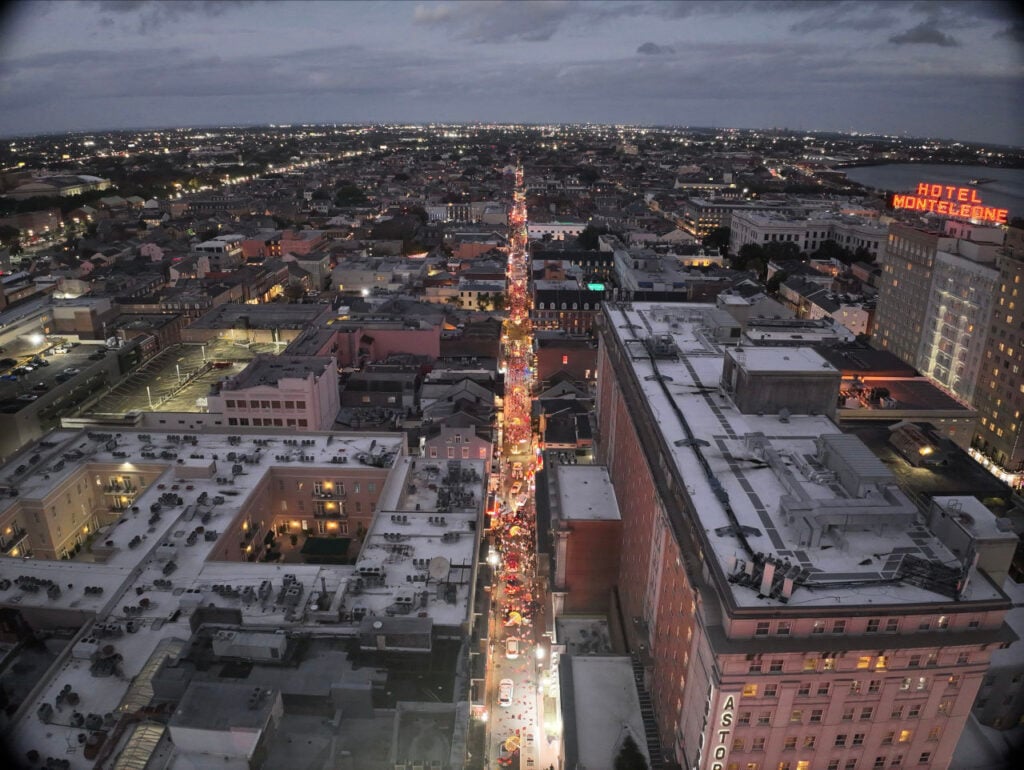
New Orleans. The Big Easy. A city known for its music, cuisine, and, of course, Mardi Gras. The delta region relishes its connection to the Mississippi River, the Gulf Coast, and its multicultural past. But a few hours after midnight on New Year’s Day 2025, the Crescent City became the site of a domestic terrorist attack, when an individual drove his pickup truck into a crowd on Bourbon Street and started a shootout with police in the French Quarter. It was the worst attack of its kind in U.S. history, resulting in the deaths of 15 people, including the perpetrator, and injuries to dozens more. The city hadn’t hurt this much since Hurricane Katrina in 2005.
Enter Katy Casbarian, who lives above Arnaud’s Restaurant on Bourbon Street’s 200 block. She had been there when the attack occurred and later reached out to Jennie West, principal and founder of Studio West Design, with an idea: to honor the victims with light installations, but she didn’t know how to accomplish it.
“We sat in a room and brainstormed and gave her a budget for what we felt was reasonable for the lighting,” recalled West. “We did this [based on] some hand sketches and a couple of renderings for her over two weeks in the spring of 2025.”
Weeks later, Casbarian called back saying she had raised the money through private and nonprofit contributions. However, West still wasn’t quite sure how it would work with the city. “We just started rocking and rolling with ideas and what was possible, and what we could get here, and what the limitations were,” West said. “It was very much a collaborative project in which we thought the vision was so incredible that we [decided] we’ll figure out a way to make it happen.
Second Line in the Sky
The vision became Second Line in the Sky, reflecting the très New Orleans tradition of a community-led procession that follows family members and funeral mourners with musicians, countering the dirge of a first line with the honor and joy of the second line. The remembrance project comprised nearly a thousand double-sided prayer flags suspended across 21 buildings, covering a 36,000-sq-ft area across multiple blocks. A programmable DMX-controlled color-hanging globe lighting system, developed alongside electrical and lighting solutions provider Curtis Stout New Orleans, resulted in a total of 12 strings and 1,248 MaxiGlobe RGBW units across the three blocks. Controlled by Lumentender Control Solutions LT-1Box power and controls enclosures, six DMX universes, and a wireless block-to-block sync, the display encouraged visitors to pause and reflect on the lives affected by the attack. The flags shared photographs, messages, testimonies, and family memories. In addition, illuminated trumpets, handkerchiefs, and umbrellas festooned the installation, helping to transform loss into hope and shift mourning into beauty. The illuminated sculptures that created the glowing canopy were embedded with miniLED strings comprising three color temperatures—warm, neutral, and cool—with each miniLED programmed to twinkle and chase outward from the trumpet bells in flattened conical bursts, evoking music breaking out of the brass.
The programmable controls were selected “to create dynamic lighting sequences, including five-minute shows on the quarter hour and 10-minute shows on the hour,” explained West. She added that the systems were integrated within the historic urban fabric to maximize atmosphere, visibility, and public engagement, while minimizing visual disruption to surrounding architecture.
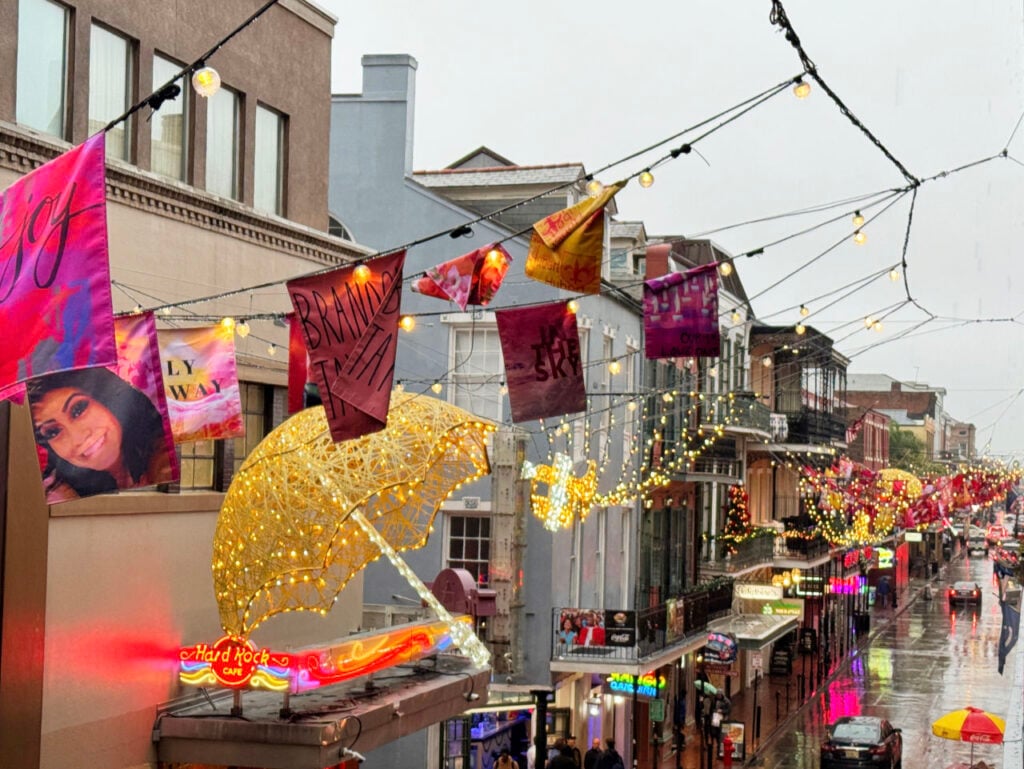
Communication was key. West explained that once her team had the vision of the display, they conveyed it to their partners within the city, including the Vieux Carre and Historic District Landmarks commissions, to determine what permits were needed and what might be restricted. For instance, the city was not permitting its light poles to be used, and power sources had to be selected from among businesses for each of the three blocks over which the flags would hang.
Studio West led the creative direction and technical coordination of the project, working with three artists—Babette Beaullieu, Margaret Crosby, Jan Gilbert—who designed the pink, red, and purple flags by working with the families to incorporate personality and infuse life into the memorial. According to West, the families had not met before the display was developed. “When we came in and presented the plans and said, ‘We’re not asking you for any money, we just want to do it and have your participation,’ I think they were a little floored by it,” she recalled. “It was incredibly meaningful for them.”
While it was crucial to have the plan and the permissions, the installation had to be completed in only two weeks and before Thanksgiving, with the governor coming to town for the ribbon cutting. “We hired police details to close the streets [and] worked in lifts with the electrical contractor,” West recalled.
A series of anchors had been set into walls of 21 buildings before the installation window. “That was challenging, because we had to pre-map the path,” she said. “Again, we had everything on drawings, but you get out there and you discover, ‘Oh, this brick’s really soft…let’s move this over here’. Once they got the first series up, it became a lot easier.”
The memorial was unveiled during a public lighting ceremony on December 1, 2025, and remained until mid-January. “The reaction from the public was the best part. It demonstrated the power of what lighting can do in a public space and that you don’t have to access it on a private property,” West said. “It created a space where people could honor what happened but also celebrate in a way.”
Woven Into the City’s Fabric
While Casbarian was crucial to sparking Second Line, that project also evolved out of Studio West Design’s past efforts to enhance the Crescent City including Light Up Lafayette Street in 2025 and the French Doors Master Plan project in 2024. In the months leading up to Super Bowl LIX at Caesars Superdome, the firm partnered with the Downtown Development District (DDD) and Greater New Orleans, Inc. to assess how to improve lighting and safety on the 100 block, which includes Bourbon, Chartres, Dauphine, Decatur, and Royal streets—those that are closest to the Mississippi River. The two projects had similar goals: Make the tourist experience in New Orleans safer and more enjoyable.
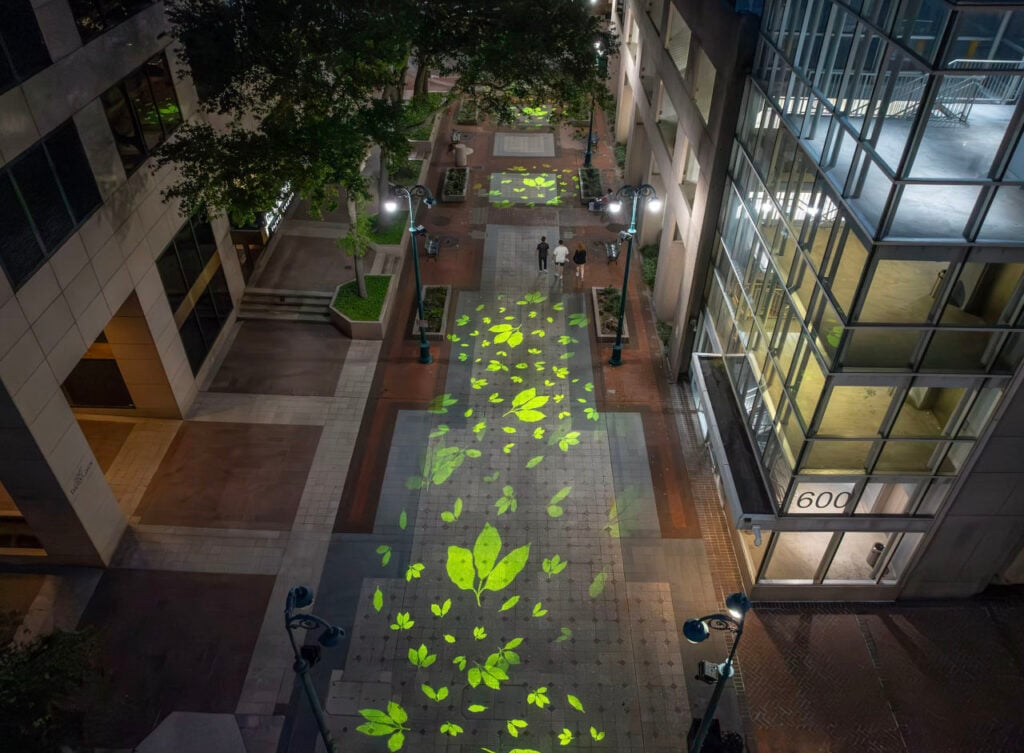
For Lafayette Street, the focus was connecting the Superdome and the adjacent hotel through Lafayette Street, which is an approximately seven-block corridor. The effort spanned seven light poles along Loyola Street, where the light projector, ECO Spot Gobo Projector for Rugged Environments, cast a pattern of glowing green magnolia leaves across the sidewalk in varying shapes and sizes. The projectors provided 0.14 watts per sq ft and the system complied with ASHRAE/IESNA 90.1 (2019).
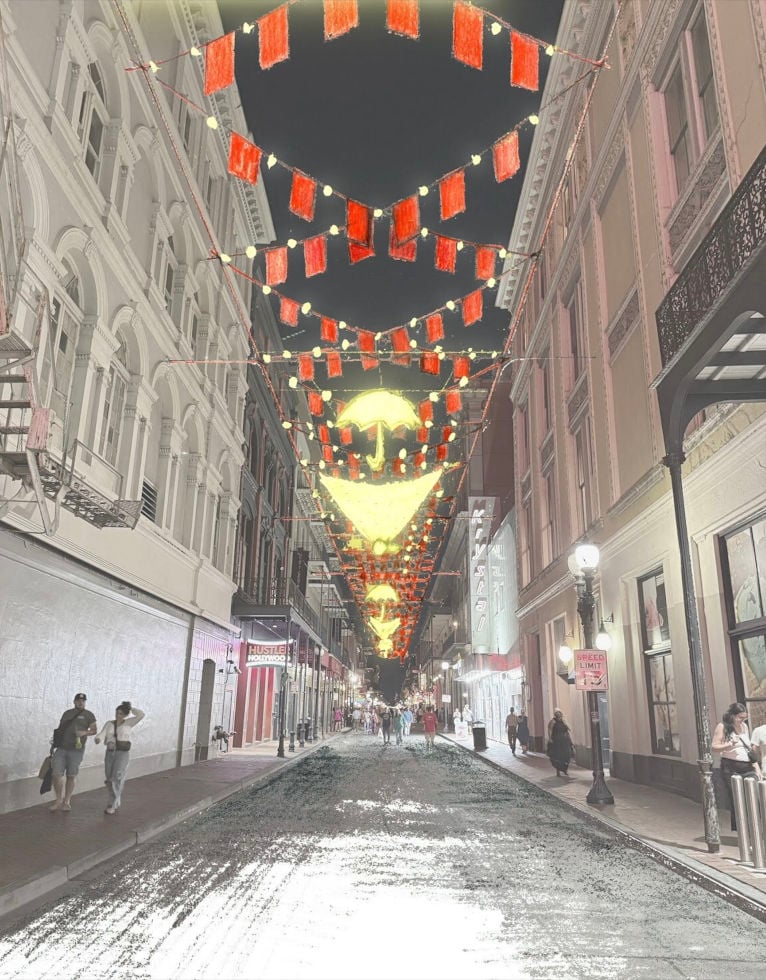
The magnolia leaf was selected as the project’s defining visual motif for its deep cultural resonance. As Louisiana’s state flower, the southern magnolia carries strong regional identity, while its year-round evergreen foliage serves as a symbolic reference to resilience. Translated into light, the motif cultivates a sense of security and safety with a playful approach that encourages pedestrians to walk through Energy Centre Plaza.
Installation proved relatively straightforward. Working alongside Allstar Electric, which maintains the existing infrastructure along Loyola Street, the project team mounted the fixtures with the assistance of a lift and then returned after dark to fine-tune aiming angles. This nighttime adjustment process was critical, allowing the designers to calibrate projection placement in real-world conditions to achieve the desired balance of visibility and coverage.
Careful coordination with existing street lighting also informed the final design. Prior to installation, the team mapped out non-functioning or underperforming streetlights along Lafayette Street, strategically positioning the projected leaf patterns in these areas to supplement ambient illumination. As a result, the installation not only introduced a distinct visual layer but also helped even out lighting conditions across the corridor, reducing disparities in brightness and improving overall visibility.
“There was a noticeable increase in activity and engagement along the corridor,” West explained. “Many locals noted an increased perception of safety. The additional lighting added visual clues toward a path between the hotel and sporting facilities to the west of the site and the neighborhood to the east, so the lighting became a sort of connector, transforming the safety of the corridor through the added light, while visually indicating a path for travel.”
Door-to-Door Service
On the French Door Project, the DDD approached Studio West with some preliminary sketches, a relatively small budget, and a compact timeline. The goal was to activate spaces, make them feel safer, and do so in an interesting way.
Studio West presented an approach that differed from the city’s perspective, with the bulk of the effort involving collecting data that could be used to address lighting challenges. Teams comprising representatives of Studio West, DDD, and Night Rangers from the National Park Service toured the streets with maps on clipboards. “We want you to walk through the space a little differently than you normally do,” West told the teams. “We want you to consider high glare and how hard it is to see things. We want you to talk to us while we’re walking about where you feel safe and where you don’t feel safe.” This strategic effort was beneficial in showing what was needed to achieve the results and impact that DDD was looking for, which inspired Studio West to develop a thorough, investigative, and community driven mapping process.
From those excursions, they developed a large workbook for the group of business owners to identify and fix broken lamps, as well as replace lighting. While some of the lighting issues could be addressed through grants, others would require permitting. “It was really just like an outdoor lighting repair plan,” West said, “but on the fly, in a very New Orleans way that had color coding.”
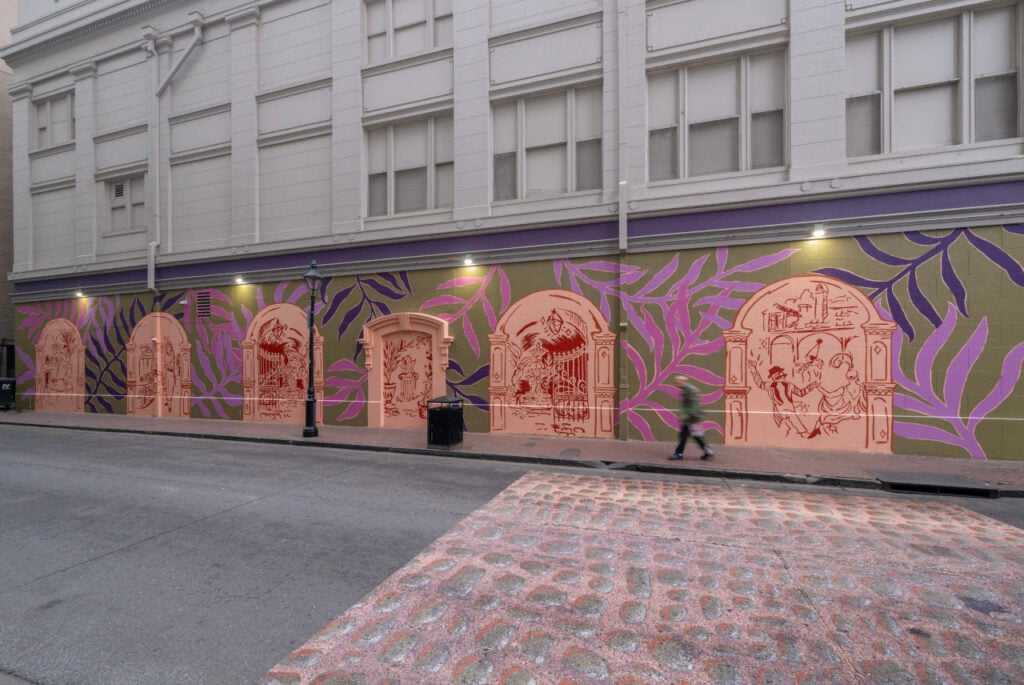
To address areas that were not as conducive to full lighting treatments or that felt unsafe, Studio West proposed murals, which would provide more color and lighter, more reflective surfaces. The thinking was that if the murals were beautiful, graffiti taggers would leave the work alone. As a result, the city partnered with Arts New Orleans to commission artists whose aesthetics fit the sites particularly well.
“In some spaces, we did change or add lighting. There’s one site that had uplighting in place, but we really needed downlighting,” West said. “Sometimes the artist would make a decision based on where the lighting was to maybe restrict the scope and the area they were painting. So, it was a nice collaborative process with the artists, Art Council, and DDD because we were all able to look at the building elements and talk about it from different vantage points.”
Staying Power
For design teams, becoming part of a city is rarely the result of a single project; it develops over time through sustained presence, curiosity, and a willingness to engage beyond the immediate scope of work. In New Orleans, that process has been shaped by long-term relationships, repeated collaboration, and a growing familiarity with how the city functions—socially, culturally, and spatially. It also reflects a broader belief that meaningful design does not stop at the building envelope but extends into the public realm, where it is experienced collectively. Approaching streets, plazas, and everyday urban spaces with the same level of attention as formal architectural projects can create opportunities not only for stronger design outcomes, but also for deeper community connection.
For design teams looking to move from working in a city to becoming part of it, West points to a long-term shift in mindset. It requires patience, humility, and a willingness to invest in relationships. “Everyone has their own lived experience, which should be valued and validated,” she said. “We are all a part of the human experience, so understanding this and making space for these local narratives and voices to be heard—through listening and observation—is fundamental and the essence of being in public space and among a culture.”
It also means embracing the idea that design is not simply delivered, but shared, shaped, and carried forward by the community. In New Orleans, where culture is deeply embedded in everyday life, that approach has allowed projects like these to resonate far beyond their physical footprint and become ingrained in the rhythms and routines of the city.
THE DESIGNERS
- Jennie Cannon West, AIA, NCIDQ, LEED AP BD+C, is the founder and principal of Studio West Design.
- Jason Richards, AIA, LEED AP BD+C, CDT, is a principal of Studio West Design.