
If you had a chance to explain lighting to 100 10-year-olds, what would it look like? For Equity in Lighting (EIL), it is the perfect mix of art, science, and a little bit of magic to inspire and connect these students to the world of light that surrounds them every day. Over eight weeks, the students played with color, made lanterns, and learned through Snap Circuits how they were connected to the entire urban grid, all through EIL’s Youth Enrichment Program.
EIL exists to ensure that everyone, regardless of background, identity, or abilities, has access to high-quality lighting, and that the profession designing it reflects the full diversity of the communities it serves. Our work lives at the intersection of education and advocacy: raising awareness of what good lighting is, why it matters, and who gets to create it. It’s not just about getting more talent into the lighting industry; it’s about making sure people value lighting as much as we do.
The diversity problem in the lighting industry compounds this issue. We trace the lack of representation directly to the field’s obscurity: Only a small, homogenous group knows lighting design exists, and the perceived path into it involves expensive graduate programs. The pipeline narrows at every barrier. EIL exists to widen that funnel by raising awareness and showing that entry into this profession doesn’t require an expensive degree. The door is wider than most people realize.
Back to School
The program started with someone who cared about two things at once. Shaun Fillion is a lighting professional, an IALD educator, and a parent and Parent-Teacher Association (PTA) member at P.S. 166Q, the Henry Gradstein School in Queens, NY. When he brought the idea to EIL, he wasn’t pitching an abstract outreach initiative. He was a dad who was aware of what his children’s school needed, and a lighting professional who knew exactly what he could offer. That combination, insider knowledge of the school community, and deep industry expertise helped make this partnership work.
From there, EIL connected with Principal Geller and PTA leadership to map out what an eight-week program could look like for their fourth-grade students. A generous grant from the Designers Lighting Forum of New York (DLFNY) fully funded the program, removing the financial burden for both EIL and the Title I public school. With logistics in place, we got to work on the part that mattered most: the curriculum.
Eight Weeks, Eight Entry Points
We wanted every student, regardless of their academic strengths, to find a way into the program. EIL designed each week around a different disciplinary lens, hand-picking roughly 20 lighting professionals as guest instructors and prioritizing people who had teaching experience alongside their technical expertise. We compensated every instructor through DLFNY support because we believe that professionals who give half a day, their expertise, and their energy to this work deserve more than a “thank you,” and a stipend is a commitment to that principle.
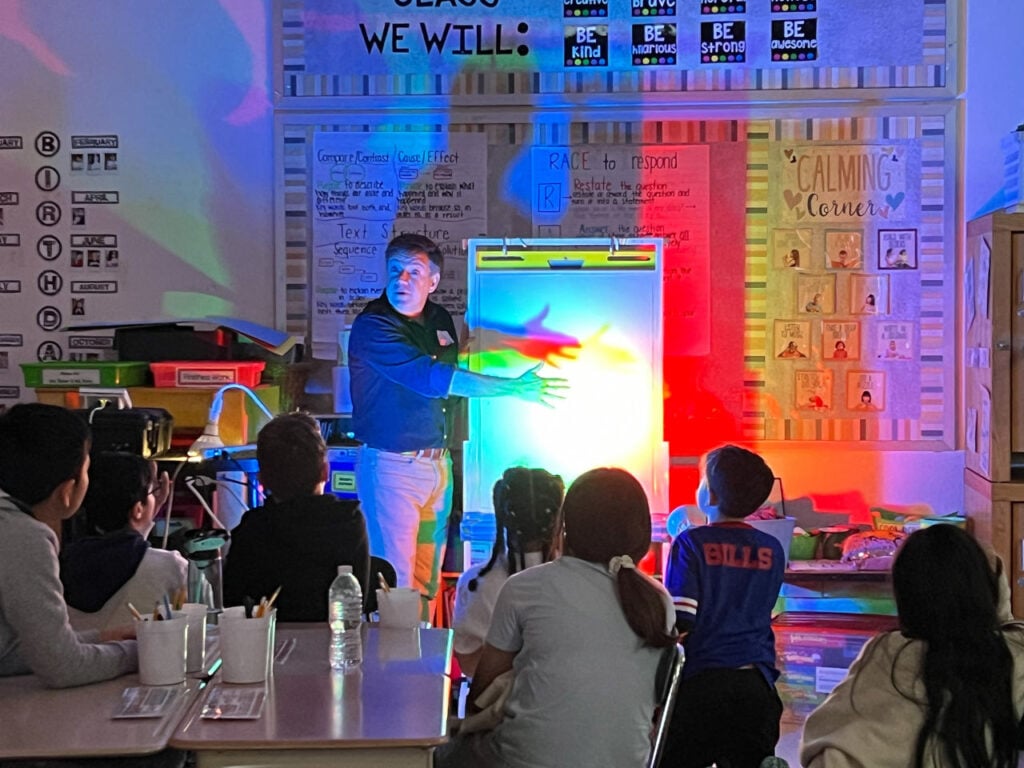
Week one opened with the art and science of color—RGB mixing, the relationship between pigment and light, and shadow puppetry with colored gels. Led by IES Color Committee Co-chair Jason Livingston and Natalie Faubert, senior associate at Cline Bettridge Bernstein Lighting Design, students discovered early on that mixing paint and mixing light are not the same thing.
Week two moved into the mathematics of light. Domingo Gonzalez Associates Lighting Director Phat Quach and Lighting Designer Ajin Cho put light meters in students’ hands and had them measure illuminance. Lumens, candela, and footcandles, concepts that can feel abstract on a page, became tangible and immediate.
Weeks three and four brought a cultural and artistic lens to the program. Students built paper lanterns after exploring how light is used across different traditions around the world with Jacqui Cacan, head of architectural design and specifications at i2Systems, and Jenny Pham, specification representative at SLS, guiding the making. Lighting Designer Robyn Bohn from Sighte Studio and June Park from Pratt Institute assisted with the curriculum development. A session guided by Tom Simon, director of design at Juniper, and Ilva Dodaj, associate principal at Domingo Gonzalez Associates, was dedicated toward students learning to give and receive critical feedback on creative work.
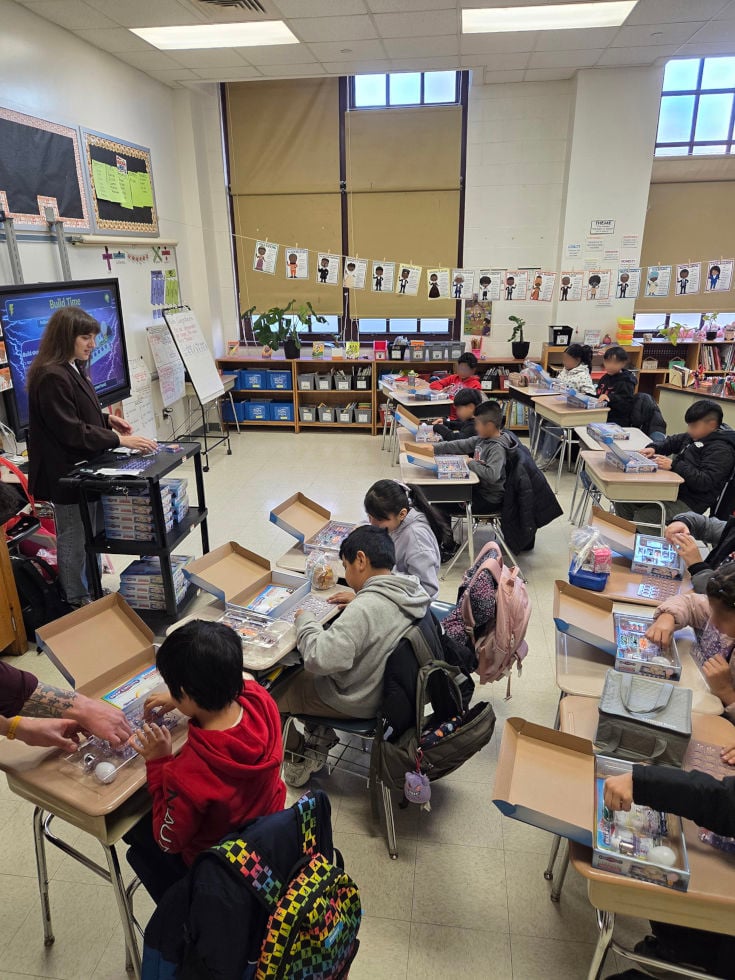
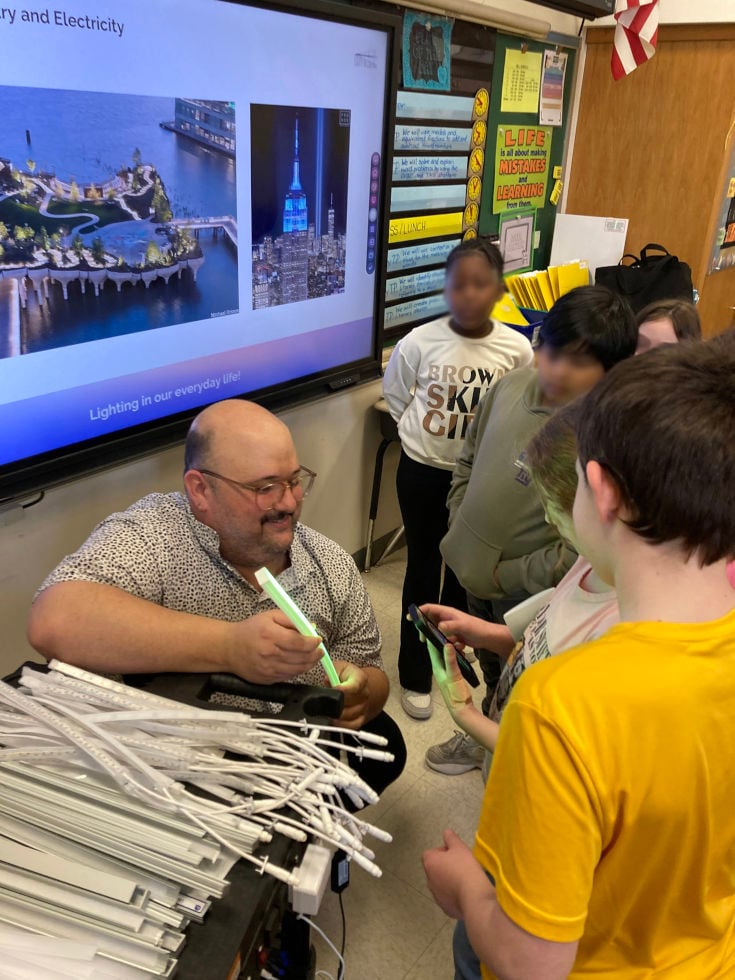
Week five was where things literally became electric. Ashley Chan, senior designer at HLB, and Seth Margolies, head of marketing and brand strategy at Barbican, joined Elaine Cook to present circuit-making sessions using Snap Circuits. In week six, the students graduated to professional LED tape and drivers provided by QTL, which was led by Jennifer Mason, regional sales manager at QTL. Students learned the basic logic of a circuit, the difference between AC and DC, and how to wire a fixture. Hands-on time with real materials has a way of dissolving fear into curiosity, and by the end of week six, students who had never previously touched a circuit were seeing the world around them as one big, connected system.
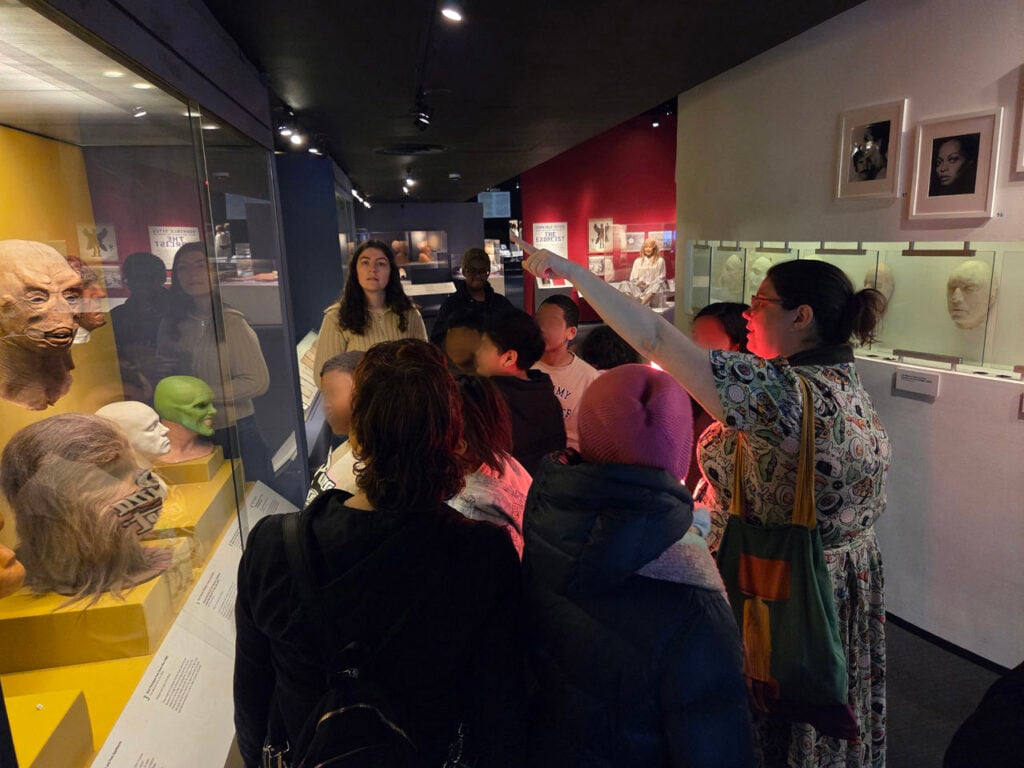
Week seven took us out of the classroom entirely. Students visited the Museum of the Moving Image in Queens, NY, where they observed layered architectural lighting and discussed how light functions in film, guided by Quincy Drane, designer at Hartranft Lighting Studio, and Brigid Hardiman, associate, and Nastassia Ortiz, associate, at Available Light. Seeing light applied in a real cultural institution, and meeting the professionals behind it, gave the program a sense of scale that classroom sessions cannot replicate.
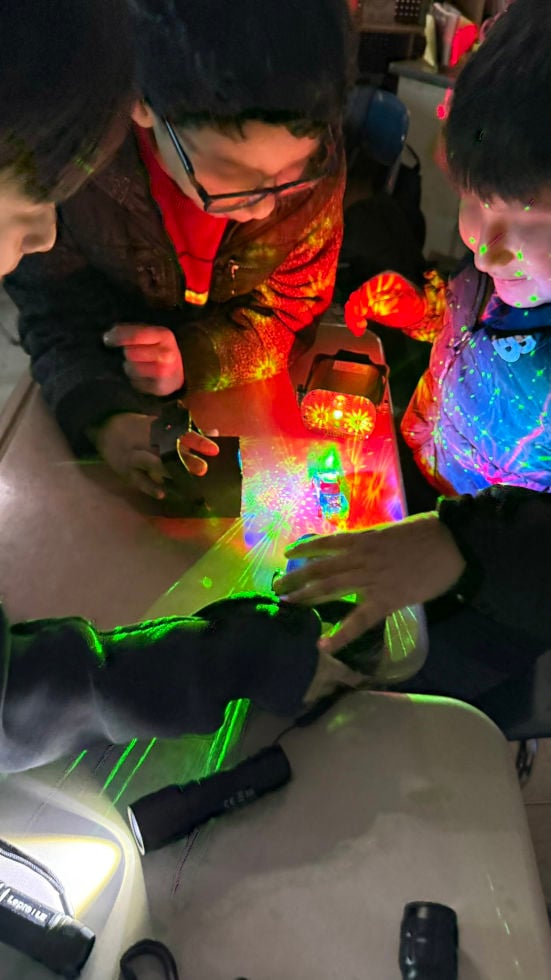
Week eight brought it all home. Fillion; Francesca Bastianini, founding partner of Sighte Studio; and Craig Young, lighting designer at Ventresca Lighting Designers, led an immersive final session exploring light and shadow using flashlights, spray bottles, and lasers. Students left with something more than knowledge—a feeling for what light can do.
The Students Said…
The students completed exit surveys at the end of the program, and the following is a tabulation their responses:
- 97 students submitted written feedback surveys
- 69% gave the program a perfect 5-star rating
- 4.4 (out of 5) average star rating across all respondents
- six to seven students awarded extra stars beyond the scale, unprompted.
The most-selected favorite activity was circuit-making, followed by color science and light and shadow. Because students could select multiple favorites, the distribution told us something important: Every single week received at least 12 selections. No student left without something that connected with them.
When asked what they would change, the most common answer was “nothing.” The unprompted final comments ranged from a simple “thank you!” to “every Friday I was always excited about you guys coming.” One student wrote that shadows come in different colors. Another said they learned the primary and secondary colors of light. A third noted that “light can travel through space and when light gets in your eye, it’s called glare.” These are not small things; they are the building blocks of a lifetime of curiosity.
What’s Next?
P.S. 166Q was our pilot. New York City is our expansion stage. Year one gave us the foundation we need to grow deliberately. We now have a cohort of roughly 20 industry professionals who understand the curriculum’s shape and tempo and are ready to lead or support future implementations. Our plan is to refine the fourth-grade program to its final form, then bring it to additional New York City schools. Once fully packaged with slide decks, supply kits, instructor guides, manufacturer partnerships, any lighting professional in any city can partner with EIL to offer the program in their local schools.
Longer term, the fourth-grade program is only the beginning. We’re developing programming for middle and high school students, exploring partnerships with schools that already feed into design and engineering pathways, and building connections with industry organizations that can help place students into internships and mentorships as they age into the profession. The goal is a continuous thread, from a 10-year-old building her first circuit all the way to a young professional walking onto her first job site.
If you have experience in directing lighting outreach or enrichment programming at any level, in any city, we want to hear from you. If you are a PTA leader, school administrator, or parent who sees an opportunity to bring this to your community, reach out. If you want a path to share your lighting knowledge with the next gen- eration, please reach out to us at enrichment@equityinlighting.org. The curriculum is ready. Help us to grow our network to touch communities beyond New York City. Let’s keep sharing the magic of light with everyone who will listen because the more people experience it, the closer we get to a world that is beautifully lit for all of us.
The Authors
Elaine Cook, Member IES, is the founder of Equity in Lighting, a nonprofit organization dedicated to ensuring that everyone has access to high-quality lighting and that the profession designing it reflects the full diversity of the communities it serves.
Shaun Fillion, LC, CLCP, LEED Green Associate, Member IES, Educator IALD, is program director for the Master of Professional Studies in Lighting Design program at the New York School of Interior Design, as well as director of Lighting Design at RAB Lighting.