
The Stack is rooted in theatrical design principles
Rising above Vancouver’s skyline, The Stack at 1133 Melville Street is more than an office tower—it’s a statement in sustainable architecture and lighting design. As Canada’s tallest zero-carbon building, its sculptural form and choreographed illumination redefine how performance, aesthetics, and environmental responsibility can coexist. From its twisting geometry to its artfully illuminated public spaces, The Stack demonstrates that light is not just functional—it’s an integral design language shaping the experience of architecture.
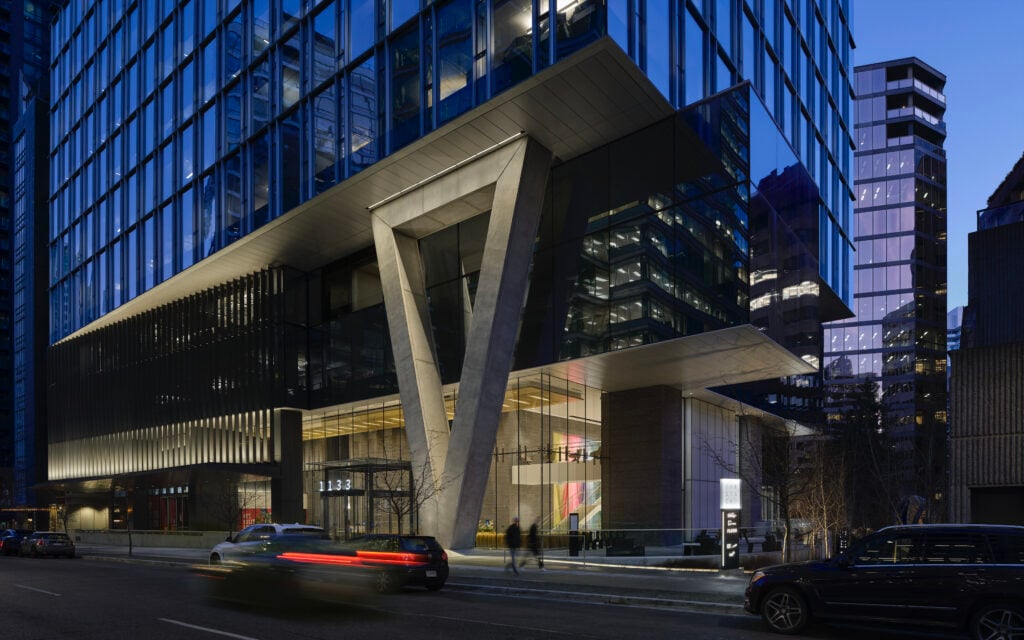
The 37-story office tower’s design consists of four offset boxes with a 6-deg twisting “stack” atop a podium. Most visually striking are the 6-deg box rotations, prodigious V-column, generous ceiling heights, and ground-level public park. The signature 55-ft-tall, V-shaped column supports cantilevered upper floors, while a black metal veil texturizes a tall lobby, visible through a glass-curtain wall façade. This sculptural interplay of structure, texture, and transparency sets the stage for a lighting design that accentuates architectural forms.
“The illuminated V-column is paired with a softly highlighted veil on the opposite side of the podium, creating a carefully calibrated composition,” explained Ellie Niakan, creative lead lighting designer at Introba Light Studio. “Uplights with optical glare control define the bases of these elements, while a linear grazer accentuates the V-column’s upper geometry. The warm interior glow extends beyond the curtain wall, gently illuminating select exterior features without overpowering the landscape.”
The V-column’s linear down-grazers utilize Lumenpulse’s Lumenfacade HO with grazer optic, 10-by-10 deg at 3500K. The V-column uplights are Orma 4-in.-diameter, in-ground, adjustable uplights with a 22-deg hex louver at 3500K. Inside the veil resides Lumenpulse’s Lumenbeam Medium fixtures with a 10-deg horizontal linear spread lens at 3500K.
Warm, interior illuminance extends outside, providing subtle, seamless transitions between indoor and outdoor environments. “Rooted in principles of theatrical design, the concept employs a rigorously layered system of top, side, and back lighting,” Niakan shared. “Downlighting, uplighting, wall grazing, and wall washing are combined to create depth and visual hierarchy throughout the interior and exterior environments. This interplay of techniques sculpts shadows and highlights architectural details, producing dramatic moments.”
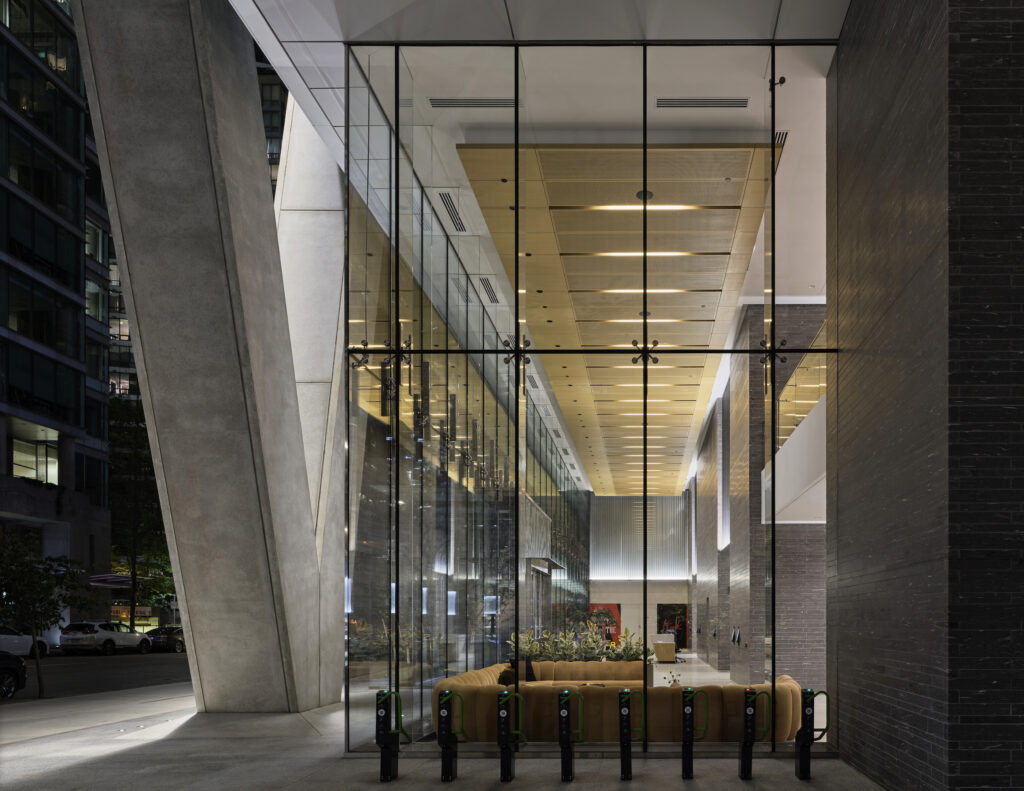
Intentional darkness and contrast create depth and visual interest. Peering through the glazed curtain wall into the lobby, integrated linear troughs and symmetrical luminaire layouts create geometrical rhythm in the architecture, with downlighting used to soften wood ceilings and highlight polished marble surfaces. Lighting scenes and groupings, enabled by DALI-based controls, allow exterior views of illuminated elevator lobbies, three-story woven-cord art installations, and communal spaces, engaging the eyes of passersby.
A Layered Exterior Experience
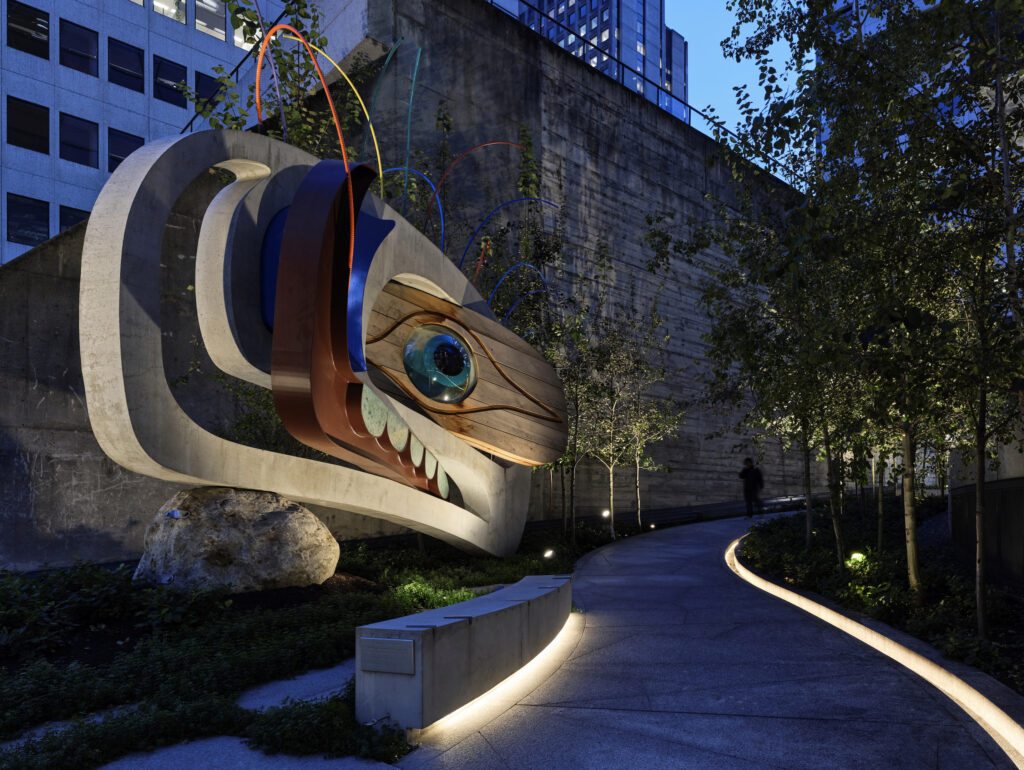
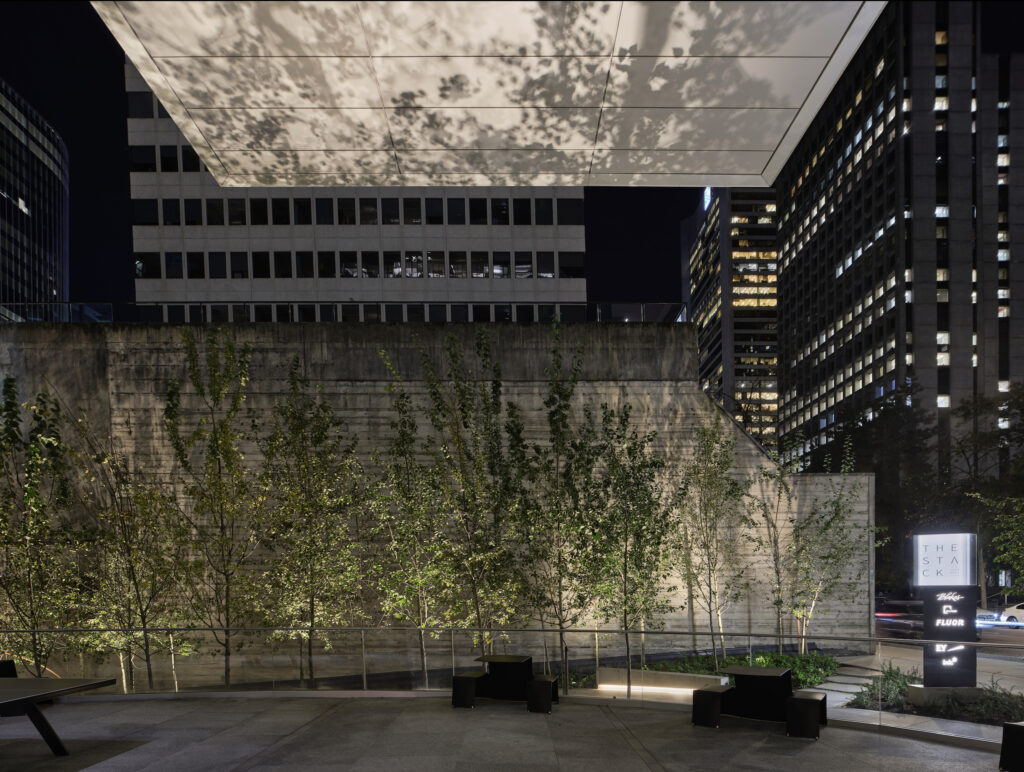
A pocket park, at ground level, and its art installation offer a green, calming retreat, transformed at night through discrete, concealed luminaires. The exterior site lighting is intentionally restrained; most uplights turn off at 10 p.m. to support dark-sky principles, wildlife welfare, and energy conservation. “In the pocket park, lighting enhances the character of the urban retreat,” Niakan said. “Trees are highlighted to create interplay between light and shadow on the cantilevered soffits, subtly merging nature with architecture. A softly illuminated storm-water runnel [containing Acclaim Lighting’s Flex Tube SC at 3000K] becomes a guiding element, leading visitors toward the art installation and enriching the nighttime experience.”
Soffits and exterior walls are free of downlights and wall-mounted luminaires, resulting in visually clean, glare-free, and uninterrupted architectural forms. Artworks are illuminated from multiple angles; the park’s large sculptural artwork is visible via ERCO’s Kona flood and extra-wide flood lights set to 3000K. Landscaping uplights—ERCO’s IP68 Kona projector with a 28-deg lens, at 3000K—through trees create moving leaf shadows across cantilevered soffits, draping organic silhouettes on constructed elements. The warm glow from the interior lobby highlights specific exterior ground zones. Meanwhile, other key architectural features remain purposefully shrouded, generating depth and contrast.
Views of the interior lobby are generously shared with pedestrians outside the building through the 9.5-ft-high glazed curtain wall. Niakan elaborated, “At the building’s edge, the glass curtain wall becomes a key mediator between inside and out. Interior lighting extends visually into the landscape, where carefully positioned luminaires accentuate trees, hardscape elements, and the signature V-columns. The result is a layered exterior backdrop that enriches interior sightlines and strengthens the connection to nature, an important component of both the user experience and the project’s sustainable design.”
Within, subtle downlighting and rhythmic luminaire arrangements accentuate order and patterns; fixtures are deemphasized. The interior lighting visually extends outdoors through the glass curtain wall, linking with the illuminated park and signature columns. Scene controls allow most luminaires to dim or shut off during evening and curfew hours, supporting energy conservation and dark-sky targets.
Sustainability and Performance
The project was not without its challenges. “The biggest challenge was designing lighting for a high-performance, sustainable building that began in 2017—one that, after seven years of design and construction, would still look current, exceed evolving energy codes, and remain timeless,” Niakan remarked. “For long-duration projects like this, technology and aesthetic trends often become obsolete by the time the building is completed, especially given the rapid pace of advancements in lighting. This is even more critical when the goal is to achieve high performance. We had to think beyond conventional solutions and truly design with the future in mind.”
As a result, The Stack is the first certified Zero Carbon-Design commercial tower in North America, achieving LEED v4 Platinum certification and reducing operational carbon emissions by 87% through intelligent lighting systems and controls. DALI-based sensors and controls are pervasive, adjusting luminaires to occupancy, daylight levels, and programmed schedules. The illumination adjusts with at least three scenes—evening, night, and curfew—to reduce energy consumption, light pollution, and skyglow. The design provides targeted illuminance (300 to 400 lux in lobby areas visible from outside) that dims based on building occupancy. Manufacturers were selected for longevity, precise optics, color accuracy, native DALI controls, and compact form factors. Additionally, the entire building’s lighting control system is DALI based and built on Cooper Lighting Solutions’ WaveLinx Wired platform.
“The exterior lighting embraces restraint, balancing architectural presence with environmental sensitivity,” Niakan said. “By integrating high sustainability standards with thoughtful functionality and artistic expression, the lighting transforms both the exterior and interior into vibrant, inspiring public spaces. The exterior becomes a dynamic symbol of innovation and urban vitality that energizes the city and engages all who encounter it, [contributing] meaningfully to downtown Vancouver’s growing collection of welcoming, visually impactful commercial environments.”
The Designers
- Ellie Niakan is creative lead lighting designer at Introba Light Studio.
- Padraic Greed is a lighting designer and lighting control specialist at Introba Light Studio.
- Mary San Miguel is a senior lighting designer at Introba Light Studio.
- Chung Ho is a former senior designer at Introba Light Studio.
The Author
David Shiller is a business development and marketing consultant to the lighting industry, as well as the publisher of LightNOW, an online lighting industry trade publication. He is a 25-year veteran of the lighting industry and co-chair of the American Lighting Association Engineering Committee.