
Venturing beyond the stadium/arena experience
Sports lighting has expanded beyond the confines of stadiums and fields, venturing into landscapes once deemed impossible to illuminate. Today, designers orchestrate light across environments as varied as the neon-saturated canyons of Las Vegas and the pristine, snow-draped slopes of Sundance in Utah. These projects demand a delicate balance where every luminaire must serve not just visibility, but human experience.
We are entering a new era, one defined less by fixture counts and wattage and more by adaptability, perception, and environmental sensitivity. These environments force lighting professionals to think beyond traditional horizontal planes of play. Light must now respond to dynamic motion, shifting surfaces, and competing visual stimuli, all while minimizing ecological and social impact. The work is part engineering and part empathy: understanding not just how bright some thing must be, but how it should feel to the people experiencing it.
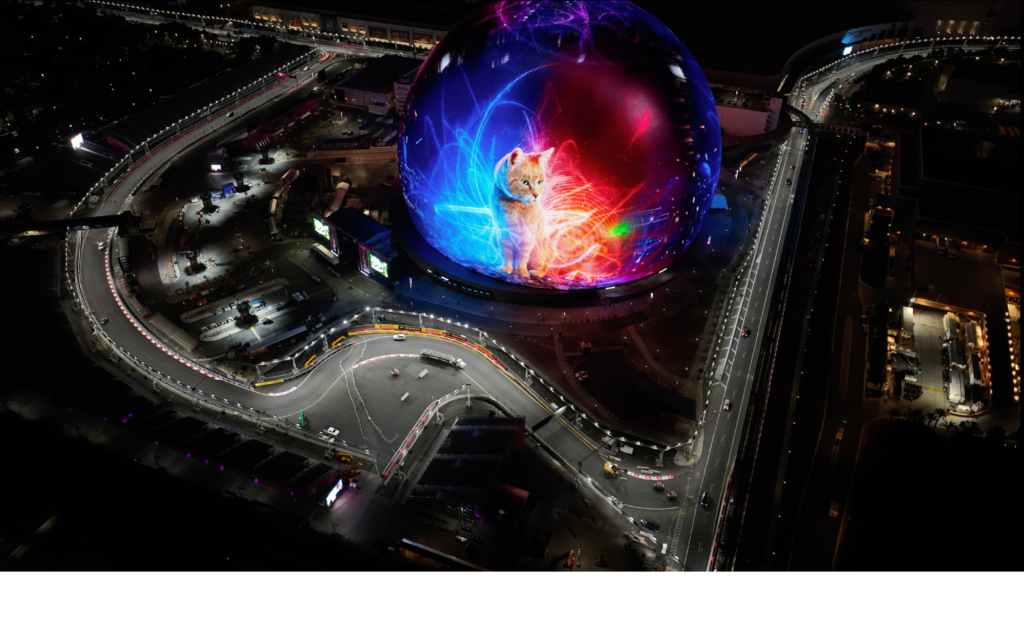
Two projects, worlds apart in setting and intent, exemplify this evolving landscape. For the 2023 Formula 1 (F1) Las Vegas Grand Prix, designers converted a dazzling entertainment corridor into a meticulously lit racetrack, balancing spectacle with precision. In contrast, the Sundance Ski Resort demanded illumination that revealed the subtleties of snow-covered terrain while safeguarding ecological integrity. Both efforts underscore that the future of sports lighting lies in contextual problem-solving—where human performance and environmental stewardship converge.
The Need for Speed
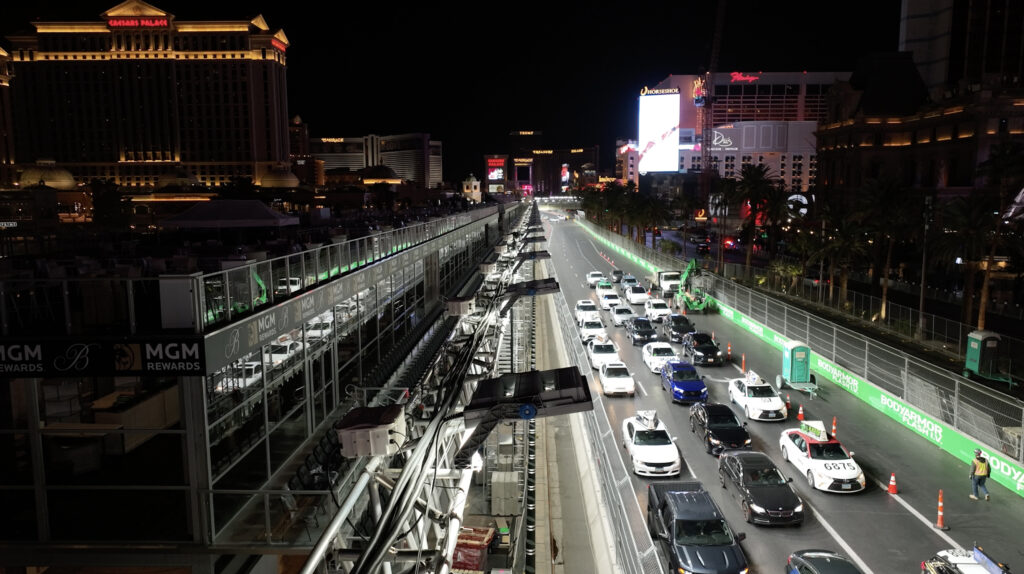
When F1 returned to Las Vegas, a team of designers from DZ Engineering, Signify, and Ephesus Sports Lighting faced a daunting sports lighting challenge: a temporary 3.8-mile circuit wound directly through the Strip’s architectural canyon, surrounded by mirrored façades, animated billboards, and millions of existing luminaires. Within that sensory over load, lighting still had to deliver the calm, high-contrast clarity that allows a driver traveling at speeds nearing 230 miles per hour to read the road ahead.
Traditional sports venues are modeled in 5- or 10-meter (~16 to 33-ft) photometric grids. F1 requires 1-meter-on-center analysis across the racing surface and surrounding structures. This resolution captures subtle vertical cues essential for depth perception at speed.
Designers must account for how a driver’s visual system adapts between bright and dark zones at roughly 300 ft per second, fitting illumination around the ability of a human being to respond. Even minor luminance differentials can distort braking perception or cause glare at corner entry. Sophisticated 3-D modeling simulated these transitions long before any infrastructure installation, ensuring that brightness ratios remained smooth through every compound curve and elevation change.
Because the circuit existed for only a few days, every component from scaffolding bases to cabling harnesses had to be modular, transportable, and re-aimable. The system was designed for rapid installation and removal yet still met the Fédération International de l’Automobile’s (FIA’s) stringent performance criteria for uniformity and vertical illuminance.
Mechanical interfaces allowed exact repeatability of aim points using indexed brackets and calibrated tilt scales. What normally requires months of fine-tuning in a permanent venue had to be executed in weeks, proving that temporary infrastructure can still achieve architectural precision.
Balancing Human Vision and Broadcast Fidelity
Lighting an F1 event means satisfying multiple audiences simultaneously: the drivers on the track, the spectators in grandstands, and millions of viewers watching ultra-high-definition broadcasts. High-speed cameras are unforgiving; even tiny flickers or color inconsistency be comes magnified under 4K HDR imaging.
Designers selected optical systems with tight binning and high-frequency drivers to eliminate flicker potential. Color temperature and color rendering were tuned to preserve the saturated hues of car liveries and sponsor graphics while maintaining accurate skin tones for broadcast crews. The lighting delivered consistent vertical illuminance on moving vehicles, preventing the exposure shifts that can occur when cars pass between zones of differing brightness.
It’s important to recognize that no amount of modeling replaces real-world validation. During early race sessions, driver feedback identified specific braking zones where contrast felt too intense and mirror reflections were distracting. Adjustments were implemented overnight, demonstrating how iterative feedback loops can refine design even within an event window.
Sustainability Through Modularity
Despite its spectacle, the Las Vegas circuit represented a forward step in sustainable event lighting. Advanced LED sources replaced legacy HID systems, cutting power consumption by roughly 70% and drastically reducing maintenance intervals while supporting F1’s target to reach Net Zero carbon emissions by 2030. Precision optics confined light to the racing corridor, limiting light spill and skyglow in a city already saturated with ambient luminance.
Equally important, reusability was engineered into the system. The same modular assemblies can be redeployed for future circuits, turning what once would have been single-use infrastructure into a long-life asset. In this context, efficiency referred not only to energy use but also to the design of light capable of handling the rigors of installation, performance, dismantling, and storage.
In a city defined by excess, the greatest challenge was restraint. The lighting had to make racing visible without competing with the Strip’s neon identity. Through sophisticated controls, operators transitioned seamlessly from race illumination to entertainment scenes for ceremonies and concerts, proving that technical precision and emotional impact can coexist when built on the same optical foundation.
Go Show It on the Mountain
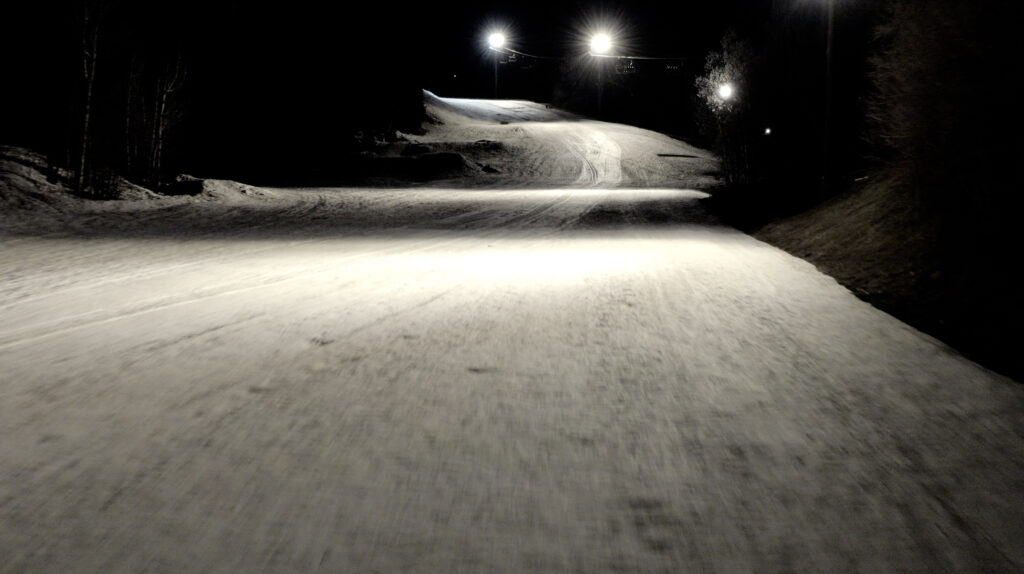
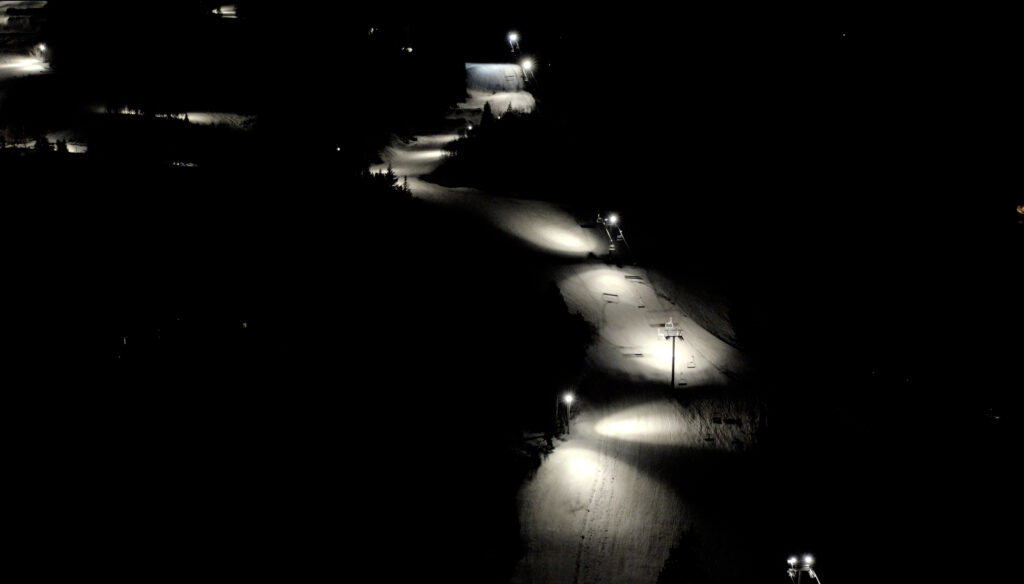
If Las Vegas demanded control amid chaos, Utah’s Sundance Ski Resort required humility within darkness. Where the Strip glows perpetually, Sundance becomes nearly black after sunset, with only starlight and reflection off snow defining space. On a ski hill, you’re trying to create something that’s the opposite of a racetrack. Flat light removes the three-dimensionality of snow. You want just enough shadow to understand what’s coming. The goal here was not uniformity but revelation, lighting that helped skiers read the mountain safely without erasing its character.
Ski-slope lighting depends on directionality. Fixtures are aimed at low grazing angles across the fall line, casting gentle shadows that reveal ridges, moguls, and transitions. Even a few degrees of deviation can change how depth appears to the human eye.
The design team conducted terrain mapping to understand slope gradient, snow reflectance, and obstructions. Instead of chasing uniformity, they pursued readability—how the eye interprets contrast and motion. At Sundance, this meant optimizing light placement for terrain perception for safety and comfort, giving skiers the confidence to navigate changing conditions.
Color temperature shapes emotional and physiological response. Warmer sources around 3000K provide better visual contrast on snow and reduce glare, especially for eyes adapted to twilight. Warm tones also preserve the natural aesthetic of the landscape, blending smoothly with wood lodges and pine surroundings.
In colder climates, this subtle warmth carries psychological comfort; it aligns the artificial light with firelight and moonlight rather than with daylight intensity. As a result, the slope feels illuminated, not flooded.
Environmental Integration
Mountain installations test every aspect of luminaire durability: thermal management, gasketing, lens integrity, and serviceability. Components must endure freeze–thaw cycles and heavy wind load while remaining maintainable through snowpack.
The design team used dark-sky guidelines and a recessed hybrid-optical system to protect the mountain’s night ecology, employing lighting at 3000K or below to limit harmful blue light for wildlife. This combination produced controlled lateral distribution that followed the slope while keeping uplight nearly zero, preserving views of the night sky for both visitors and wildlife.
Control flexibility was achieved through a wireless AirMesh system that removes the need for additional control cables to be installed, reducing the impact on the surrounding environment, while providing complete control over scene programming, dimming schedules, and adaptive responses to operating conditions. The result was a system that could dynamically adjust for ski-run closures while maintaining safety and energy efficiency.
Together, these strategies allowed the resort to extend night skiing hours with minimal environmental footprint and proof that illumination and preservation can coexist.
Lighting as Personal Navigation
Unlike the collective focus of motor sport, ski-slope lighting is inherently personal. Each skier perceives a private world of depth, texture, and rhythm. The lighting’s job is to guide that perception rather than command it. The ski slope ends up providing just enough information for individuals to ski safely while keeping the experience immersive and quiet.
That principle of restraint defines mountain design. By aligning light levels with human adaptation, the resort maintained safety while preserving darkness, a quality increasingly rare in the built environment.
Opposite Extremes, Shared Principles
Placed side-by-side, the F1 circuit and the ski slope seem to exist on different planets. One thrives on spectacle and speed, the other on silence and subtlety. Yet both rely on the same fundamentals of modern lighting practice: optical control, environmental awareness, and feedback-driven refinement.
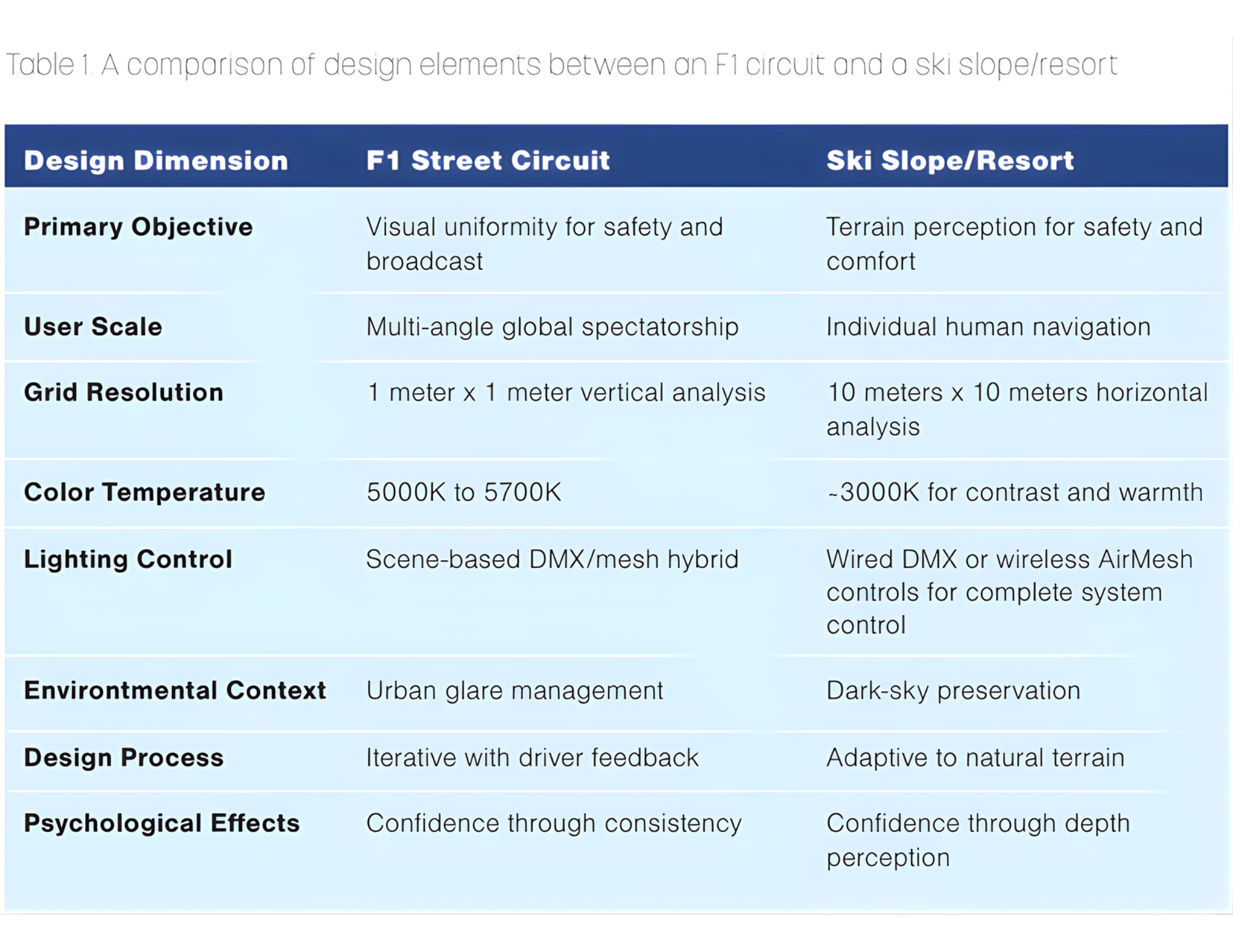
At their core, both projects used lighting as a tool for human performance. Table 1 summarizes their contrasting yet complementary priorities.
Both lighting approaches also demonstrate the growing value of human-centered iteration. In Las Vegas, driver telemetry and visual-comfort studies informed ongoing adjustments; at Sundance, operators fine-tune output in response to snow conditions and moonlight. Each environment becomes a feedback ecosystem where technology and perception continuously refine one another. This shared adaptability defines contemporary sports lighting: not static illumination, but responsive experience.
The two extremes suggest a broader evolution in professional identity. Lighting design for sports once lived largely in engineering spreadsheets that calculate lighting levels, angles, and energy use. Today, it exists equally in the realms of psychology, cinematography, and ecology.
Lighting professionals now collaborate with broadcast engineers, urban planners, and environmental scientists. They interpret standards not as limits but as baselines to be exceeded when context demands. In this sense, the F1 circuit and the ski resort represent two sides of the same learning curve with one focused on technological precision and the other on environmental empathy. We don’t want the lighting to be the story. It should be integral to everything—showing off the performance, but never about itself.
That humility is what unites cutting edge projects across all scales. Whether lighting ball parks, arenas, stadiums, asphalt, or snow, success is measured not in lux but in trust. In this case, drivers trusting what they see at speed and skiers trusting their footing on a quiet slope.
From Precision to Perception
Both projects reaffirm that illumination is most effective when it enhances performance while disappearing into the experience. The profession is moving toward this balance of precision and perception, where data-driven control meets human driven design. With the advancement of LED lighting technologies, designers are positioned to develop venues that enhance safety and energy efficiency, while also providing an immersive and engaging environment for both athletes and spectators.
Ultimately, the future of sports lighting will be shaped not by increasing brightness or power, but by a more profound understanding of how illumination interacts with its surroundings. Lighting must be carefully tailored to the unique qualities and needs of every space, whether it’s a vibrant corridor filled with energy or a serene, snow-covered landscape beneath a starry sky. As technology advances, the complexities and opportunities in lighting design will only grow, demanding thoughtful and adaptive solutions for each unique environment.
THE AUTHORS
- Ryan Demorest is commercialization manager for Ephesus Sports Lighting, bringing extensive sports-industry experience to advancing high-performance LED systems.
- Darren Couch is the applications manager for Ephesus Sports Lighting and has been lighting venues for televised sports since 1990.