

Gaylord Hotels’ ICE! brings a sparkle to the holiday season
For more than 70 years, good ol’ Charlie Brown has suffered indignities such as Lucy repeatedly pulling a football away before he could kick it and being labeled a “block-head.” However, the tables have turned in recent years as the entire Peanuts gang, along with other classic Christmas characters, have received the blockhead treatment in the form of massive ice sculptures used to create ICE!, an annual event held at Gaylord Hotels properties across the U.S.
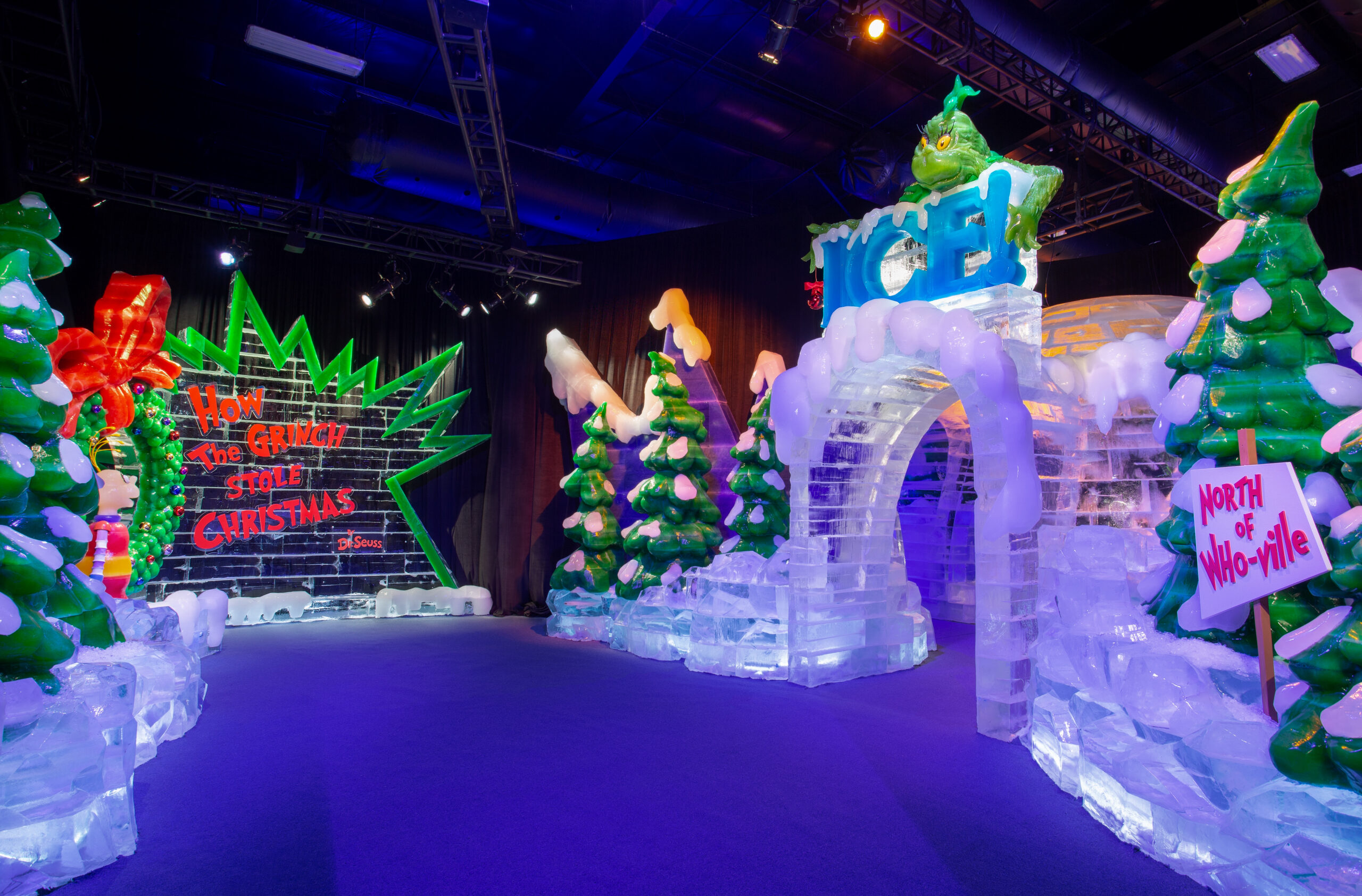
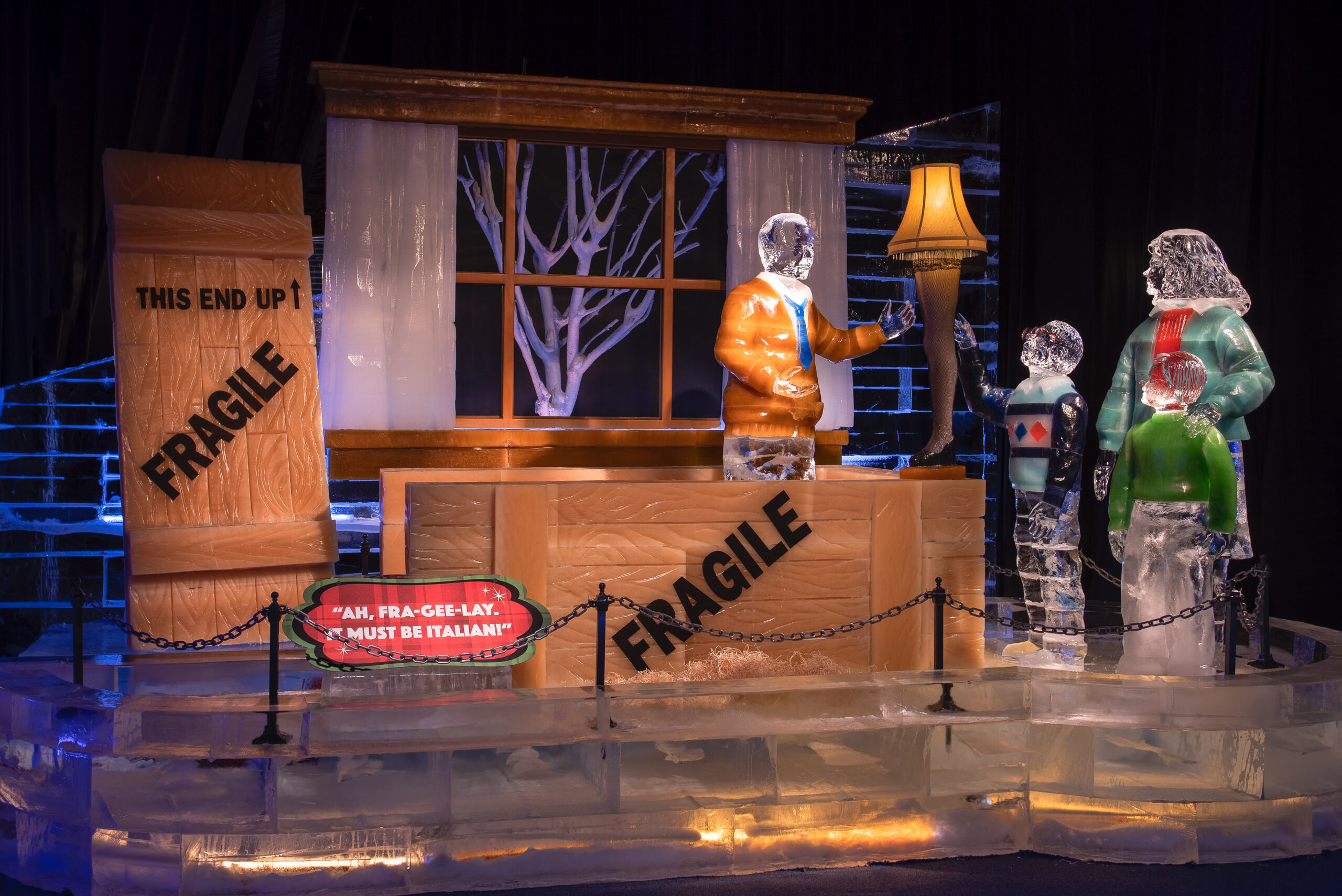
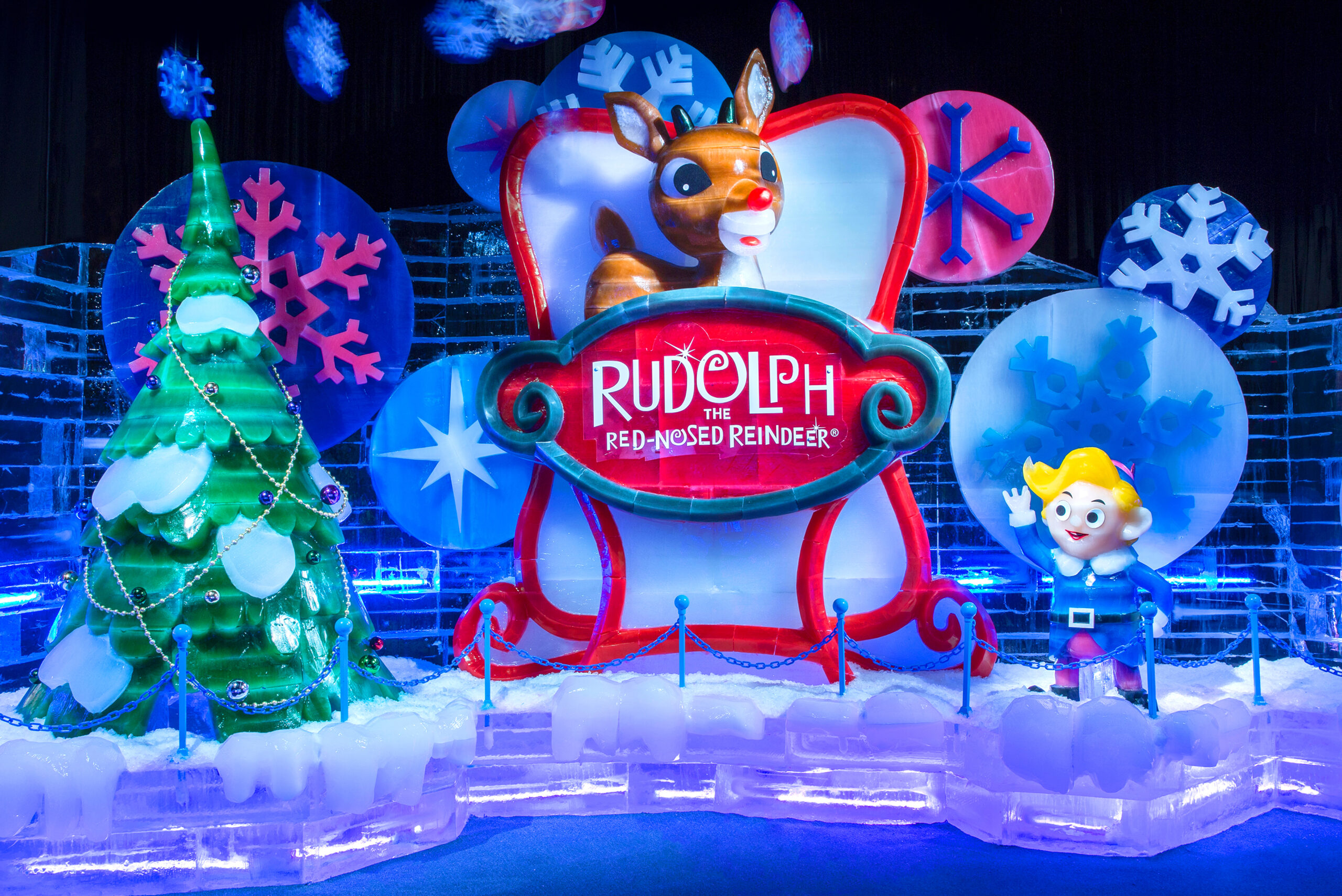
More than 5,000 tons of ice were trucked in by the resorts, where artisan carvers from Harbin, China, used chainsaws, chisels, hand tools and grinders to create attractions that include the stories of Rudolph the Red-Nosed Reindeer (Gaylord National, National Harbor, MD), The Polar Express (Gaylord Opryland, Nashville, TN), A Charlie Brown Christmas (Gaylord Palms, Kissimmee, FL), A Christmas Story (Gaylord Rockies, Aurora, CO) and Dr. Seuss’ How the Grinch Stole Christmas (Gaylord Texan, Grapevine, TX). While the resorts offer dozens of immersive holiday activities including ice skating, visits with Santa and holiday escape rooms, among others, ICE! is the most popular event at each resort. Lighting designers are essential in creating dramatic show vignettes using spotlights, accent lighting, colorful projections and LEDs frozen into sculptures.
Gaylord Hotels’ Lighting Director for ICE! and Principal at Lightswitch Warren Kong, and his team have been working on the attraction for more than a decade and face numerous challenges in recreating immersive scenes with which the public is well-acquainted, thanks to the popularity of the timeless films and television specials on which they are based. Any Heat Miser or Snow Miser worth their salt will tell you that adding heat to ice can be a recipe for disaster, not only for the sculptures but also the health of the lighting and fixtures. The ICE! attractions are kept at a consistent 9 deg Fahrenheit, with blowers churning out sub-zero temperatures to hold an optimal atmosphere. As a result, many of the theatrical lighting fixtures and accessories used, such as LED par cans and gobo rotators are wrapped in heated blankets while traditional incandescent lights are employed as well, since they are naturally warmer than LED technology. Lighting is also positioned as a primary heat source to keep the motors in gobo rotators warm so that they continue to operate properly.
“We have to put the entire lighting rig up when the temperature is still warm, before there is a stitch of ice,” Kong explains. “The art directors will go through with a can of spray paint and mark out all of the lines on the ground where every sculpture should be. We have to hang all the lights based on visualization. We have the opportunity, in 3D, to move them where we want and do the lighting plan. We procure the equipment and have one more opportunity to move things around when we hang the lights. When you’re wrapped up in a freezing tent and working next to an air duct that’s blowing even colder air, there’s no moving lights.”
Along with the obstacles presented by working with a form that possesses different properties based environmental conditions and the type of water used to make the ice, there is another factor to consider: color. In the A Christmas Story attraction, all of the characters’ faces are clear ice, as opposed to Charlie Brown and the Grinch, where the ice is dyed with vivid hues. The colors are different as well; since A Christmas Story was filmed in the 1980s and takes place in the 1940s, it leans into gray tones. However, both Charlie Brown and the Grinch were animated in full color. ICE! lights each attraction with the goals of capturing hyper-realism and fitting seamlessly into the time period in which the project takes place.
“A lot of times, you look at a traditional lit environment, you’re adding color to that environment,” Kong says. “That’s a challenge because the formulas differ with each block of ice. The blocks of ice have both their internal color and final color—many times an outer layer of ice is applied so that the color will not bleed when touched. So, we have to experiment with color tones and spectrums to find the ‘sweet spot’ in the color frequency that allows the ice to glow. Using RGBW or RGB/UV fixtures makes this easier, but in many cases, we need to sit there with a swatch book of gel to find the perfect colors.”
Color is one thing, but how do you give a figure chiseled out of a 300-pound ice block the feeling of motion? One example is when ICE! focused on evoking a feeling of movement from the opening scene of A Charlie Brown Christmas, where Snoopy skates with the Peanuts gang in tow. The team set out to create rotations of light so that it appeared that the characters were spinning. This was accomplished by utilizing gobo rotators along with unique items such as custom-produced brackets and beam benders around the characters. By bringing these “rotating swirls” out into the audience area, guests are pulled into the show rather than simply serving as spectators.
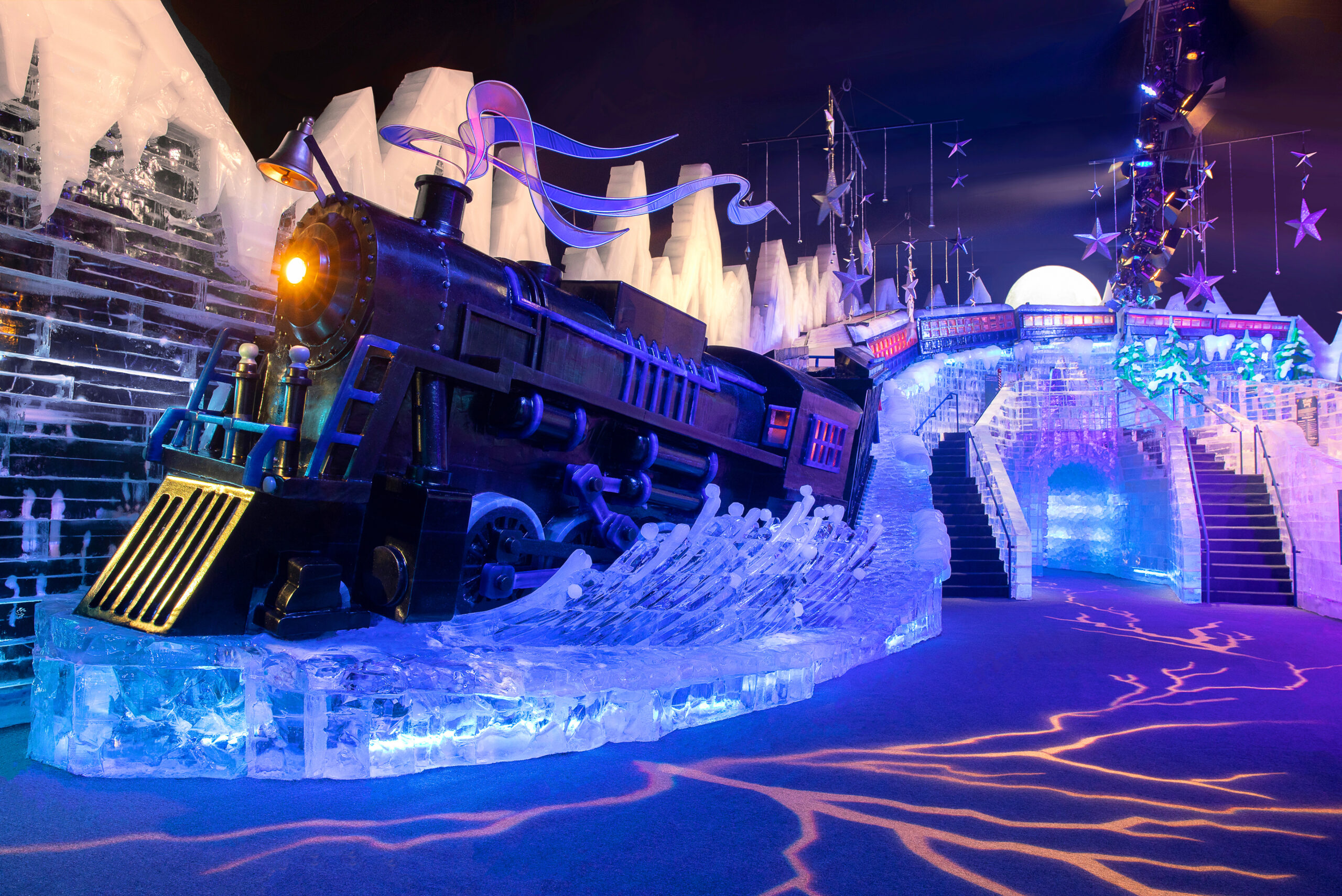
While the scale of the characters is impressive, there are set pieces that reach greater heights, such as ice slides and a recreation of the Polar Express locomotive. The locomotive is created with forced perspective, so as guests enter the room, the large, life-size train is apparent. As the train goes farther back to the top of the slide, it gets smaller, and the cracks in the ice appear to be forming all around the train and guests. “The slides are two stories high, so guests climb up and slide down,” explains Niko Nickolaou, senior director of Special Events and Creative Entertainment at Gaylord Hotels. “My favorite, though, is The Polar Express. When you go in, you know what a train looks like but when you see the Polar Express and the deep, rich, black ice with the music playing and it’s cold—that’s impressive.”
The spirit of the holidays is not created without significant experimentation—sometimes it leads to breakthroughs while other efforts fall short. When attempting to create an Aurora Borealis effect for Rudolph the Red-Nosed Reindeer, Kong and the team tested a technology comprising a spinning, long, glass cylinder that was crushed in multiple locations. Unfortunately, it did not create the desired effect, nor was it hackable, so it was abandoned. However, the team’s ingenuity has led to a number of discoveries including creating a cylinder around a car headlamp to mimic a train light passing through a window and illuminating hanging layers of tie-line lights from the side to produce a snowfall effect so realistic it has guests doing double-takes.
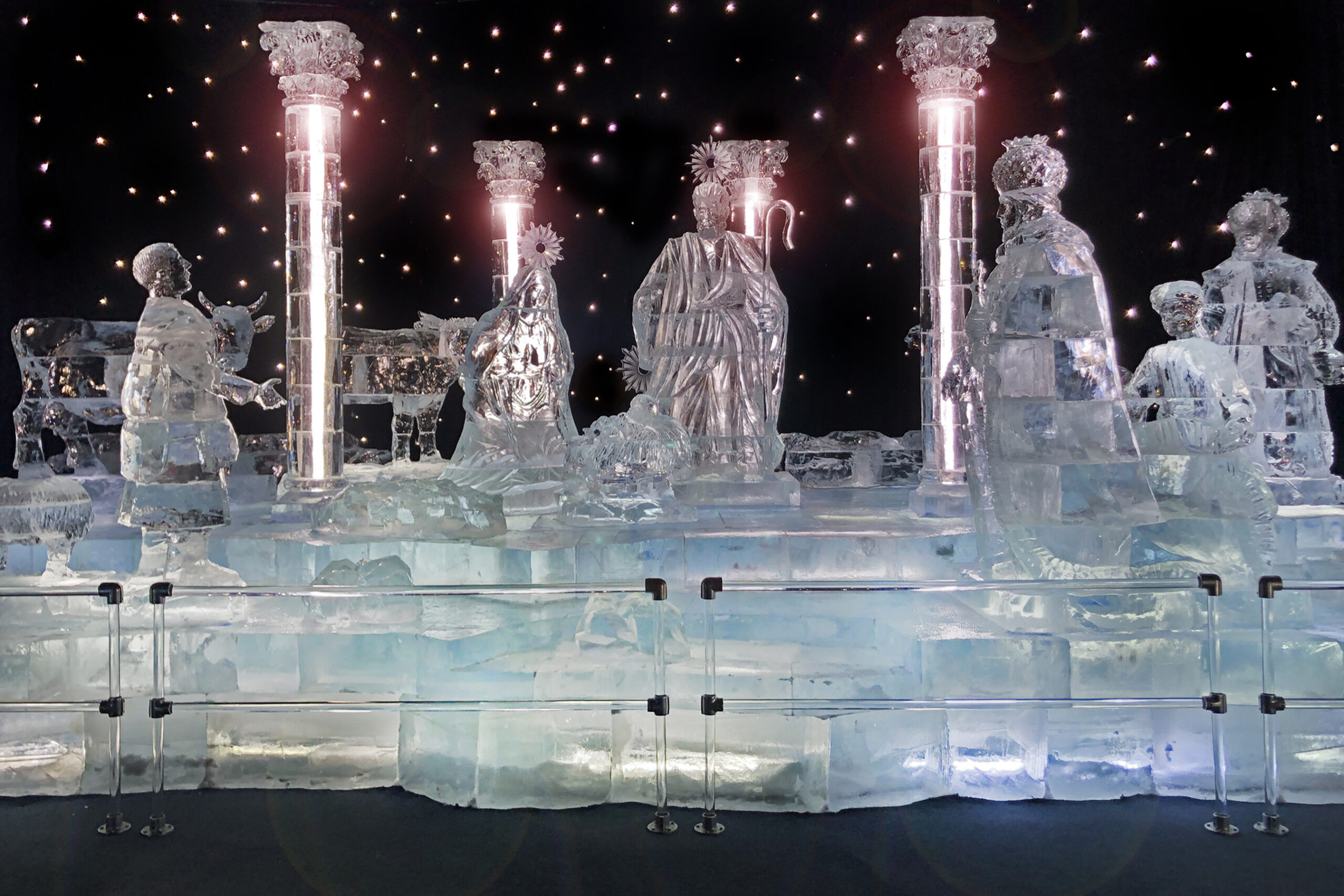
Another technique that has proven popular is freezing LEDs into the ice, which resulted from a collaboration between the art direction team, lighting designer and the artisans. A team is dedicated to carving channels into the ice and wiring the lighting through the ice. In some of the shows, linear tubes with chase lighting are installed under the slide to give the sense of speed. One year, lights were embedded behind the doors of small ice houses to represent the warm glow of the homes inside. But the most emotional use of these LEDs is during the finale of all ICE! attractions, when the pure look of 6500K white light is hidden inside the clear ice of the Nativity scene. “I’ve seen people drawn to tears in front of it,” admits Nickolaou. “In this case, we remove all external lighting and let the ice glow.”
December ushers in the season of lights, and ICE! continues to be at the forefront of marrying the mood of lighting with beloved holiday icons. “Our customers tell us that they love traditional Christmas; they love the classics,” notes Nickolaou. “There is a lot of support around the country for what I call a ‘pop-up Christmas theme park.’ ICE! is the star—it’s the Brad Pitt of the movie. You want that anchor there…We try to do a good job of reinventing, innovating and making a big impact each year. We have millions of guests that walk through ICE! in just 8 weeks, so you want to make it memorable.”