
By Chip Israel
The lighting design process should be a collaborative vision, not a preconceived notion of what the light fixture or luminaire needs to be. And throughout the process, the lighting design needs to be flexible to adapt to any changes that the project team makes. A designer is tasked with solving problems or needs on every project.
Most of the time, the solution to “light” something is easy, but the optimal solution to do it in a way that eliminates the visibility of the luminaire and especially the light source is much more difficult.


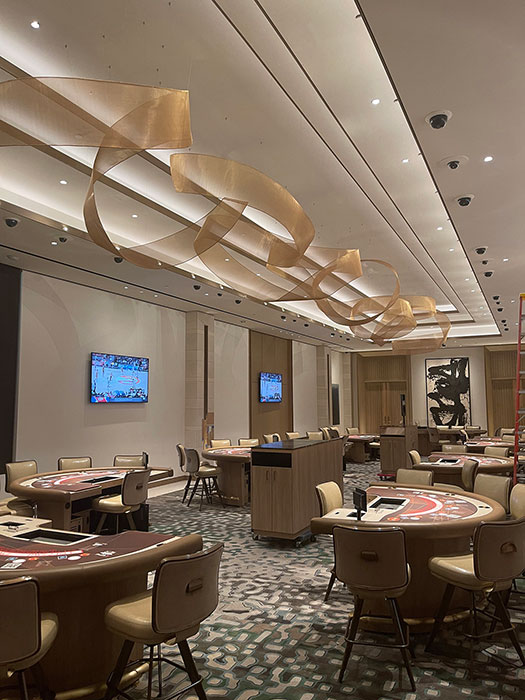
Here is a real-life example of how creative solutions can solve a complicated problem. Value Engineering caused a key
feature of the interior design to change from an illuminated chandelier to a suspended, metallic fabric sculpture. With the light sources no longer integrated into the chandelier structure, the lighting design had to adapt to this new metal fabric sculpture. There were options:
- Accent it with downlights centered over the fabric, but that would be very ineffective as it would only illuminate the top, not the vertical sides that you actually see.
- Another option would be a series of recessed ceiling downlights or, better yet, adjustable accents, 2 ft on center, on either side of the fabric. It could work, but the cost could be just as much as the original chandelier and visible trims on the ceiling would detract from the sculpture itself.
- As the fabric called out for vertical illumination on its sides, the stepped coffer/cove feature allowed for another solution—a small, recessed light—but it needed to be glare-free and affordable. Or, in other words, cheap due to the quantities. Adjustable downlights can be used in walls (confirm with manufacturer) but the size and cost could be an issue.
With no other alternatives, Matthew Bates, the project designer, turned to a landscape manufacturer known for their 1-in. aperture, narrow-beam, well-lights. The beam spreads worked perfectly, but would the light sources be visible? Ideally, a custom fabricated, deeply regressed lens and optical assembly could work, but time and cost were now critical. Instead, Bates added a simple tube or pipe, cut on an angle, and created a glare snoot (see center image). With the snoot rotated to the bottom, no guests can see the light source from the 44 fixtures now installed, and the sculpture glows as if illuminated from concealed sources. The inexpensive cost and the single remote driver worked perfectly.
Problem solved.
Bottom Line:
If the correct product isn’t readily available, work with one of your trusted vendors and develop the required solution.